Dounreay's Oldest Reactor To Be Demolished

15th August 2017

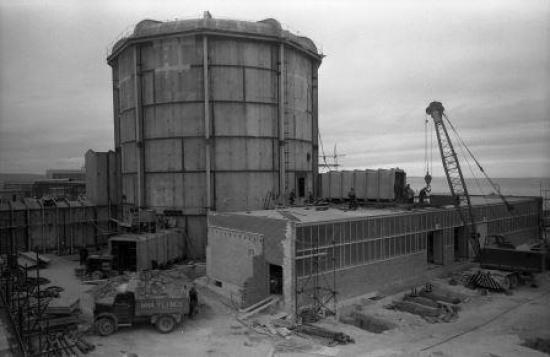
Photograph of Dounreay's Oldest Reactor To Be Demolished

It is 60 years this weekend since the first criticality was achieved in Scotland using a test rig at Dounreay. Now the decommissioning team responsible for the site is marking that milestone by taking a major step towards demolishing the oldest reactor that remains at the former fast reactor research centre.

Companies are being invited to bid for a contract to demolish the iconic Dounreay Materials Test Reactor (DMTR) which became Scotland's first operational reactor in 1958. DMTR, which was built with steelwork weighing in at almost 600 tonnes and stands on foundations more than 25 metres in diameter, tested the effects of irradiation on metals and was the only reactor on the site to use heavy water instead of liquid metal as a coolant.

Fuel was removed soon after it shut down in 1969 and many of the surrounding facilities, including cooling towers, emergency control room and pipework have since been cleared out and demolished. The control room desk and panels, which were key to the operation of the reactor, were transferred to Caithness Horizons in 2015 where they remain on display and the final support building is on track to be knocked down by the end of the year.

Bill Lambie, Project Manager, said: "This month we celebrate the 60th anniversary of the first criticality in Scotland, which took place in a temporary test rig. That was an immense achievement, and we are now poised to demolish its successor and the oldest reactor on site, DMTR.

"The removal of DMTR from the skyline will be a significant step for Dounreay, and will be a real and visible sign of the decommissioning progress being made."

A contract notice will appear in the Official Journal of the European Union for the project estimated to be worth around £7 million over three years. A contractor is expected to be appointed in the first half of 2018.

The first criticality, where neutrons collide to create a nuclear chain reaction, was achieved in a test rig known as ZETR (zero energy test reactor) located alongside DMTR at lunchtime on 13 August 1957. Bill added: “This was an historic moment because it put Dounreay on the map as the UK's centre of fast reactor research, and encouraged the local population to acquire scientific skills and abilities that have been associated with the area ever since."
 

Related Businesses


Related Articles

15/4/2026 : Other Public Services

Buried in the Sand: The Radioactive Legacy Washing Up on Britain's Shores

It sounds like something from a Cold War thriller, not a family day out: fragments of radioactive material, invisible to the naked eye, quietly lying in the sand.  Yet for decades, beaches near Dounreay and Sellafield have been the final resting place for exactly that.  

14/3/2026 : Other Public Services

 
Why Repaint a Building Marked for Demolition? The Practical Logic Behind the Dounreay Dome's Fresh Coat

At first glance, the decision to repaint the iconic Dounreay dome as it is a structure already scheduled for demolition seems baffling.  Why spend money maintaining a building that will soon be torn down? Why refresh the exterior of a landmark whose days are numbered? The answer is far more practical than it appears.  

11/3/2026 : Advisory / Counseling Services

 
Nuclear project academy goes national

The Nuclear Decommissioning Authority (NDA) is launching a UK‑wide training programme to support the development of project professionals across the nuclear sector.   The One NDA Project Academy is an expansion of a programme initially launched at Sellafield in 2016.  

3/2/2026 : Other Public Services

 
From Headlines to Hidden Lines - Dounreay's Quiet Legacy of Radioactive Particles

For years, radioactive particles discovered near Dounreay were headline news.  Each find triggered a press release, picked up by local and national outlets, reminding communities that the nuclear legacy was still with us.  

17/12/2025 : Advisory / Counseling Services

UKAEA and NDA strengthen collaborative approach to decommissioning

UKAEA and NDA sign formal agreement to share knowledge and expertise, advancing the delivery of major decommissioning programmes.   Memorandum of Understanding agreed to enable and encourage knowledge sharing, and improve best practice.  

3/12/2025 : Other Public Services

 
TAE Technologies and UKAEA partner to commercialise fusion tech

Joint venture to develop neutral beams for fusion and non-fusion applications, creating high-skilled jobs and establishing a critical supply chain.   TAE Technologies, a leading US private fusion energy firm with over 25 years at the forefront of scientific innovation, today announces a bilateral and reciprocal investment commitment with the United Kingdom's national fusion laboratory, the UK Atomic Energy Authority (UKAEA) to commercialise TAE's proprietary particle accelerator technology for the global market.  

1/12/2025 : Other Public Services

 
Buried Hazards, Unfinished Business - What the NDA's 2025 Progress Report Really Tells Us

The Nuclear Decommissioning Authority (NDA) has released its 2025 Mission Progress Report is a slightly sprawling document chronicling one of the UK's most complex environmental undertakings.  The safe dismantling of its early nuclear legacy.  

30/11/2025 : Other Public Services

 
New recruit officers join the Civil Nuclear Constabulary

The Civil Nuclear Constabulary (CNC) welcomes its newest recruits.   The CNC hosted two passing out parades for the graduating Authorised Firearms Officers (AFOs) of Initial Foundation Programme (IFP) 106.  

29/11/2025 : Other Public Services

 
Dounreay's next generation of talent honoured by apprentice award

Nuclear Restoration Services Dounreay's Kate Thomson has won Modern Apprentice of the Year at the Highlands & Islands Apprenticeship Awards in Inverness.   Kate, who is in the second year of her apprenticeship in commercial and quantity surveying, said she was thrilled by the honour.  

24/11/2025 : Other Public Services

 
Taskforce calls for radical reset of nuclear regulation in UK

Nuclear Regulatory Taskforce publishes final report and calls for radical reset of overly complex nuclear regulatory system.   An overly complex nuclear regulatory system has contributed to the "relative decline" of the UK's ability to deliver faster and cheaper nuclear projects.