New Highland Primary Teachers Graduate With Online Course
7th July 2015
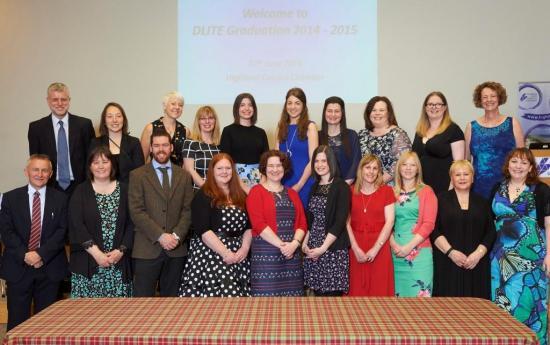
Sixteen Highland students graduated (Saturday 27 June) through the University of Aberdeen in partnership with The Highland Council following an eighteen month distance learning diploma in Primary Teaching.
The course, Distance Learning Initial Teacher Education (DLITE) is completing its inaugural session in June 2015, seeing these students enter their Probation year in Highland schools this August.
Another twelve students began the second phase of DLITE in January this year, and will qualify in June 2016.
The strong partnership between the Local Authority and the University of Aberdeen has led to the development of DLITE, with opportunities for local people to train to become teachers via distance learning techniques, while remaining in their home towns and current employment.
Bill Alexander, Highland Council's Director of Care and Learning said: "We know that we need to look for new ways to add to the cohort of teachers, and this is a tremendous and highly successful example, which will enhance the profession, by opening doors to people with talent who have a passion for teaching and working with young people."
Elaine Kirkham, Highland Council's Quality Improvement Officer with the Care and Learning Service added: "This is a great achievement for all the students graduating today. The interest the DLITE course continues to generate is remarkable and we hope to continue this method of teacher training in the future as it allows people to study from home, while employed which is proving a popular very popular avenue of learning for people thinking of a career change."
While the majority of study time occurs through online learning, are also regular face to face sessions with current Highland practitioners sharing their expertise on subjects such as Literacy, Numeracy, Child Protection and PE, through network days. Students have also benefitted from days at the University with their Aberdeenshire colleagues. DLITE has followed the same programme provided for full time students studying at the University.
Dr Yvonne Bain, Deputy Head of School (Strategic Planning) at the University of Aberdeen said: "The University of Aberdeen is very pleased to be working in partnership with Highland Council to provide DLITE as an alternative route for entry to teaching.
"The DLITE PGDE students have done incredibly well showing great perseverance and resilience, juggling the many commitments of family life, work and the demands of an intensive part-time study programme to successfully gain the PGDE (Professional Graduate Diploma in Education) award to become teachers in Highland.
"The University of Aberdeen is keen to build on the positive partnership with Highland Council in order to retain and develop opportunities for teacher education through initiatives like DLITE."
Students who graduated this weekend were:
Sulekha Millar (Kingussie.) Alison Graham, Elaine Lynch, Jennifer Main, Katy Hardiment, Ruth Urquhart, (Inverness). Lauren Clark also of Inverness was not present at the graduation ceremony.
Caroline Haines (Fort William) and Lindsay Forster (Glencoe).
Dawn Morgan (Muir of Ord), Donald MacPherson (Fortrose); and Shona Leggatt and Vivien Carmichael (Avoch).
Isla Christie and Yvonne Beaton (Tain).
Lois Canham (Rogart).
For further information on the DLITE Professional Graduate Diploma in Education (Primary) visit the University of Aberdeen website. https://www.abdn.ac.uk/education/partnerships/dlite-pgde-664.php
The DLITE initiative offers an eighteen month, part-time distance learning Professional Graduate Diploma in Education (PGDE) (Primary). The programme is fully accredited by the General Teaching Council for Scotland (GTCS).
It is offered within some of our partnership local authorities and is aimed at graduates living and working in partner authorities.
The programme mirrors the full-time PGDE requirements where students complete eighteen weeks placement in schools, and academic courses of study. The emphasis on flexible learning enables participants to remain in employment whilst studying for the PGDE, as long as they can be released for the full-time school placement blocks.
Applicants can only apply where a partnership agreement exists between the Local Authority and the University. The partnership arrangement supports the blended learning experiences with mixed mode online learning activities provided through the university online environments, and face-to-face workshops on Saturdays within the local authority (Network Days).
Highland Schools
Highland currently has 29 secondary schools and 177 primary schools. Across these 206 schools, there are 29 secondary head teachers and 168 primary head teachers, 20 of which are currently vacant. Schools vary in size from just 2 pupils in the primary sector to 1250 in the secondary sector. The complexities which require a diverse model of management posts at all levels for Highland schools do not just derive from the size of school. The geographic size and nature of the Highland area also has a bearing.
There are many (often small) rural schools, in both primary and secondary and there are also urban schools of all sizes. In addition, there is provision across primary and secondary sectors through the medium of Gaelic. Currently one primary provides Gaelic Medium (GM) education only, and there are plans for a further two schools. Primary schools also provide early years education which, through national developments is growing across all areas.
School management structures vary depending on sector and size and, in line with many local authorities, Highland has developed a partial model of faculty management in the secondary sector. Many primary schools have teaching head teachers, often they are the sole senior manager in the school.
PHOTO
LtoR (Back) Bill Alexander Highland Council Director of Care and Learning, Sulekha Millar (Kingussie), Alison Graham, Elaine Lynch, Jennifer Main, Katy Hardiment, Ruth Urquhart (All Inverness), Caroline Haines (Fort William) and Lindsay Forster (Glencoe), Elaine Kirkham Highland Council. (Front) Jim Steven, Head of Education Highland Council, Dawn Morgan (Muir of Ord), Donald MacPherson (Fortrose), Shona Leggatt, Vivien Carmichael (both Avoch), Isla Christie, Yvonne Beaton (both Tain) and Lois Canham (Rogart), Roseanne Fitzpatrick (Aberdeen University) and Holly Ross, Highland Council.
Related Businesses
Related Articles