Highland is ready for winter - are you?
14th October 2017

The Highland Council is ready for winter and prepared to grit council roads as the council's winter maintenance programme starts on 14 October.
Trunk roads in Highland are the responsibility of Transport Scotland and their operators Bear Scotland.
The council can confirm it has adequate salt stocks for the region of around 60,000 tonnes for the start of the main winter season and that there are no concerns about future provision of deliveries from the council's supplier.
The total salt usage for last winter 2016/17 was 37,200 tonnes, which was around 28% (£1.12m) of the overall cost of the service last year.
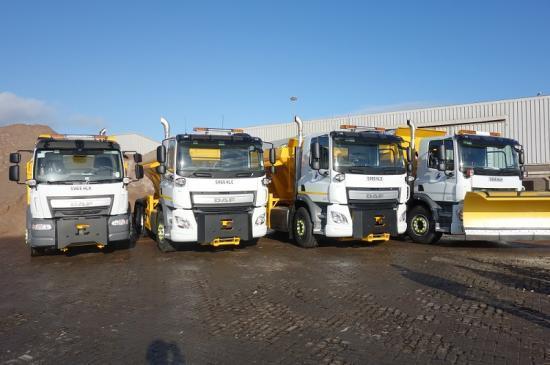
The winter fleet has been mobilised, serviced and salt spreading equipment checked. The fleet includes 105 gritters, 42 footpath tractors and over 200 staff providing winter maintenance services.
This year (2017/18) the Council is replacing some of its existing winter fleet with 14 new vehicles; the first of which have arrived and remaining are expected to be delivered through November. On completion of this latest order the authority will have renewed 59 vehicles (57%) of the winter heavy fleet over the last four years.
Staff involved in winter services provision at area level are trained in using the Council’s weather forecasting service. The forecasts are used each year to assist local decision-making on daily and longer term winter services actions.
Chair of the Council’s Environment, Development and Infrastructure Committee, Cllr Allan Henderson said: "We have the supplies and resources in place to provide a winter service this year in the Highlands according to the Council’s policy. Council roads and pavements are gritteds as specified within the council’s agreed winter maintenance policy - details of this are on the council’s website at www.highland.gov.uk/gritting.
"The Council will continue to do what it can within its resources and policy however, I would encourage communities to come forward and apply for winter resilience assistance from the Council that will provide them with salt in grit bins or heaps and other equipment to take action in their local areas that are important to them."
Within its winter roads maintenance budget of £4.98 million for 2017/18, the Council is ready to salt - according to its policy - the 6,744km of roads for which the Council has responsibility.
Area Winter Maintenance Plans are set by Area Committees within Council strategy and budget allocated by the Environment, Development and Infrastructure Committee. The Ross and Cromarty, and Caithness Winter Maintenance Plans for 2017/18 will be set at the next Area Committee meetings on 31 October and 21 November respectively. Until those dates, the existing 2016/17 Winter Maintenance Plans plans for each area will be in place.
Related Businesses
Related Articles
The Highland Council welcomes moves by the Scottish Government to introduce greater flexibility on how it could design a Visitor Levy Scheme for consultation. The Visitor Levy (Scotland) Act 2024 currently provides local authorities with discretionary powers to implement percentage-based levies following statutory consultation.
As it looks to set out its forthcoming priorities, the council is seeking involvement from members of the public, including businesses, community groups, parents, and young people. All their opinions are going to be crucial in deciding how Highland Council will take on its budget challenge for 2026-2027.
Thurso is to benefit from £100m investment in education and community facilities and are rolling out the first phase of public consultations on 9 and 10 December 2025. The Highland Council is inviting people that live, work, or study in Thurso, to come along to the public consultation events to have their say; this is an opportunity to help shape the future of Thurso, to gather views and ideas.
A new online portal has been launched to bring empty homeowners together with prospective buyers or developers with the aim of facilitating more properties to be used as homes again. Covering the whole of Scotland, this builds on the success of local pilots, referred to as "matchmaker schemes".
Steps towards introducing a short term let control area have been considered by Highland Council's Isle of Skye and Raasay area committee. On Monday (1 December 2025) the committee heard evidence to justify the grounds for the introduction of a Short Term Let Control Area covering all or part of Skye and Raasay.
EMPLOYERS and educators from across the Highlands have gathered to hear how a new initiative is aiming to transform the region's economy. Workforce North - A Call to Action brought together business leaders and teachers from primary and secondary schools from across the Highland Council area with a wide range of partners geared towards education, learning and skills development at Strathpeffer Pavillion.
The Highland Council continues to call for meaningful engagement from the Home Office over its plans to temporarily accommodate up to 300 adult male asylum seekers at Cameron Barracks, Inverness. It follows an email on Monday from Alex Norris MP, Minister for Border Security and Asylum, to Council Leader, Raymond Bremner, which failed to answer questions raised by the Council or address community concerns.
SSEN Transmission has become the first company to sign up to the Highland Social Value Charter (HSVC), marking a significant milestone in delivering long-term socio-economic benefits for communities across the Highlands. Investment commitments from the company include funding for roads, new homes, jobs, and work for local contractors in addition to a local and regional fund for communities to apply to.
The Highland Council continues to work through the procurement process for the provision of the Wick Public Service Obligation for the Highland Council. We have now entered the preferred bidder stage and have entered a standstill period.
Maps of the Council's gritting routes by priority and policy are available online at www.highland.gov.uk/gritting (external link) The information provided is a summary of reports from operational staff and is intended to give a general indication of typical conditions in each area at a point in time. It is not intended to imply that any individual route is entirely snow and ice free and drivers must be aware that conditions can change rapidly and make their own assessment of conditions for travelling.