Household Survey In Highlands And Islands Highlights Investment Needs
13th October 2022
HIE has published the findings of its My Life in the Highlands and Islands survey, carried out by IPSOS at the start of the year.
More than 5,300 people over the age of 16 living in 4,442 households across the region responded to the study.
The vast majority (88%) said they take pride in living in their local area, and more than half (55%) take part in local activities.
Quality of life was highlighted by more than a third 36%) as one of the main reasons to move into the region, along with to take up a job (26%) and to be close to family (23%).
While 73% said they either don't ever intend to move away (50%) or plan to stay at least another five years (23%), around half (47%) of those aged 16-29 said they do plan to move away within five years.
The survey also raised a series of issues facing communities in the region, including access to health services, issues with digital connectivity and an over reliance on fossil fuels and cars.
While 95% of households have access in person to a GP within a 20-minute drive (excluding those who don't know), this reduces to 81% for physiotherapists and dentists and 66% for mental health services. Access is more limited for households in remote rural areas.
Of those living in remote rural communities, 37% have to drive at least 20 minutes to the nearest supermarket and 29% for a bank or mobile bank.
Access to superfast broadband has increased from 64% in 2016 to 82.8%, though this is still noticeably less than the UK figure of 97.3%. Around a fifth (21%) of households in the region cannot stream a TV programme or film without it buffering, rising to 32% in Caithness and Sutherland and 29% in Shetland.
Factors that could adversely affect Scotland's progress towards the country's ambitious net zero targets include a heavy reliance on cars for day-to-day living, with 87% owning at least one car and 44% owning two or more.
Only 7% of respondents said they had bought an electric vehicle and just 6% said they were planning to do so. The main barriers to making the switch are cost, battery range and perceived lack of charging points.
The survey also shows that 71% of households have already made energy efficiency improvements, mainly installing loft insulation or double- or triple-glazing. A further 36% are planning improvements over the next two to three years, most commonly having a smart meter fitted, installing a new boiler or heating system, or draught-proofing. Relatively few are using green technologies to heat their homes (13%) or have plans to switch fuel type (6%).
More than a fifth (22%) say they would like a ‘green' job that helps the environment or helps prevent climate change. Meanwhile more people (46%) believed their current job would be affected by the need to reduce carbon emissions than those who didn't (42%).
Housing was raised as a major issue. While 90% said their home meets their own needs very or fairly well, 76% agreed there aren't enough affordable houses for rent or to buy locally.
Young people, households with children and those in island and remote rural communities are more likely to perceive housing challenges.
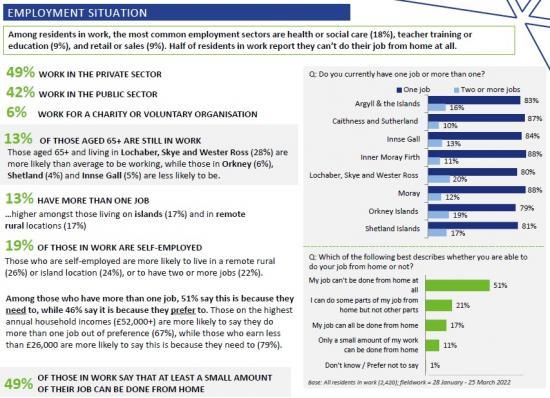
Two thirds (65%) say they are happy in their current job, while half (49%) are paid at least the real living wage. Of those in work, a fifth (19%) are self-employed, higher than nationally, and a further 12% would like to start their own business. Self-employment is more common in island (24%) and remote rural (26%) communities. Around a third of respondents (34%) working in the public sector reported that they moved to the region to take up a job, which highlights the importance of such roles in supporting population attraction and retention.
HIE has shared the findings with the Convention of the Highlands and Islands and the Regional Economic Partnership.
Stuart Black, HIE’s chief executive, said, ""We are extremely grateful to everyone who took part in this survey. It’s a fascinating and extremely useful report that provides valuable insight into what it really means to live and work in the Highlands and Islands, where the strengths are and the vulnerabilities.
"It quantifies the challenges and inequalities, while clarifying some of the factors that residents really value about the region.
"There are many well documented advantages and opportunities, particularly around renewable energy and the just transition to net zero. These qualities will serve communities and the economy, and indeed the country, extremely well if we can tap into them effectively.
"What this report makes clear is that sustained and flexible investment will be required in order to make that happen. It will serve as a vital reference across the public sector, informing policy development and investment decisions at local, regional and national levels in line with the National Strategy for Economic Transformation."
Deputy First Minister John Swinney said, ""I am grateful to Highlands and Islands Enterprise for their work on the survey and for sharing its insights with the Regional Economic Partnership, and the Convention of the Highlands and Islands.
"The survey shows the importance of supporting people in our communities across Scotland, whilst highlighting the opportunities and challenges often faced. We will carefully consider the findings of the survey and continue to work closely with our partners through the Convention and the Regional Economic Partnership to make the most of the opportunities we have to grow our economy across the Highlands and Islands."
Read the full report HERE
Related Businesses
Related Articles