Autonomous Robot Paves The Way For Future Fusion Maintenance

20th September 2024
Photograph of Autonomous Robot Paves The Way For Future Fusion Maintenance

In a world-first, a fully autonomous robot has been used to inspect the inside of a fusion energy facility.

In a world-first, a fully autonomous robot has been used to inspect the inside of a fusion energy facility.

The United Kingdom Atomic Energy Authority (UKAEA) and the Oxford Robotics Institute (ORI), University of Oxford, have achieved a first-ever autonomous robot deployment in a fusion facility.

The 35-day trial took place in UKAEA's Joint European Torus (JET) facility, which until its recent scientific operational shutdown, was one of the largest and most powerful fusion research machines in the world.

In a step towards the commercial viability of fusion energy, a world-leading robotics alliance has successfully demonstrated that part of a fusion facility's maintenance can be carried out by an autonomous robot, thus making such work safer for humans and more cost efficient for its operator.

Fusion powerplants will need regular maintenance. Traditionally, robotic inspections required humans to make decisions and to operate.

"The project aimed to validate the reliability of autonomous robotic technology and instil trust and confidence in their use for safe and efficient inspections in fusion facilities over extended periods," said Dr Robert Skilton, Head of Research, at UKAEA's Remote Applications in Challenging Environments division.

Such advancements pave the way for autonomous maintenance and decommissioning in future fusion facilities where human access may be limited owing to challenging conditions posed by radiation, vacuum-level pressure and extreme temperatures.

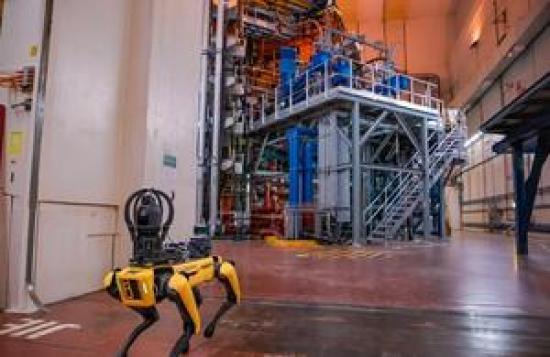
JET provided the ideal opportunity to test ORI's autonomy platform "AutoInspect" controlling a Boston Dynamics Spot quadruped robot in an environment still hazardous after two high-powered deuterium-tritium experiments in the space of three years.

"This deployment demonstrates that autonomous robots can enhance safety and cut costs. These ‘next generation’ solutions are becoming ready to be used in other industrial facilities such as nuclear decommissioning, environmental clean-up, and disaster relief," Dr Skilton continued.

The inspection tasks within JET involved mapping the entire facility, taking sensor readings of its environment, and avoiding obstacles and personnel involved in the decommissioning process.

To address these challenges, UKAEA’s inspection payload was integrated with ORI’s localisation and mission autonomy solutions, developed through a collaboration between Professors Hawes’ and Fallon’s teams. This setup was combined with Boston Dynamics’ hardware and collision avoidance technology to enhance the robot’s capabilities.

This integrated robotic system collected essential data on JET’s environment and overall status twice a day. This allowed the team to assess the feasibility of replacing human inspections with fully autonomous processes.

Prof. Nick Hawes, Professor of AI & Robotics, University of Oxford, said of ORI’s aims in the project, "Projects like this demonstrate the value of autonomous robots - robots that can do things themselves without direct control of humans. They also ground our science in real use cases, and provide requirements and constraints that drive us to invent new AI and robotics algorithms." 

ORI’s work in this project was supported by the Engineering and Physical Sciences Research Council through the Embodied Intelligence: From Sensing to Collaboration programme grant which aims to create autonomous systems that enhance human capability and potential.

The results will assist planning for the next stages of the JET decommissioning and repurposing (JDR) programme.

PHOTO
Spot returning after deployment at UKAEA's Joint European Torus (JET) facility (Credit United Kingdom Atomic Energy Authority).


Related Businesses


Related Articles

4/6/2026 : Other Public Services

Wylfa Decommissioning But With Good Propects For Future Nuclear Dvelopments

Wylfa, located on Anglesey, North Wales, is a historic nuclear site that operated from 1971 to 2015, featuring the UK's largest and last Magnox reactors.   Known for its significant contribution to UK energy, it is currently undergoing decommissioning while being designated as a premier location for new, small modular reactor (SMR) technology.  

20/5/2026 : Other Public Services

 
Scottish nuclear site hails e-learning platform as great example of industry collaboration

The Engineering Construction Industry Training Board’s (ECITB) award-winning e-learning platform has been hailed as a great example of industry collaboration in action.   To mark Learning at Work Week 2026, NRS Dounreay has highlighted how the ECITB’s Learning Experience Platform (LXP) has become a “go-to training solution” for its 1,400 workers.  

15/5/2026 : Other Public Services

 
NRS socio-economic funding supports 129 UK community projects

Almost £2 million was invested by Nuclear Restoration Services (NRS) last year in socio-economic initiatives, supporting good causes in communities local to its 14 decommissioning sites.   The NRS socio-economic scheme provided £1,979,721 during 2025-26 to enhance the social and economic wellbeing of communities located near NRS sites.  

15/4/2026 : Other Public Services

Buried in the Sand: The Radioactive Legacy Washing Up on Britain's Shores

It sounds like something from a Cold War thriller, not a family day out: fragments of radioactive material, invisible to the naked eye, quietly lying in the sand.  Yet for decades, beaches near Dounreay and Sellafield have been the final resting place for exactly that.  

1/4/2026 : Advisory / Counseling Services

 
Hunterston B nuclear power station has transferred to the NDA

Hunterston B nuclear power station in North Ayrshire has transferred ownership from EDF to the Nuclear Decommissioning Authority.   Today, Hunterston B nuclear power station in North Ayrshire has transferred ownership from EDF to the Nuclear Decommissioning Authority (NDA) to be decommissioned by its subsidiary Nuclear Restoration Services (NRS).  

19/3/2026 : Advisory / Counseling Services

Two weeks to go: Hunterston B achieves licence milestone

Office for Nuclear Regulation grant a site licence to Nuclear Restoration Services (NRS) - major milestone that will enable the site's decommissioning.   With exactly two weeks until Hunterston B becomes the UK's first Advanced Gas-cooled Reactor (AGR) site to transfer into UK Government ownership, a major milestone that will enable the nuclear power station’s decommissioning has been achieved.  

14/3/2026 : Other Public Services

 
Why Repaint a Building Marked for Demolition? The Practical Logic Behind the Dounreay Dome's Fresh Coat

At first glance, the decision to repaint the iconic Dounreay dome as it is a structure already scheduled for demolition seems baffling.  Why spend money maintaining a building that will soon be torn down? Why refresh the exterior of a landmark whose days are numbered? The answer is far more practical than it appears.  

11/3/2026 : Advisory / Counseling Services

 
Nuclear project academy goes national

The Nuclear Decommissioning Authority (NDA) is launching a UK‑wide training programme to support the development of project professionals across the nuclear sector.   The One NDA Project Academy is an expansion of a programme initially launched at Sellafield in 2016.  

24/2/2026 : Advisory / Counseling Services

NDA publishes latest nuclear decommissioning strategy

NDA publishes latest strategy setting out long term roadmap for the safe and secure decommissioning of the UK's legacy nuclear sites.   The Nuclear Decommissioning Authority (NDA) has published its latest strategy, setting out its long term roadmap for the safe and secure decommissioning of the UK's legacy nuclear sites.  

3/2/2026 : Other Public Services

 
From Headlines to Hidden Lines - Dounreay's Quiet Legacy of Radioactive Particles

For years, radioactive particles discovered near Dounreay were headline news.  Each find triggered a press release, picked up by local and national outlets, reminding communities that the nuclear legacy was still with us.