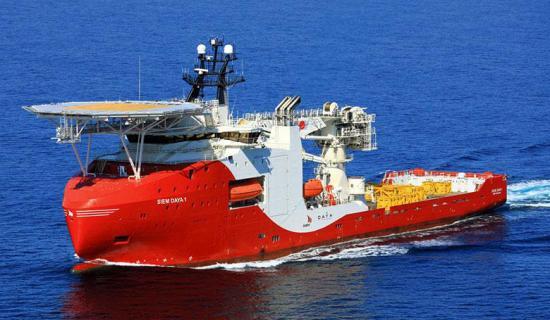
Seabed cable-laying operations in the Pentland Firth's Inner Sound, off Canisbay
12th September 2015
Seabed cable-laying operations in the Pentland Firth's Inner Sound, off Canisbay, which may occur in the period 10.09.15 to 25.09.15.
The cable ship being used in the Inner Sound is the 121 metre long Siem Daya 1 and she will reel in the four cables at Hartlepool in NE England. A modern 'Offshore Subsea Construction Vessel' with accommodation for 110 persons on board , she is expected to work round the clock for 48 hours to actually lay the cables. The 8,400 tonne Siem Daya 1 is one of a 50-strong Siem Offshore fleet.
Siem Offshore, a spin-off from Subsea 7 in 2005,, has a corporate unit called SOC ...Siem Offshore Constructors ... that specialises 'in the installation, repair and maintenance of submarine cables for the renewable energy sector' (until now, for offshore wind-farms) in Europe.
The Inner Sound works are to be undertaken by Mojo Maritime of Falmouth, Cornwall and Osiris Marine Ltd, both of which are now James Fisher & Sons plc's subsidiaries.
Also involved in the contract is award-winning Leask Marine of Kirkwall, Orkney
which is deploying its latest multicat , the 2015-acquired 26 metre C-Chariot.
The cables will be laid Northwards out into the Sound from the four 'duct exits' that were near-horizontally drilled during the spring of 2015 by the Manchester company O'Connor Utilities. The cable-ducts are bored into the Caithness flagstone bedrock and dip down so that the mini-tunnels go underneath the rocky Gills Bay forehsorec at Ness of Quoys, on the coats some 200 metres NE of historic Canisbay Kirk.
The ends of the drilled ducts lie c. 550 metres offshore from the headland on Gills Bay, where the 'Power Conversion Building' is currently under construction by the British 'arm' of international Swiss/Swedish electrical contractors ABB.
Before the cable ship, which is fitted with DP (dynamic positioning) capabilities, starts her planned laying operation on 19th September,, a team of divers will have installed rock and concrete-filled bags to 'stabilise the duct protrusions' as well as fitting 'bell-mouths' to those ducts for the cable-pulling operations.
Divers will also be 'setting down' unlit 'pick-up' buoys to mark the cable-ends during the works; a World-first for a demonstration tidal array, with an anticipated installed capacity of 6 MW (megawatts).
The fast little 'rigid inflatable boat' 'Rib Natural Explorer' will be on hand to help ensure that the diving tasks are un-interrupted.