A Decade In The Un-making - Decommissioning Dounreay
10th April 2018

Decommissioning a nuclear reactor is about more than removing the core itself and, around a decade after work started to pull apart a host of support facilities associated with Dounreay's oldest reactor, they have all gone.
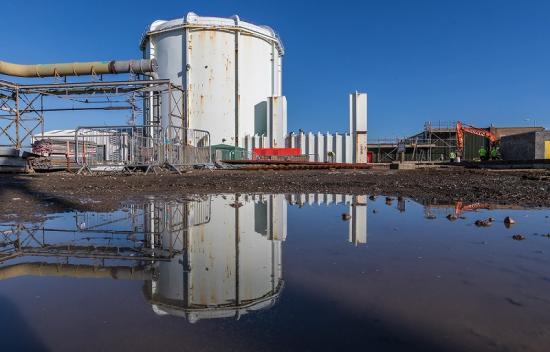
Radioactive facilities, including a cooling pond, storage compound and examination cells assisted Dounreay Materials Test Reactor (DMTR) during its operational life. All have now been safely and painstakingly stripped out, culminating in the support building itself being removed from the landscape.
That final demolition included removal of a 27-tonne crane and several hundred pieces of cladding. Work to dismantle the inside of the structure saw remotely operated Brokks being deployed as well as a mobile crane which lifted 26-tonne shielded doors out through the roof.
Project Manager, Bill Lambie, said: "The final demolition of this complex is a significant achievement for all of those involved and represents a major step towards the ultimate removal of Scotland's oldest operational reactor. This was an area of the site with a highly radioactive inventory, large waste volumes and defunct plant and equipment.
"Now, due to the commitment and professionalism of the team, we have dealt with those hazards by applying innovation while keeping safety as the number one priority. This has been a team effort between Dounreay staff and a number of highly-experienced contractors including Nuvia, GDES, Matom and JGC Engineering."
The successful conclusion of this project leaves the reactor structure itself to be removed, with 5 companies bidding for the 3-year £7 million clean-up job. A contract is expected to be awarded later this year.
Bill added: "This is the first of three reactors that will be removed as part of the contract to decommission Dounreay. The knowledge, experience and skills gained by the team in the last decade will help other projects at the site as well as further afield."
DMTR was the first operational research reactor to achieve criticality in Scotland in May 1958. It had a thermal output of 25MWth and supported the site's fast reactor research programme, before closing in 1969.
Dounreay is Scotland's largest nuclear decommissioning project and is widely recognised as Europe’s most complex nuclear closure programme. The work is being delivered by Dounreay Site Restoration Limited, a company owned by Cavendish Dounreay Partnership, on behalf of the Nuclear Decommissioning Authority.
Mark Raffle, NDA Lead Programme Manager, Dounreay, said: “The removal of this significant support complex, which for many years played a key role in various site operations, is a clear demonstration of decommissioning progress on site. Its removal facilitates further work, including the removal of the DMTR."
Related Businesses
Related Articles
Joint venture to develop neutral beams for fusion and non-fusion applications, creating high-skilled jobs and establishing a critical supply chain. TAE Technologies, a leading US private fusion energy firm with over 25 years at the forefront of scientific innovation, today announces a bilateral and reciprocal investment commitment with the United Kingdom's national fusion laboratory, the UK Atomic Energy Authority (UKAEA) to commercialise TAE's proprietary particle accelerator technology for the global market.
The Nuclear Decommissioning Authority (NDA) has released its 2025 Mission Progress Report is a slightly sprawling document chronicling one of the UK's most complex environmental undertakings. The safe dismantling of its early nuclear legacy.
The Civil Nuclear Constabulary (CNC) welcomes its newest recruits. The CNC hosted two passing out parades for the graduating Authorised Firearms Officers (AFOs) of Initial Foundation Programme (IFP) 106.
Nuclear Restoration Services Dounreay's Kate Thomson has won Modern Apprentice of the Year at the Highlands & Islands Apprenticeship Awards in Inverness. Kate, who is in the second year of her apprenticeship in commercial and quantity surveying, said she was thrilled by the honour.
Nuclear Regulatory Taskforce publishes final report and calls for radical reset of overly complex nuclear regulatory system. An overly complex nuclear regulatory system has contributed to the "relative decline" of the UK's ability to deliver faster and cheaper nuclear projects.
A specialist ports consultant has been appointed to develop a long-term strategic plan for Wick Harbour Authority (WHA) in Caithness. WHA has secured £47,775 from Highlands and Islands Enterprise (HIE) and the Nuclear Restoration Services, NRS Dounreay towards the cost of the services.
Rising star from North Scotland honoured at event to celebrate brightest and best in industry. An electrical apprentice from North Scotland is celebrating after being recognised for her contribution to industry at the 13th annual Engineering Construction Industry ECI Training and Development Awards in London.
The NDA group graduate scheme offers far more than just a stepping stone into the nuclear industry; it's a chance to grow professionally, explore new places, and become part of a supportive community. Nuala Ledward, Assurance and Performance Graduate, shares how her secondment to Dounreay brought these benefits to life.
At its recently opened Central Support Facility (CSF), UKAEA has commissioned an electron beam additive manufacturing machine that can be used to incorporate tungsten into components, alongside a selective laser manufacturing machine. Fusion can play a key role in a global low carbon energy future.
As part of the Fusion Futures (FF) programme, UKAEA's Remote Applications in Challenging Environments (RACE) has partnered with industry leaders to develop two groundbreaking technologies for remote maintenance in fusion energy engineering. Thanks to FF funding, industry has taken the lead in maturing UKAEA technology concepts—delivering real-world solutions that enhance operational autonomy and reduce maintenance burdens in extreme environments.