Public Sector And Business To Benefit From New Multi-million-pound Full Fibre Broadband Investment - Thurso, Wick, Fort William, Inverness
10th March 2022
A multi-agency investment into digital infrastructure in Highland will ensure the public sector and businesses are equipped to deliver next generation connectivity.
Today, The Highland Council and partners within the Highlands, UK Government's Department of Culture, Media and Sport, Capita and CityFibre announced the completion of a four-year project across Inverness, Fort William, Thurso and Wick, as part of the Building Digital UK (BDUK) Local Full Fibre Networks (LFFN) programme.
Following the UK Government's £4.3m investment, Highland public sector partners contributed the remainder of the capital funding to the entire £7.7m costs for the network infrastructure.
It has now delivered a gigabit speed fibre optic broadband network which will connect 152 public sector sites (schools, university campuses, Highland Council and NHS Highland) in the geographically challenging Highlands of Scotland.
Back in 2019 less than 1% of the Highland region had these next generation connections, a figure that was less than 10% UK wide. The potential of this project for Inverness and the wider Highlands is enormous through improved productivity, inward investment and innovation.
This announcement marks the initial stage of moves to expand the footprint of gigabit, full fibre digital infrastructure to other parts of Highland.
Looking to the future, Scotland is set to benefit from the UK Government's £5bn Project Gigabit funding, announced in 2021, and allocated to provide gigabit capable speeds to more than a million hard to reach homes and businesses.
The UK and Scottish governments are working together on next steps and an Open Market Review was launched in February by the Scottish Government to understand which areas are due to be covered commercially and where further public subsidy will be required.
The Highland Council is working closely with both governments to identify early opportunities for the region, and where the digital infrastructure funding provided by the Inverness and Highland City Region Deal might improve coverage yet further.
Chair of Highland Council’s Strategic Communities and Place Committee, Cllr Allan Henderson, said: "The conclusion of this phase of digital network infrastructure will ensure that Highland will be at the forefront of the digital opportunities, rather than being led.
"The delivery of full fibre to some of the biggest agencies and partners working in the Highlands will introduce the capacity to look at new ways of delivering education, health services, commercial and council services to all of the Highlands. This will improve the quality of services, reduce wait times and reduce costs for partners and the people of the Highlands."
The fibre optic upgrade is being supported by a collaboration between the Highland Council, Highlands and Islands Enterprise, Scottish Natural Heritage, NHS Highland, the University of the Highlands and Islands (UHI) and the Department of Digital Culture Media and Sport (DCMS) using the LFFN Public Sector Anchor Tenancy framework.
The LFFN project has stimulated additional commercial rollout in the region, with Cityfibre committed to a £24.5m private investment to expand the full fibre network to cover the majority of premises in Inverness.
Bringing pure fibre optic connectivity to some of the remotest rural towns in Scotland is no mean feat and in theory it could lay the groundwork for a wider roll-out of 1Gbps capable Fibre-to-the-Home (FTTH) style services to residents in the near future.
UK Digital Infrastructure Minister Julia Lopez said: "We're putting millions behind top-of-the-range internet upgrades for public buildings across Scotland and I'm thrilled to see the Highlands is the latest area to benefit.
"Our investment will not only help deliver better quality public services for the community but it also makes the Highlands a more attractive location for even more broadband companies to build their networks and boost connectivity for surrounding homes and businesses."
Allan McEwan, city manager for CityFibre in Inverness said: "The successful delivery of these key sites across the Highlands future-proofs the digital infrastructure enabling its public services - including hospitals, schools, libraries, offices and service points - while underpinning faster and more reliable connectivity, and more efficient digital services for all.
“What’s more, the network has been constructed in parallel with our £24.5m private investment in Inverness which is bringing full fibre connectivity to almost every home and business in the city, making it one of the best digitally connected places in the world."
The project has delivered core networks in 4 Highland settlements: Fort William, Inverness, Thurso and Wick. The project has provided connectivity to 152 public buildings, provided by the five partners who sit on the Digital Programme Board.
Procured through Capita’s SWAN framework, the Council signed an order with Capita to provide full fibre connections to 152 prescribed sites. The Scottish Wide Area Network (SWAN) is one of the most significant single public sector ICT initiatives ever undertaken in Scotland. The programme was set up to establish a single shared network and common ICT infrastructure across Scotland's entire public sector.
Capita in turn contracted CityFibre to construct the networks and provide the connections into each site.
Adam Newton, Head of Sales - Scotland at Capita said: “In 2019 we set out to provide full fibre connectivity to the largest population centres of the Highlands, driving further competition at the infrastructure layer to bring real social value and digital inclusion.
“Today I am proud to state that we have delivered that shared vision alongside Highland Council and their partners. Our model of using a public sector anchor tenant has not only improved connectivity in each of these sites but has driven significant inward investment."
He added: “Remarkably, the enablement of fibre to the home has catapulted the Highlands from outside of the top 100 fibre connected regions, to within the top 10 in the UK. Looking ahead, it will drive further service innovation and stimulate greater commercial investment in the region.”
Planning and installation activities have been running from February 2018 to deliver this project which were only slightly delayed due to the COVID-19 pandemic.
Cllr Henderson added: “It is worth highlighting that for state aid reasons the central focus was on providing 152 full fibre connections to public buildings, but I would commend the partners vision as they also secured commercial investment to expand the anchor tenancy networks. This truly is the most important prize to realise.”
The fibre network has helped Highland Council to deliver its services during the COVID 19 impact. The NHS are in the process of rolling out some remote services as a result of this capability, reducing the requirement of having to travel into Raigmore Hospital in Inverness, and aiding vaccination rollout. The improved connectivity is also enabling remote learning and IT solutions in tertiary education.
Highlands and Islands Enterprise provided funding to secure additional benefits for the whole of Fort William by providing a connection to Banavie Primary School, which provided an opportunity to support businesses in Banavie and Corpach. It also ensured the fibre optic link could be bridged across the canal to Lochaber High School, which was a challenging task.
Scott Dingwall, Head of Regional Development at HIE’s Lochaber, Skye and Wester Ross Area team said: “We are really pleased to provide additional support for this project to extend enhanced connectivity benefits across the canal in Fort William to Banavie and to Wick Business Park is crucial.
"This extension opens up access to businesses in previously out of reach areas and ensures that maximum economic benefit can be levered for them through CityFibre’s high-speed fibre network.”
Jem Taylor, Head of Strategy and Development at the University of the Highlands and Islands (UHI) said: “Through this partnership UHI has been able to invest in the future. We now have full fibre availability which not only allows us to develop our IT services with fewer constraints, but to enhance the education experience and connectivity for our students.”
NHS Highland’s Deputy Chief Executive David Park said: “NHS Highland is a forward-thinking organisation and is always looking at new and innovative ways of improving health outcomes for our communities.
“This investment in the Local Full Fibre Network will ensure the organisation is best positioned to deliver fast, efficient and modern digital services to those who need it. The COVID-19 pandemic has shown that technology such as the Near Me appointment service and the ability to quickly set up in new locations for services such as vaccinations is vital, and the LFFN will make this quicker and easier.”
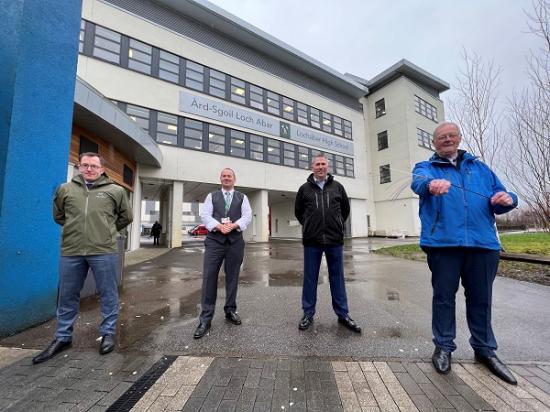
PHOTO
(left to right) Michael Kelly, UK Government’s Department of Culture, Media and Sport, Lochaber High School Head Teacher Scott Steele, HIE’s Scott Dingwall and Chair of Highland Council’s Strategic Communities and Place Committee, Cllr Allan Henderson.
Related Businesses
Related Articles