Council Embarking On E-cargo Bike Pilot In Bid To Further Reduce Fleet Emissions

19th March 2023

Photograph of Council Embarking On E-cargo Bike Pilot In Bid To Further Reduce Fleet Emissions

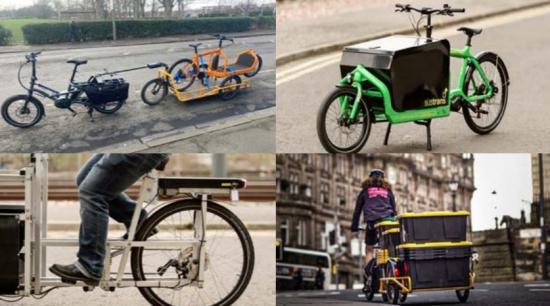
Three Highland Council teams will be taking part in a Sustrans-funded E-Cargo bike pilot scheme aimed at reducing fleet emissions supporting the local authority's wider Net Zero ambition.

The pilot will involve a trial of three E-Cargo bikes which will be used for business by Inverness Amenities team, Inverness roads team and the Fort William Child Health team.

The project aims to reduce fleet emissions by offsetting fleet vehicle travel with low-emission E-cargo bike travel, reduce car miles, offer fuel savings and provide health and wellbeing benefits for Council employees.

The pilot will include two E-cargo trial sessions and user trainings, bike equipment (e.g. helmets, bike lock), a secure storage shed, ongoing support and maintenance as required.

Members at today’s (16 March 2023) Climate Change Committee noted the progress of the pilot and heard about the next steps which have been identified to progress the project.

Those next steps include the arranging of public liability insurance for all users, the development of a cycling policy, the identification of training and trial days. The next steps also include providing information to staff about the pilot and how to arrange come and try sessions.

Two training days have been provisionally arranged for Fort William (25 April 2023) and Inverness (26 April 2023) between 10am and 12pm.

Chair of the Climate Change Committee, Cllr Karl Rosie said: "This is a very exciting pilot and one which supports our wider Net Zero agenda. It also promotes low-carbon, active travel within our communities and the wider region and is warmly welcomed."

The Climate Change (Scotland) Act 20091 and the subsequent Climate Change (Emissions Reduction Targets) (Scotland) Act 20192 (“the Act’) introduced binding targets and legislation to reduce Scotland’s emissions by 75% by 2030, and to end Scotland’s contribution to climate change no later than 2045.

The Highland Council declared a climate and ecological emergency on 9 May 2019 in recognition of the serious and accelerating changes to the world caused by climate change.

In so doing, Members recommitted to achieving a carbon neutral Highland by 2025, and in 2022 established the Climate Change Committee to oversee and expedite the shift to a Net Zero future.

The transport sector is currently the greatest contributor to harmful climate emissions in Scotland. The Scottish Government has made the commitment to work with public bodies to:

Reduce car kilometres by 20% by 2030

phase out the need for all petrol and diesel cars and light commercial vehicles from the public sector fleet by 2025

phase out the need for all new petrol and diesel vehicles in Scotland's public sector fleet by 2030

To facilitate the move towards these targets, the Council established a fleet decarbonisation project. This is a joint project between the Fleet Team and the Climate Change and Energy Team. The Council has already made significant progress on the fleet decarbonisation, with changes in the way we work through various Council policies such as New Ways of Working (NWOW), the use of the Council Car Club, and introduction of Ultra Low Emission Vehicles (ULEV) within the Light Fleet.
 

Related Businesses


Related Articles

Today : Local Authority

Homelessness statistics in Scotland - April to September 2025

An update on Homelessness Statistics covering 1 April to 30 September 2025 has been released today.   Over that period: There were 20,643 applications for homelessness assistance.  

29/1/2026 : Local Authority

Council Services Outsourced But Not Immune - Why High Life Highland Is Still Vulnerable to Budget Cuts

When Highland Council transferred responsibility for leisure, culture and community learning services to High Life Highland (HLH), the move was often presented as a way to protect valued local services from the worst of council budget cuts.   By placing libraries, leisure centres, swimming pools and cultural provision into a charitable trust, the council could take advantage of tax reliefs, external funding opportunities and more flexible operating arrangements.  

29/1/2026 : Local Authority

How Highland Council's Budget Decisions Expose Some Services More Than Others

Highland Council faces a set of financial pressures that are both familiar across Scottish local government and uniquely intensified by its geography, population size, and historic investment choices.   While headline debates often focus on council tax rises or total debt levels, the real impact of financial tightening is felt in how different services are protected, redesigned, or reduced over time.  

29/1/2026 : Local Authority

Which Services Are Most Likely to Face Cuts or Reductions At Budget Day

When budgets tighten in Highland Council, cuts tend not to fall evenly.  Some services are much more exposed than others because of how local government funding rules work and because of Highland's geography.  

29/1/2026 : Local Authority

How Highland Council Debt Affects Local Services

Highland Council's high debt connects to local services and council tax, in practical, day-to-day terms.   Council debt doesn't pay for services directly — but it affects them.  

29/1/2026 : Local Authority

 
Highland Council Debt Is One Of Highest Per Person in the UK

Highland Council has one of the higher levels of debt among Scottish local authorities, especially when looked at per person.  It is not necessarily the absolute highest in total debt compared with councils that have much larger populations like Edinburgh or Glasgow.  

29/1/2026 : Local Authority

 
Scotland's councils risk becoming financially unsustainable

Whilst councils have made significant savings, the cost of delivering services is rising faster than available funding.  This risks the financial sustainability of councils over the next three to five years.  

29/1/2026 : Local Authority

Asset Management is a catalyst for change for The Highland Council

At the Housing & Property Committee (Wednesday 28 January 2026), Members approved the introduction of a new framework to guide decisions on the future of its assets, supporting a more efficient, sustainable and future-ready approach to service delivery.  The Strategic Asset Management Plan (SAMP) will help streamline the estate, embed new ways of working, and contribute to significant savings set out in the Council's Delivery Plan.  

29/1/2026 : Local Authority

Reduction in households in temporary accommodation and improved housing outcomes

At Housing & Property Committee (Wednesday 28 January 2026), The Highland Council reported a strong performance across several key housing indicators, including a reduction in households in temporary accommodation, improved repairs times, and the lowest level of rent arrears in three years.   New figures show that the number of homeless households living in temporary accommodation has fallen to 421, the lowest level recorded since The Scottish Government introduced this measure in April 2016.  

24/1/2026 : Local Authority

 
New facility for additional support needs pupils at Wick High School

Last week Wick High School was delighted to welcome guests from The Highland Council, Wick High Parent Council and the wider community to the open day of a new facility for children with additional support needs.   Avonlea, which was previously a residential unit, has now been repurposed, and this enhanced provision represents a significant step forward for pupils with complex additional support needs.