Council’s Commitment to Highland tourism industry
14th March 2013

In recognising that tourism is the Highland’s biggest industry, members of the Council’s Planning Environment and Development Committee today agreed funding to VisitScotland of up to £270k in 2013/14. They also agreed that a further £80,000 be used to both deliver services directly by the Council’s tourism team and to provide discretionary funding to business or community groups undertaking tourism projects.
Sustainable tourism is one of Scotland’s key growth sectors and is the Highlands’ most important industry. Latest full year figures (2011) show in the Highlands it is responsible for generating £748m of direct expenditure, a further £175m of indirect expenditure and supporting over 18,000 direct jobs.
VisitScotland receives central government funding for national activities and the money from The Highland Council will go towards the cost of providing local services that would not take place without this support. This includes regional marketing activity and running a network of VisitScotland Information Centres.
The council has recently carried out a review of its tourism funding which showed that on top of the annual grant given to VisitScotland, in the last five years it has provided over £213k for projects and initiatives to Highland tourism groups.
The Programme for The Highland Council gives a commitment that the council will work with the Scottish Government, Highlands & Islands Enterprise, the private sector and partners to maximise the tourism potential of the Highland area. It also states that the Council will review how its cash support for tourism is allocated, working with partners to ensure appropriate and effective support is offered to promote unique Highland identities, traditional sports and culture.
Almost a fifth of the £4.2 billion tourism brings to the Scottish economy is generated in the Highlands.
Chairman Councillor Thomas Pragg said: “Tourism has played a key role in our economy for so long we are in danger of taking it for granted. Our spectacular scenery and distinct culture along with a wide range of attractions and activities makes us well placed to capture much of the business from both overseas and UK based visitors. To do this effectively we must target our resources and make sure we get the best use of every pound we spend.
“It has been very worthwhile to review how we do things as sustainable tourism is becoming very competitive and technology is changing how visitors access information. The role of Visitor Centres is going to change but we still need a very visible presence in our communities. I also feel there is work to do to boost the image of having a career in the service industry.”
Photo
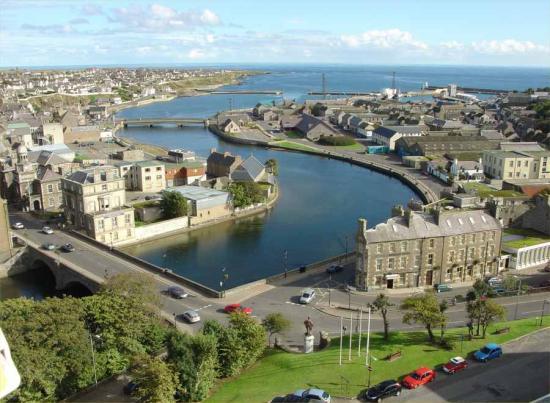
Wick with Mackays Hotel in bottom right
Photographer - Bill Fernie
Related Businesses
Related Articles
The Highland Council welcomes moves by the Scottish Government to introduce greater flexibility on how it could design a Visitor Levy Scheme for consultation. The Visitor Levy (Scotland) Act 2024 currently provides local authorities with discretionary powers to implement percentage-based levies following statutory consultation.
As it looks to set out its forthcoming priorities, the council is seeking involvement from members of the public, including businesses, community groups, parents, and young people. All their opinions are going to be crucial in deciding how Highland Council will take on its budget challenge for 2026-2027.
Thurso is to benefit from £100m investment in education and community facilities and are rolling out the first phase of public consultations on 9 and 10 December 2025. The Highland Council is inviting people that live, work, or study in Thurso, to come along to the public consultation events to have their say; this is an opportunity to help shape the future of Thurso, to gather views and ideas.
A new online portal has been launched to bring empty homeowners together with prospective buyers or developers with the aim of facilitating more properties to be used as homes again. Covering the whole of Scotland, this builds on the success of local pilots, referred to as "matchmaker schemes".
Steps towards introducing a short term let control area have been considered by Highland Council's Isle of Skye and Raasay area committee. On Monday (1 December 2025) the committee heard evidence to justify the grounds for the introduction of a Short Term Let Control Area covering all or part of Skye and Raasay.
EMPLOYERS and educators from across the Highlands have gathered to hear how a new initiative is aiming to transform the region's economy. Workforce North - A Call to Action brought together business leaders and teachers from primary and secondary schools from across the Highland Council area with a wide range of partners geared towards education, learning and skills development at Strathpeffer Pavillion.
The Highland Council continues to call for meaningful engagement from the Home Office over its plans to temporarily accommodate up to 300 adult male asylum seekers at Cameron Barracks, Inverness. It follows an email on Monday from Alex Norris MP, Minister for Border Security and Asylum, to Council Leader, Raymond Bremner, which failed to answer questions raised by the Council or address community concerns.
SSEN Transmission has become the first company to sign up to the Highland Social Value Charter (HSVC), marking a significant milestone in delivering long-term socio-economic benefits for communities across the Highlands. Investment commitments from the company include funding for roads, new homes, jobs, and work for local contractors in addition to a local and regional fund for communities to apply to.
The Highland Council continues to work through the procurement process for the provision of the Wick Public Service Obligation for the Highland Council. We have now entered the preferred bidder stage and have entered a standstill period.
Maps of the Council's gritting routes by priority and policy are available online at www.highland.gov.uk/gritting (external link) The information provided is a summary of reports from operational staff and is intended to give a general indication of typical conditions in each area at a point in time. It is not intended to imply that any individual route is entirely snow and ice free and drivers must be aware that conditions can change rapidly and make their own assessment of conditions for travelling.