Highland Declared Benefits & Welfare Reform Team Of The Year
26th November 2018
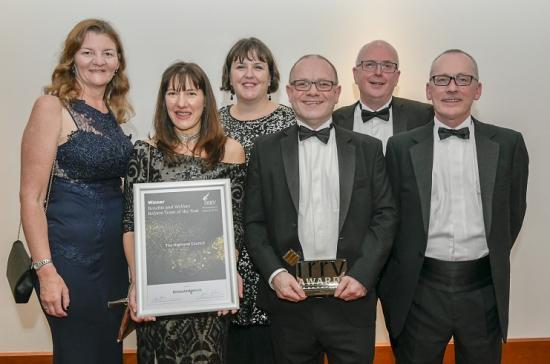
Highland Council's outstanding revenue and customer services team has won both the Scottish and UK IRRV awards for its excellent approach to reforming services.
Teamwork and new online applications mean that the council consistently meets the challenging one-day national target for getting crisis payments into the hands of vulnerable customers which is crucial for many of the applicants and no mean feat when you consider that the council covers a geographical area which is a third of the land mass of Scotland and 20% larger than Wales.
Part of the council's corporate resources service, the service delivery team administers the Scottish Welfare Fund and other entitlements such as free school meals, clothing grants and education maintenance allowance; putting the customer first and ensuring that information is only collected once by a team of experts.
The council's service delivery manager Alasdair Bruce explains: "Our mantra has always been to put the customer first and look after the needs of the people of the Highlands. The vision was to introduce a first class, customer-centric, model that would create a generic gateway to all council entitlements whilst also reducing cost and generating additional income. We have a modern digital first agenda but this is complemented by a strong commitment to localism, retaining the traditional contact channels throughout the Highlands and offering the customer choice."
All too often the assumption is that cutting costs automatically leads to a reduction in performance, quality or service. Highland Council don't share that view. Instead, they have achieved more with fewer resources and the result is a high quality and accessible service with a sharp focus on effective performance management that delivers continuous improvement despite increased workload.
The plans were ambitious but they have proven to be great success. Benefit Highland council's award winning teamtake-up has increased by £6 million, 100% of crisis grants are paid within one day and housing benefit administration performance is among the best in the UK. All this whilst also saving the council more than £1.3 million contributed to the team being declared ‘Benefits & Welfare Reform Team of the Year' in both the Scottish Institute of Revenue and Rating Valuation (IRRV) annual awards and the IRRV's UK awards (pictured above).
The council provides a range of online services and they worked with IEG4 to introduce a portal for residents to access the Scottish Welfare Fund.
A freephone service is structured in a way that, despite high volumes, it rarely has queues and customers in crisis can speak directly to decision makers and are not passed from pillar to post.
Helping people at a challenging time
Bruce explains: "It is obviously a challenging time for any customer who has to make a Scottish Welfare Fund application. They need our help and support quickly so we wanted a reliable system that would simplify a complex process and be easy to use across mobile, PC and other devices. The IEG4 solution achieves this, helping us to quickly and efficiently assess entitlement and customer feedback confirms ease of use.
"The vast majority of our customers choose to receive crisis grants and indeed school clothing grants by SMS text message which can be redeemed for cash at more than 150 local PayPoint outlets across the Highlands. This means customers can make a claim, get a decision, and receive payment all within an hour. This has been a key enabler as we continue to pay 100% of crisis grants on time. For customers in crisis, this service is invaluable and we regularly receive very positive feedback."
When choosing a partner to administer the fund, the council wanted a solution that was easy to use, could be easily integrated and was intuitive for customers and staff alike.
Bruce adds: "It was clear to us that the IEG4 system was the right way forward. Local government is a challenging environment with ever reducing budgets and pressures on service delivery. Our job was to deal with this whilst also improving services. The results speak for themselves. We have improved performance, improved customer satisfaction and improved administrative procedures in all aspects of benefits and welfare reform."
The team recognised early on that customers were coming to the council in difficult circumstances, having to make separate applications for different types of help via different departments. A new structure brought together all of the different functions so customers only had to apply once whilst also ensuring the team was able to flex and respond to future changes such as welfare reform, universal credit full service rollout, the council's digital agenda, and forecasted reductions in both council and Department for Work and Pensions funding.
It made sense that one team administered all entitlements so the Scottish Welfare Fund sits within an experienced team which also administers other entitlements. The whole team is trained on the fund so that those handling applications can be rotated and numbers can be increased depending on demand at any given time.
The Scottish Welfare Fund also includes the payment of community care grants which have helped people move forward and make changes in their lives for the better such as helping war veterans move to quieter parts of the Highlands and improve their basic quality of life.
All staff members receive regular training to keep their skills and knowledge up to date. The council also provides health awareness sessions; giving their staff access to experts for advice on stress and relaxation, posture and general health care to help them cope with what can be a stressful service to deliver.
Making a real difference
The customer support is two-fold though as benefits and welfare manager Sheila McKandie explains: "Welfare support is much wider than the entitlements administered by the council. It's not just about what happens during the application process but also what happens before and afterwards. We look after the customer and put them first, whether it is gathering all relevant information to assess their claim, providing expert advice, maximising their entitlement and supporting them through any appeals process or hearings. Support and advice is provided for all welfare benefits, effectively giving the customer a 'health check', ensuring they receive all they are entitled to. Personal budgeting and home visits are also included.
"Using technology to make our advisers mobile allows us to take the service to our vulnerable customers in their own homes, and local venues such as libraries and drop-in centres. The use of electronic diary systems has improved efficiency, allowed us to visit more customers, and made this service a financially viable option."
Highland Council's high level capability is impressive and the most important point is that it is making a real difference to peoples' lives.
PHOTO
At the IRRV Awards (Left to Right): Murdina Boyd, Business Development & Support Manager; Sheila McKandie, Benefits & Welfare Manager; Lucy Lallah, Business Management Analyst; Allan Gunn, Head of Revenues and Customer Services; Alasdair Bruce, Service Delivery Manager; Alister MacBain, Client Manager
Related Businesses
Related Articles