Independence would hit Scottish economy 2 to 3 times harder than Brexit
4th February 2021
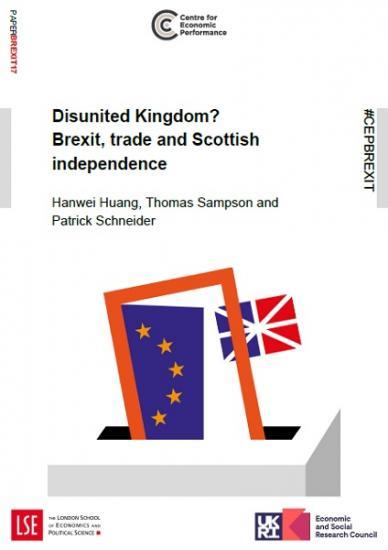
Brexit and independence together to shrink Scottish economy by 6% to 9%.
Rejoining the EU would not offset the costs of independence.
The combination of independence and Brexit would reduce Scotland's income per capita by between 6.3 per cent and 8.7 per cent in the long-run, a new study from the London School of Economics and Political Science shows.
The economic hit from the two events is equivalent to an income loss of between £2,000 and £2,800 per person every year, economists estimate. The study Disunited Kingdom? Brexit, Trade and Scottish Independence published today by the LSE's Centre for Economic Performance, analyses the impact on Scotland's economy of potential changes in trade barriers resulting from Brexit and Scottish independence.
It finds that the economic costs of independence are two to three times greater than the impact of Brexit. And the report concludes that the losses from independence are similar regardless of whether an independent Scotland rejoins the EU or maintains a common economic market with the UK.
Authors Hanwei Huang, Thomas Sampson and Patrick Schneider find that independence would hit the Scottish economy harder than Brexit because Scotland's trade with the rest of the UK is about four times larger than its trade with the EU. This large difference means that creating a border within the UK would be more costly than
the increase in UK-EU trade costs due to Brexit.
The report also shows that there is around six times more trade between Scotland and the rest of the UK than predicted by the standard gravity model of international trade, highlighting the trade benefits from being part of a United Kingdom.
Hanwei Huang, assistant professor at the City University of Hong Kong, said: "This analysis shows that, at least from a trade perspective, independence would leave Scotland considerably poorer than staying in the United Kingdom. While many considerations will play a role in shaping the outcome of a second referendum, voters need to know what the likely costs and benefits of each course will be. This briefing contributes to that knowledge."
Thomas Sampson, associate professor of economics at LSE, said: "We find that the costs of independence to the Scottish economy are likely to be two to three times greater than the costs of Brexit. Moreover, rejoining the EU following independence would do little to mitigate these costs, and in the short run would probably lead to greater economic losses than maintaining a common economic market with the rest of the UK."
Patrick Schneider, a PhD student at LSE, said: "We show that rejoining the EU will only support the Scottish economy in the long-run if a costly condition is met - that the move to independence reduces trade with the rest of the UK by so much that the EU becomes Scotland's largest trading partner."
The LSE's Centre for Economic Performance said the impacts on its trade with both the UK and the EU would shrink Scotland's economy in the long run by between 6.3% and 8.7%.
That was equivalent to a loss of between £2,000 to £2,800 per capita a year: with Scotland's population estimated to be nearly 5.5 million, that puts the losses at between £11bn and £15.4bn.
The UK is Scotland's largest and most important trading partner, the report said, accounting for 61% of its exports and 67% of its imports - around four times greater than its trade with the EU. Independence would increase trading costs with the rest of the UK by 15% to 30%.
The estimates reflect the long-run effects of Brexit and independence, and it could take a generation or more for the full effects to materialise. The report focuses on trade costs and does not study other economic consequences of independence, such as changes in fiscal arrangements or Scotland's currency.
Hanwei Huang, one of the report's authors, said: "This analysis shows that, at least from a trade perspective, independence would leave Scotland considerably poorer than staying in the United Kingdom.
The report concludes -
Many considerations beyond economics will play a role in shaping the outcome of a second referendum on Scottish independence. But to make an informed decision on the costs and benefits of independence, voters need to know what the likely economic consequences of independence would be. This briefing contributes to that goal by analysing how changes in trade costs due to independence and Brexit are expected to affect aggregate Scottish income per capita.
We find that the costs of independence to the Scottish economy are likely to be two to three times larger than the costs of Brexit. Moreover, rejoining the EU following independence would do little to mitigate these costs and in the short run would probably lead to greater economic losses than maintaining a common economic market with the rest of the UK.
Our work focuses on the aggregate effects of changes in trade costs holding production technologies constant. A complete account of the economics of independence should also consider changes in technology, foreign investment, immigration, currency arrangements and fiscal transfers as well as studying the distributional consequences of independence. But our analysis shows that, at least from a trade perspective, independence would leave Scotland
considerably poorer than staying in the United Kingdom.
Read the full report HERE