Fraud And Irregularity 2020/21 In Scottish Public Bodies
1st July 2021
Background
Impact of Covid‑19
The risk of fraud and error has increased over the last year due to the Covid‑19 pandemic. This is due to many reasons,
including:
• public bodies have become stretched, controls and governance arrangements have required to be changed.
• staff working remotely and under pressure
• staff adapting to new ways of working with associated new
processes and procedures
• staff being redeployed to work in new and unfamiliar departments as public bodies have responded to increased demands for certain services
• continuous fraud attempts on public bodies including both traditional types of fraud and newer cybercrimes
• former verification and control processes being unable to operate as new ways of working are introduced
• new support schemes for business and communities being developed and implemented at speed.
Public bodies need to review their systems and identify areas where
the threat from fraud and error has increased. They need to review existing controls to ensure they are still effective and appropriate and at the same time introduce new controls to address new risks. Measures like these have always been important but the unprecedented challenges and pressures brought by the pandemic, and the opportunities it has presented for fraudsters, bring a
renewed focus on ensuring effective governance and controls are in place.
Additional risks will continue to emerge as public money and services are targeted by fraudsters. Fraudsters will continue
to look for new opportunities to exploit weaknesses in systems and controls.
Public bodies and auditors should stay alert to new scams and approaches by fraudsters, and regularly review controls and governance arrangements to ensure they remain fit for purpose.
Good governance and sound controls are essential in crisis and changing situations.
Aims of this report
This report sets out a range of fraud risks emerging since the
start of the Covid‑19 pandemic along with suggestions of what
public bodies may do to help reduce these risks. It aims to help
public bodies identify and manage these risks.
This report also shares information about cases where internal
control weaknesses in public bodies have led to fraud and
irregularity, to help prevent similar circumstances happening
again. External auditors have shared specific details about
significant frauds and other irregularities in public bodies during
2020/21. The level of fraud and irregularity reported by external
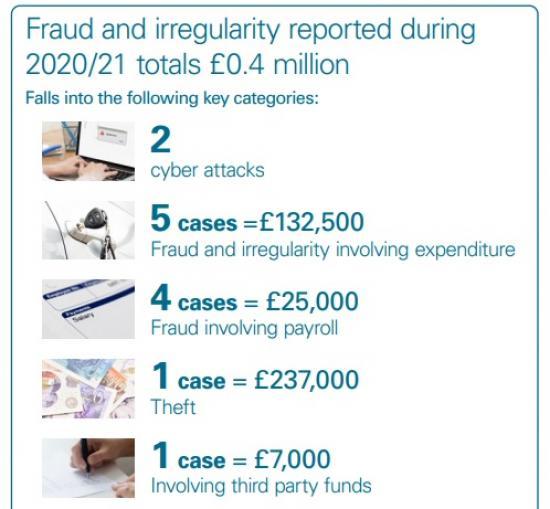
auditors of £0.4 million remains small compared to the 2020/21
Scottish budget of £49 billion.
This report is informed by information provided by external
auditors during 2020/21 in their fraud and irregularity returns to
Audit Scotland. External auditors are required to report frauds
(or suspected frauds) where they are caused or facilitated by
weaknesses in internal controls at public bodies. Frauds and
irregularities are considered significant where the value of the
loss is over £5,000 or where it is of significance due to the
nature of the activity.
Auditors of local authorities are not required to report cases of
fraud perpetrated by claimants, for example, grant claimants or
housing benefit claimants, unless the fraud was facilitated by
the collusion of local authority staff or otherwise by weaknesses
in internal control. The cases included in this report are likely to
have been investigated internally, but it is not necessary for the
police to have been involved or for it to have been proven as
fraud in a court of law.
Read the full report HERE