Four Ways To Reduce Your Household Energy Use - Proven By Research
11th October 2022
A particularly cold September has given us a glimpse of the winter to come. The cold will bite hardest for the 13% of England's households that are already in fuel poverty. As the energy crisis intensifies, this is expected to rise further.
European leaders have therefore rushed to implement measures to protect households. The UK's Energy Price Guarantee caps the unit price of electricity and gas at 34p and 10p respectively. While this will ease some concerns over rising energy bills, many households will still be priced out of warming their home in the coming months.
So here are four ways research indicates households can reduce their energy use in time for the winter - and save money in the process.
1. Air dry laundry
Washing and drying clothing is responsible for around 12% of household electricity use in the UK.
Hand washing is frequently suggested as an energy-saving alternative to machine washing.
Yet modern washing machines are highly efficient, typically using 0.5 kilowatt hours for a 9kg wash. This is considerably less than the 0.82 kilowatt hours used on average by hand washing. Even inefficient washing machines tend to use less energy than hand washing as much less hot water is required.
By instead restricting use of the tumble dryer, greater reductions in energy use can be achieved. Tumble dryers use a lot of energy, with a single cycle using up to 4.5 kilowatt hours. This will cost £1.50 per cycle at the price cap.
By air drying laundry instead, I calculated that the average household could save over £130 a year.
2. Use less hot water
Facing critical gas shortages, the German city of Hanover turned off the hot water in the bathrooms of all public buildings earlier this year.
While energy-saving measures this severe are unlikely, hot water production in the UK is a major consumer of energy, accounting for roughly one quarter of household energy use. There are several ways households can reduce their hot water use.
One way is reducing the time spent in the shower. A high-pressure shower lasting nine minutes uses around 4.3 kilowatt hours of gas. At the price cap, this will cost households 44p per shower. By reducing the time spent showering to six minutes, households can save 15p on heating water for each shower.
If you have a hot water tank, making sure it is well insulated can also deliver cost savings. This will keep water warmer for longer and reduce heating costs.
Another approach is to install a low-flow shower head. This restricts the flow of water while maintaining the feel of a high-pressure shower. At lower flow rates, a shower will consume less hot water. For households that average two nine-minute showers a day, this could save over £100 per year.
However, a low-flow shower head will only work well in areas where the water pressure is already sufficiently high. Reducing the flow of an already low-pressure shower would transform the shower into a dribble.
3. Make better use of heating
As the energy crisis intensifies, it is important to make sure heating is not wasted unnecessarily. Research indicates that energy use could be slashed by up to 30% by reducing heating when occupants are asleep or away.
This can be done by manually dialling down the thermostat or by turning the heating off altogether. For those who habitually forget to lower the heating, a smart thermostat could prove a useful investment. These can be controlled remotely via your mobile, or automatically through presence sensors and allow heating to be lowered when the home is unoccupied.
Energy is also wasted by heating unused rooms. Thermostatic radiator valves are one way to control the temperature across different rooms. They regulate the flow of hot water through radiators and can be programmed to modulate the temperature for each room.
Thermostatic radiator valves can deliver substantial energy savings. One study found that they result in 10%-18% less energy use compared to homes with no heating controls. However, it is important that the doors between rooms remain closed to prevent energy being wasted.
4. Maximise insulation
Although we can make better use of heating, Britain's homes are hugely energy inefficient. Its housing stock is one of the least insulated in Europe.
Maximising your insulation is one way to reduce your energy use. Secondary glazing in the form of window shutters can halve the amount of heat lost through a single glazed window. I calculated that this could save the average UK home over £50 per year in heating costs.
But window shutters do not always represent an immediate energy-saving strategy. Shutter installation can be costly and if installed on a building's exterior may require planning permission.
Closing blinds or curtains at night and during cold spells instead represents a cheaper way of retaining heat. Research indicates that blinds can reduce the amount of heat lost through windows by up to 38%.
Changes in habits and small investments can substantially reduce energy consumption. If widely implemented, they can ease the energy crisis. While the Energy Price Guarantee will provide temporary relief to many, investment in energy efficiency measures such as insulation must be prioritised to reduce our energy burden longer term.
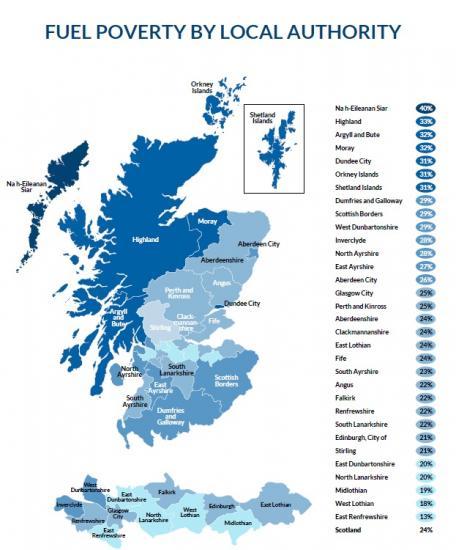
The worst areas for fuel poverty in Scotland revealed.
As industry and charities call for urgent action to support people with their energy bills this winter, the extent of Scotland's fuel poverty problem has been geographically captured for the first time.
Figures mapped out by fuel poverty campaigner's Energy Action Scotland show that 40% of people living in the Western Isles live in fuel poverty compared to just 13% in East Renfrewshire. The Scottish average was 24% of all households.
Fuel poverty is defined by the Scottish Government as any household spending more than 10% of their income on energy - after housing costs have been deducted.
‘It maybe not surprising to most people that the Western Isles is the most fuel poor part of the country given the inclement weather conditions, dependence on electric heating and low levels of energy efficiency, but the extent of the problem is alarming. Two in every five household cannot afford to heat their home is something that needs to be addressed urgently,' said Energy Action Scotland's, chief executive, Frazer Scott.
Energy Action Scotland is urging the UK government to cut VAT on energy bills, redistribute the VAT windfall already received to help those with the lowest incomes and consider radical reforms to ensure that vulnerable fuel poor households are protected.
‘This is not a problem that is going away; it is only likely to get worse. We estimate that as prices rocket over 100,000 more households will seriously struggle to heat their homes. We urgently need more government action to improve the energy efficiency of homes across the country but particularly targeted at households that suffer the greatest rates of fuel poverty,' said Frazer.
Industry analysts have warned that continued volatility in wholesale energy markets could push average household energy bills up by more than £700 to £2,000 a year from April.
‘Continued inaction will cost lives. Over 2000 more people die in winter when cold damp homes reduces health and wellbeing than they do in summer,’ he added.
Note
The main article is from The Conversation web site. To read it with links to more information go HERE
To read more about fuel poverty in Scotland go HERE