Home Employment and labour market People in work Labour productivity Productivity overview - UK Productivity overview - UK October to December 2022
26th April 2023
The main findings from official statistics and analysis of UK productivity, presenting a summary of recent developments.
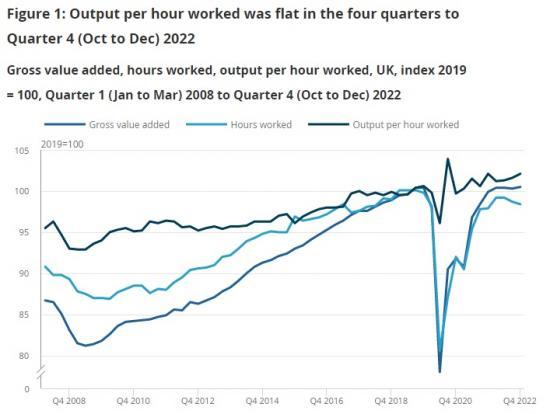
Growth in output per hour worked in Quarter 4 (Oct to Dec) 2022 was flat (0.0%) compared with Quarter 4 2021.
Output per worker and output per job in Quarter 4 2022 were respectively 0.2% and 0.3% lower than the same quarter a year ago.
Relative to the same quarter a year ago, construction and administrative service industries had the biggest positive industry contribution to annual productivity growth.
Labour productivity
Quarter 4 (Oct to Dec) 2022 completed four quarters without the furlough. Therefore, for the first time in a post-coronavirus (COVID-19) period, we can compare quarter on quarter from a year ago without the distortion of furlough effects.
Output per hour worked, our headline measure of labour productivity, was flat (0.0%) in the four quarters to Quarter 4 2022. Growth in gross value added (GVA) (0.5%) was balanced closely by growth in hours worked (0.6%) over the past year.
Output per worker and output per job were 0.2% and 0.3% below their respective Quarter 4 2021 levels. This is because of higher growth in the number of workers (0.8%) and jobs (0.9%) than in the GVA (0.5%).
Output per hour worked was 2.1% above its pre-coronavirus pandemic levels (2019 average level) in Quarter 4 2022. This growth was driven by a fall in the number of hours worked (1.6%) and an increase of GVA by 0.5% (see Figure 1) since 2019. Output per worker and output per job were also above their pre-coronavirus pandemic levels, at 0.4% and 0.2% respectively. This was because of a higher increase in GVA (0.5%) compared with the growth in the number of workers (0.0%) and the number of jobs (0.3%).
Labour productivity by industry
Figure 2 shows the contribution to annual growth in output per hour worked for 17 industries in Quarter 4 (Oct to Dec) 2022 relative to the same quarter a year ago. Construction and administrative service industries made the biggest positive industry contribution to annual productivity growth. By contrast, manufacturing and wholesale and retail industries detracted from productivity growth. The mining and quarrying industry did not make any contribution to productivity growth over the same period.
Read the full ONS report HERE