Number Of New Disability Benefit Claims Remains High, But Today's Data Show Tentative Signs Of Easing
15th June 2023
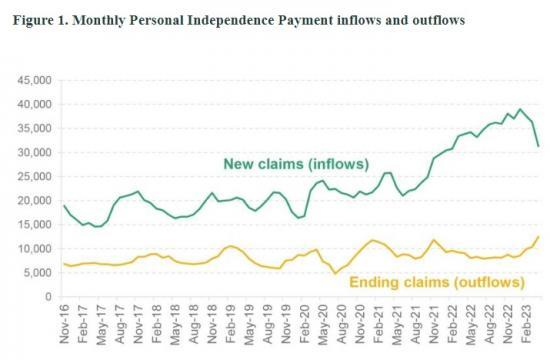
In the years since the pandemic, there has been a large and sustained rise in the number of adults being newly awarded working-age disability benefits each month.
In the years since the pandemic, there has been a large and sustained rise in the number of adults being newly awarded working-age disability benefits each month. Today's data offers the first tentative sign of a reversal - but the monthly number of new claims remains high. Between February and April this year, 31,000 individuals started receiving the benefit each month on average, down 7% compared to 2022. Still, this was more than 50% higher than the number in February-April 2019.
The number of individuals whose claim ends each month has not substantially changed, and, at around 10,000 per month, is far below the number of people starting a claim (see figure below).
As a result, the total number of people on working-age disability benefits is rising, and rising much faster than before the pandemic.
The total number of claimants now stands at 2.7 million - 670,000 (or 25%) more than in April 2019. Approximately 5 in 6 of these individuals are out of work.
Supporting these new recipients will require billions of extra spending each year. In 2019-20 spending on working-age disability benefits was already £14bn (2023-24 prices) - official forecasts predict a spend of £19bn this year, rising to more than £25bn in 2027-28.
Note: Calculated based on changes in PIP cases with entitlement. Does not include DLA reassessments. Excludes Scotland, because from 2022 PIP is being replaced by Adult Disability payment in Scotland.
Source: Authors' calculations using data from DWP Stat-Xplore.
Article Source - Institute for Fiscal Studies
Authors Sam Ray-Chaudhuri and Tom Waters