Rising Ill-health And Economic Inactivity Because Of Long-term Sickness UK - 2019 To 2023
27th July 2023
More working-age people are self-reporting long-term health conditions, with 36% saying that they had at least one long-term health condition in Quarter 1 (Jan to Mar) 2023, up from 31% in the same period in 2019 and 29% in 2016.
The number of people economically inactive because of long-term sickness has risen to over 2.5 million people, an increase of over 400,000 since the start of the coronavirus (COVID-19) pandemic.
For those economically inactive because of long-term sickness, nearly two-fifths (38%) reported having five or more health conditions (up from 34% in 2019), suggesting that many have interlinked and complex health issues.
Over 1.35 million (53%) of those inactive because of long-term sickness reported that they had depression, bad nerves or anxiety in Quarter 1 2023, with the majority (over 1 million) reporting it as a secondary health condition rather than their main one.
For those inactive because of long-term sickness and who had a main health condition that is musculoskeletal in nature, over 70% reported that they had more than one type of musculoskeletal condition.
For those inactive because of long-term sickness, there has been an increase of 277,000 (42%) people reporting five or more health conditions between 2019 and 2023, totalling 937,000 adults in 2023. Of those inactive because of long-term sickness, 38% now report they have five or more health conditions, up from 34% in 2019. There has been a larger proportion of people reporting five or more health conditions for both the youngest and oldest who are long-term sick, with 23% of those aged 16 to 34 years reporting five or more health conditions in 2023 (up from 17% in 2019) and 46% of those aged 50 to 64 years (up from 41% in 2019). The proportion that has five or more health conditions for those aged 35 to 49 years has stayed constant (31%), but there has been an increase in the proportion that has three or four conditions (29% in 2019 and 31% in 2023). This suggests that those who are inactive because of long-term sickness have increasingly complex health issues, the majority with more than one health barrier to them returning to the labour market.
ypes of health conditions
In 2023, the most prevalent health condition reported by the working-age population was depression, bad nerves or anxiety (5 million people, 12%). This was also the largest health condition for those who are economically inactive because of long-term sickness, with 53% (1.35 million people in 2023) reporting it as a health condition, higher than the 48% who reported it in January to March 2019. This aligns with the Opinions and Lifestyle Survey results, published in our Cost of living and depression in adults article between 29 September and 23 October 2022 where 59% of those who were inactive because of long-term sickness said they experienced moderate to severe depressive symptoms, far higher than the prevalence for those employed or self-employed (15%), or those inactive but for other reasons excluding being retired (24%).
Between 2019 and 2023, the number of people inactive because of long-term sickness who reported depression, bad nerves or anxiety rose by 386,000 (40%). Most of this increase was from people reporting it as a secondary health condition (increased 50% over the same period), whereas it only increased by 14% as a main health condition.
For those who were inactive because of long-term sickness and told us their main health condition, 1.35 million people stated they have a musculoskeletal health condition. Since 2019, problems with legs or feet rose by 243,000 (29%) and problems with back or neck rose by 217,000 (28%).
Table of contents
Main points
Health condition trends
Types of health conditions
Combinations of health conditions
Wider context
Rising ill-health and economic inactivity because of long-term sickness data
Glossary
Data sources and quality
Related links
Cite this article
Print this article
Download as PDF
1.Main points
More working-age people are self-reporting long-term health conditions, with 36% saying that they had at least one long-term health condition in Quarter 1 (Jan to Mar) 2023, up from 31% in the same period in 2019 and 29% in 2016.
The number of people economically inactive because of long-term sickness has risen to over 2.5 million people, an increase of over 400,000 since the start of the coronavirus (COVID-19) pandemic.
For those economically inactive because of long-term sickness, nearly two-fifths (38%) reported having five or more health conditions (up from 34% in 2019), suggesting that many have interlinked and complex health issues.
Over 1.35 million (53%) of those inactive because of long-term sickness reported that they had depression, bad nerves or anxiety in Quarter 1 2023, with the majority (over 1 million) reporting it as a secondary health condition rather than their main one.
For those inactive because of long-term sickness and who had a main health condition that is musculoskeletal in nature, over 70% reported that they had more than one type of musculoskeletal condition.
Back to table of contents
2.Health condition trends
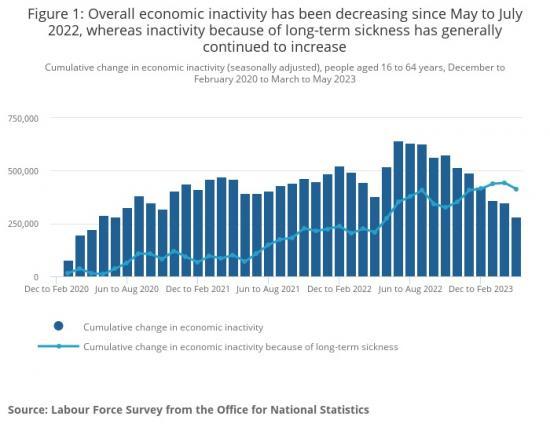
In November 2022 we published an article about the increase in the number of people who were economically inactive because of long-term sickness. Our Economic inactivity by reason dataset (March to May 2023), shows that the number of people economically inactive because of long-term sickness is now over 2.5 million. This article aims to expand upon the insights already published, but with a particular focus around the health conditions reported by those who are inactive because of long-term sickness.
Figure 1: Overall economic inactivity has been decreasing since May to July 2022, whereas inactivity because of long-term sickness has generally continued to increase
Cumulative change in economic inactivity (seasonally adjusted), people aged 16 to 64 years, December to February 2020 to March to May 2023
Cumulative change in economic inactivityCumulative change in economic inactivity because of long-term sicknessDec to Feb 2020Jun to Aug 2020Dec to Feb 2021Jun to Aug 2021Dec to Feb 2022Jun to Aug 2022Dec to Feb 20230200,000400,000600,000800,000
May to Jul 2022
● Cumulative change in economic inactivity: 641,710
● Cumulative change in economic inactivity because of long-term sickness: 352,011
Source: Labour Force Survey from the Office for National Statistics
Download this chartFigure 1: Overall economic inactivity has been decreasing since May to July 2022, whereas inactivity because of long-term sickness has generally continued to increase
Image .csv .xls
The Labour Force Survey asks respondents to report their long-term health conditions from a list of 18 different options, as shown in Section 8, Data sources and quality. Between 2016 and 2019, there was a small fall in the proportion of people who reported no health conditions, decreasing from 71% to 69%. However, from the onset of the coronavirus (COVID-19) pandemic, this downward trajectory accelerated so that in January to March 2023, only 64% of working-age people reported having no health conditions. This is an absolute drop of 2 million since the same period in 2019. Conversely, the number of people who reported having one or two health conditions has steadily increased over time, from 8.5 million (21%) in 2016 to 10.6 million (25%) in 2023.
Figure 2: The proportion of people reporting no long-term health conditions has been decreasing in recent years
Proportion of long-term health conditions of those aged 16 to 64 years, UK, January to March 2016 to January to March 2023
01 to 23 to 45 or more20232022202120202019201820172016020406080%
Source: Labour Force Survey from the Office for National Statistics
Notes:
In 2020 the Labour Force Survey (LFS) added "autism" as an additional option when asking respondents about their health conditions. This means those who reported autism in 2020 may have listed another condition prior to this option being available.
Percentages may not add to 100% because of rounding.
Download this chartFigure 2: The proportion of people reporting no long-term health conditions has been decreasing in recent years
Image .csv .xls
For those inactive because of long-term sickness, there has been an increase of 277,000 (42%) people reporting five or more health conditions between 2019 and 2023, totalling 937,000 adults in 2023. Of those inactive because of long-term sickness, 38% now report they have five or more health conditions, up from 34% in 2019. There has been a larger proportion of people reporting five or more health conditions for both the youngest and oldest who are long-term sick, with 23% of those aged 16 to 34 years reporting five or more health conditions in 2023 (up from 17% in 2019) and 46% of those aged 50 to 64 years (up from 41% in 2019). The proportion that has five or more health conditions for those aged 35 to 49 years has stayed constant (31%), but there has been an increase in the proportion that has three or four conditions (29% in 2019 and 31% in 2023). This suggests that those who are inactive because of long-term sickness have increasingly complex health issues, the majority with more than one health barrier to them returning to the labour market
Figure 3: The number of people inactive because of long-term sickness reporting five or more health conditions has been increasing since the pandemic
Number of health conditions of people aged 16 to 64 years who are economically inactive because of long-term sickness, UK, January to March 2019 to January to March 2023
1 to 23 to 45 or more202320222021202020190250,000500,000750,0001,000,000
2022
● 1 to 2: 819,643
● 3 to 4: 639,781
● 5 or more: 800,178
Source: Labour Force Survey from the Office for National Statistics
Notes:
A very small number of responders who were inactive because of long-term sickness did not provide any health conditions. These have been excluded from the calculations.
Download this chartFigure 3: The number of people inactive because of long-term sickness reporting five or more health conditions has been increasing since the pandemic
Image .csv .xls
Back to table of contents
3.Types of health conditions
In 2023, the most prevalent health condition reported by the working-age population was depression, bad nerves or anxiety (5 million people, 12%). This was also the largest health condition for those who are economically inactive because of long-term sickness, with 53% (1.35 million people in 2023) reporting it as a health condition, higher than the 48% who reported it in January to March 2019. This aligns with the Opinions and Lifestyle Survey results, published in our Cost of living and depression in adults article between 29 September and 23 October 2022 where 59% of those who were inactive because of long-term sickness said they experienced moderate to severe depressive symptoms, far higher than the prevalence for those employed or self-employed (15%), or those inactive but for other reasons excluding being retired (24%).
Between 2019 and 2023, the number of people inactive because of long-term sickness who reported depression, bad nerves or anxiety rose by 386,000 (40%). Most of this increase was from people reporting it as a secondary health condition (increased 50% over the same period), whereas it only increased by 14% as a main health condition.
For those who were inactive because of long-term sickness and told us their main health condition, 1.35 million people stated they have a musculoskeletal health condition. Since 2019, problems with legs or feet rose by 243,000 (29%) and problems with back or neck rose by 217,000 (28%).
Figure 4: The most prevalent health condition among those economically inactive because of long-term sickness was depression, bad nerves or anxiety
Top 10 types of health conditions of people aged 16 to 64 years who are economically inactive because of long-term sickness, UK, January to March 2019 to January to March 2023
20192023Depression, bad nerves, anxietyProblems with legs or feetProblems with back or neckMental illnessProblems with arms or handsHeart, blood or circulationOther health conditionsChest or breathing problemsDigestive problemsDiabetes0200,000400,000600,000800,0001,000,0001,200,0001,400,0001,600,000
Diabetes
● 2019: 253,221
● 2023: 362,607
Source: Labour Force Survey from the Office for National Statistics
Notes:
Respondents were able to report multiple health conditions.
In 2020 the Labour Force Survey (LFS) added "autism" as an additional option when asking respondents about their health conditions. This means those who reported autism in 2020 may have listed another condition prior to this option being available.
See Section 8, Data sources and quality for full health condition labels.
Download this chartFigure 4: The most prevalent health condition among those economically inactive because of long-term sickness was depression, bad nerves or anxiety
Image .csv .xls
In December 2022 we published an article that looked at self-reported long-COVID in the labour market, which showed that people reporting long-COVID were more likely to be inactive (excluding retirement) compared with pre-infection. In the Labour Force Survey, respondents were not given explicit guidance on what health condition to report for coronavirus-related illnesses such as long-COVID. As a result, those with long-COVID are likely to fall into the "other health problem or disabilities" category because it includes conditions similar to long-COVID such as post-viral fatigue syndrome. As reported in our November 2022 publication, the largest main health condition reported by those who were inactive because of long-term sickness was "other health problem or disabilities", up to 394,000 people in 2023. Additionally, it increased by 53% between 2019 and 2023 as either a main or secondary health condition, with 754,000 reporting it.
Read the full ONS report HERE