It's Getting Hot In Here - How Ever-Warmer UK Summer Temperatures Will Have An Outsized Impact On Low-income Households And Low-paid Workers -
20th August 2023
Although the UK's summer of 2023 has been something of a washout so far, the country is getting hotter, with temperatures over 40oC - first experienced in the UK in 2022 - set to become the norm. Hotter weather will impact different people in different ways, so this Spotlight explores what it means for Brits at home and at work.
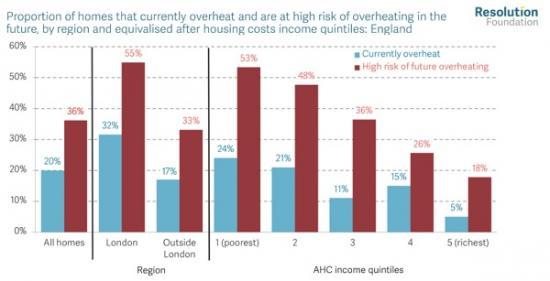
At current summer temperatures, a fifth of homes in England overheat, but the make-up of the housing stock means that one-third (36 per cent) have attributes that put them at high risk of overheating in the future. Additionally, more than half (54 per cent) of the poorest fifth of English families, three-times as many as among the richest fifth (18 per cent), live in homes liable of getting too hot, while two-thirds of socially-renting households, six-in-ten of those with young children, and more than half of ethnic-minority families have the highest risk of their homes getting too hot as the nation warms.
At work, one-in-four (23 per cent) of UK workers currently work in occupations at risk of heat stress, thereby facing the greatest health risks as the nation warms. Although this is fairly evenly distributed across the bulk of the income distribution, those in the top third have a notably lower-than-average risk. However, older workers are particularly exposed to heat at the workplace - 31 per cent of those in jobs liable to cause heat stress are aged over 50 - and office workers in less deprived areas are more likely to be able to be kept cool by air conditioning at work than those in more deprived places.
So, on top of forging a path to net zero that does not unfairly burden those on lower incomes, we also need to consider how to adapt to higher temperatures. For homes, this means considering heat - as well as cold – during retrofit. For workplaces, it means learning from countries that have long had higher temperatures, including legal rights for maximum workplace temperatures, and better adapted buildings.
Climate change means rising temperatures, and the UK isn't ready
This summer we've had a glimpse of what climate change will mean for global temperatures. July was the hottest month ever recorded, bringing extreme heatwaves across the northern hemisphere, temperatures exceeding 50oC in the US and in China, and extensive wildfires in Mediterranean countries. And, although this summer has so far been something of a washout in the UK, the general trend of rising temperatures is clear: 2022 was the UK's hottest year on record, with temperatures topping 40oC for the first time – extremes expected to become the ‘new normal' in years to come. These instances are made much more likely by the world’s changing climate, especially as in the UK changes in temperature extremes are occurring much faster than changes in averages temperatures, bringing more frequent ‘uncomfortably hot days’ in summers to come.
So, as high temperatures are both with us and set to worsen, this Spotlight looks at how homes and jobs will be impacted by hotter weather.
More homes will be at risk of overheating as temperatures rise
Much attention has been paid to the health risks associated with the UK’s old and inefficient building stock being too cold in the winter. But, with one-in-five homes already overheating during the summer months, a warmer world is set to present property owners with another need to adapt their homes.
Overheating comes with big health risks. Heat exhaustion and heat stroke, cardiovascular and respiratory issues, and sleep disturbance and mental health problems are all linked to high temperatures in the home. Risks are highest when air temperatures exceed 25oC, and there is a clear association between heat-related deaths and temperatures, particularly for the elderly.
But how can we identify homes at the most risk of overheating in the future? The most comprehensive source of data on this comes from a BEIS study in which temperature sensors were placed in hundreds of bedrooms and living rooms to record how, and to what extent, overheating occurred (where ‘overheating’ is defined as temperatures exceeding 26oC for more than 3 per cent of occupied hours[1]). This evidence identifies housing type as a key factor in heat exposure: flats and smaller homes have a higher risk, as they are less able to dissipate heat, as do properties with more residents – especially if over-occupied. In addition, properties in urban environments are more exposed to ‘heat-island’ effects – whereby built-up areas experience significantly warmer temperatures than rural locations – causing both hotter days and less cooling overnight.
We can extrapolate using these risk factors – small flats, small homes and overcrowded properties – to identify which properties are at the highest risk of overheating as the UK’s temperature rises, with the latest projections of UK summers being 1.3 to 5.1oC warmer by 2070, depending on the extent to which global carbon emissions are reduced. Concerningly, this exercise shows that one third (36 per cent) of English homes can be deemed as high risk, an 80 per cent increase on the number of homes that recorded overheating in the Government’s 2021 study, as Figure 1 shows.
Read the full article HERE