Pathways Into Hospitality - How Do Hospitality Workers Interact With The Scottish Education System?
23rd August 2023
A report by the Fraser of Allender Institute will be of interest to anyone in the hospitality industry and educators looking at career pathways.
In June, as part of our work with Serving the Future, a three-year research project into the hospitality industry, we published the results of a study that involved hospitality owners and managers discussing the biggest drivers of change in their industry. In this study, we created a workshop and gave these industry leaders a forum to discuss the biggest potential drivers of change for their businesses and the industry as a whole.
A major theme of the discussion was about the efficacy of government policy, particularly concerning the educational system. They felt that prospective workers are not set up with the necessary skills required to work in hospitality, and that the system as a whole is confusing and difficult to navigate.
This workshop took place in September and gave us an insight into the skills development landscape in Scotland from one perspective. In May, an economy-wide report on the post-school learning system came out with similar results: that the current skills delivery landscape is confusing, disjointed, and creates "significant tensions" between educational institutions, industries, and the government. It is important to note that all sides have good intentions and good ideas, but the overall structure of the system lacks cohesion and clarity.
These two perspectives led us to a question - how do hospitality workers interact with the educational system, and how does the education system support the hospitality industry?
Skill gaps in hospitality
The hospitality sector is important in Scotland - employing around 164,000 people and adding nearly £6 billion to the Scottish economy in 2022. However, hotels and restaurants face higher vacancy rates and lower wages than any other industry. These issues are compounded by higher skills gaps in the hospitality sector relative to other industries.
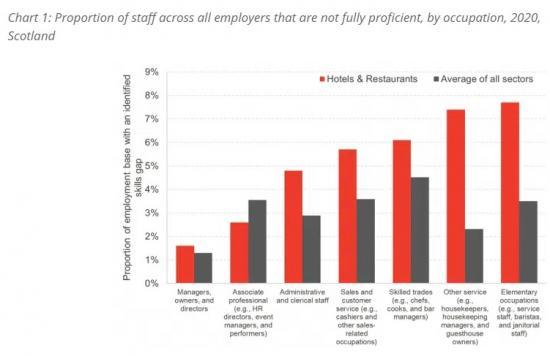
Chart 1 shows a breakdown of skills gaps across various occupations in hospitality relative to the rest of the economy.
Across all sectors, the skills gap in "elementary occupations" was 3.5% according to the Scottish Employer Skills Survey, a 2020 survey which interviewed around 3,500 employers. This means that, across all industries, businesses found that around 3.5% of workers in elementary occupations were missing one or more necessary skills.
In comparison, elementary occupations in the hospitality industry - which includes jobs like servers, bartenders, baristas and cleaners - had a skills gap of nearly 8%. Around half of all hospitality workers fall under the elementary occupations category, with an additional 30% falling under skilled trades (chefs, cooks and bar managers) and manager categories.
Read the full report HERE