Median Monthly Pay Increased 6.7% Compared To Last Year
12th September 2023
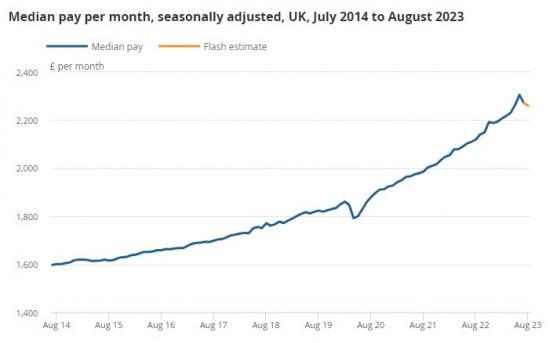
Early estimates for August 2023 indicate that median monthly pay was £2,260, an increase of 6.7% compared with the same period of the previous year.
Following a general trend of increasing pay growth between mid-2015 and mid-2018, pay growth tended to fluctuate around 3.6%, until 2020 when it became negative. This coincided with the coronavirus (COVID-19) pandemic and related economic and policy responses. From June 2020 median pay growth has been positive and is now above pre-coronavirus pandemic (February 2020) levels. The high level of pay growth in April 2021 is attributed to the relatively high median pay in April 2021, combined with the suppressed level of median pay in April 2020 at the start of the coronavirus pandemic.
Pay distribution
In the three months to July 2023, the 10th percentile of the monthly pay distribution was £751, the 90th percentile was £5,410 and the 99th percentile was £15,104 (Figure 5). This means that:
10% of payrolled employees earned equal to or less than £751 per month
90% of payrolled employees earned equal to or less than £5,410 per month
99% of payrolled employees earned equal to or less than £15,104 per month
London and Northern Ireland experienced higher growth than the UK average between January 2017 and early 2020, while the North East and Scotland experienced lower growth than the UK overall.
Over the course of the coronavirus (COVID-19) pandemic, all regions' growth rates followed a similar pattern. Growth rapidly declined and became negative in April 2020, but from the middle of 2021 began to recover. As regions have caught up with their pre-coronavirus level, these high growth rates have started to fall back to rates seen historically before the coronavirus pandemic.
Comparing August 2023 with the same period of the previous year for NUTS1 regions, changes in payrolled employees ranged from the highest being a 1.7% increase in London to the lowest being a 1.1% increase in Yorkshire and The Humber.
Examining NUTS3 regions, Camden and City of London experienced a decrease of 1.4% in payrolled employees in comparison with August 2022, and Coventry experienced an increase of 3.9% (Figure 7).
There is greater variation at LAU level, with growth rates varying between negative 6.8% and positive 4.7%.
Industry data
The industrial sectors in this bulletin are based on the UK Standard Industrial Classification (SIC) codes, as defined by the Office for National Statistics (ONS). These codes have been determined from both the most recent Inter-Departmental Business Register (IDBR) and data from Companies House for each Pay As You Earn (PAYE) enterprise. The findings from the 14 largest sectors are presented. The seven smaller sectors have been removed from the bulletin for presentational purposes, but their estimates are available in our accompanying datasets.
The three largest sectors - Wholesale and retail; repair of motor vehicles, health and social work, and education - account for around 40% of UK employees. These three sectors combined with administrative and support services; manufacturing; professional, scientific and technical; and accommodation and food service activities account for more than 70% of UK employees.
Since January 2017, employee growth has not been even across sectors (Figure 9). Sectors such as construction, transportation and storage, and information and communication experienced higher growth than the UK average between January 2017 and early 2020. Sectors such as manufacturing, and Wholesale and retail; repair of motor vehicles experienced lower growth than the UK overall.
All sectors highlighted experienced a decrease in employee growth around April 2020, with the smallest decrease being in health and social work.
Public administration and defence, and health and social work saw early recoveries in their growth rates, as did administrative and support services, and education from early 2021 onwards.
When comparing early estimates for August 2023 with the same period of the previous year, percentage changes in payrolled employees ranged from negative 0.8% in accommodation and food service activities to positive 5.0% in finance and insurance.
Read the full ONS report HERE