UK Unemployment Nudges Up To 4.3% - Half Percent Higher
12th September 2023
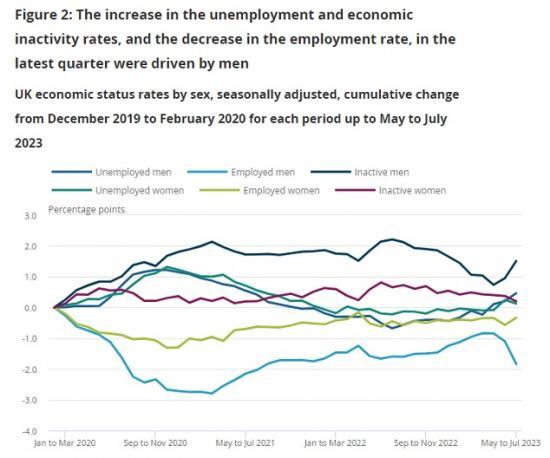
May to July 2023 estimates show a decrease in the employment rate compared with the previous quarter (February to April 2023) while the unemployment and economic inactivity rates increased.
The UK employment rate was estimated at 75.5%, 0.5 percentage points lower than the previous quarter and 1.1 percentage points lower than before the pandemic (December 2019 to February 2020).
The UK unemployment rate was estimated at 4.3%, 0.5 percentage points higher than the previous quarter and 0.3 percentage points higher than before the coronavirus (COVID-19) pandemic.
Employment
Following an increase in the employment rate since early 2012, the rate decreased from the start of the coronavirus (COVID-19) pandemic. There has largely been an increase since the end of 2020; however in the latest quarter, the employment rate decreased and remains below pre-pandemic levels.
The number of full-time employees decreased during the latest quarter but is still above pre-pandemic levels. Part-time employees had generally been decreasing since the beginning of 2022; however they saw an increase during the latest quarter. The number of self-employed workers fell in the first year of the COVID-19 pandemic, and both full-time and part-time self-employed workers decreased in the latest quarter.
The UK economic inactivity rate was estimated at 21.1%, 0.1 percentage points higher than the previous quarter and 0.9 percentage points higher than before the coronavirus pandemic.
Total hours worked decreased compared with the previous quarter and are below pre-coronavirus-pandemic levels again.
The number of people in employment with second jobs fell in the early stages of the pandemic but steadily increased thereafter. In the latest quarter however, the number fell to 1.2 million (3.7% of people in employment).
Hours worked
Total actual weekly hours worked in the UK have been generally increasing since the relaxation of COVID-19 lockdown measures; however this was followed by a slight decrease since April to June 2022. In the latest quarter, total actual weekly hours worked decreased by 18.5 million hours to 1.04 billion hours in May to July 2023 (Figure 4). This is 12.2 million hours below pre-COVID-19 pandemic levels (December 2019 to February 2020).
The decrease in the latest quarter was largely driven by men. The total weekly hours worked by women also decreased on the latest quarter, but is still above pre-pandemic levels. The total actual weekly hours worked by men remains below pre-pandemic levels.
After falling sharply in the early stages of the pandemic, average actual weekly hours worked exceeded pre-COVID-19 pandemic levels in recent periods, however it decreased in the latest quarter and is now below pre-pandemic levels. The actual weekly hours worked in May to July 2023 have been affected by the additional bank holiday in May 2023. Average actual weekly hours worked have also been affected recently by the additional bank holidays in the summer and autumn of 2022, and by strikes in recent periods.
Read the full ONS report HERE