Vacancies And Jobs In The UK - September 2023
12th September 2023
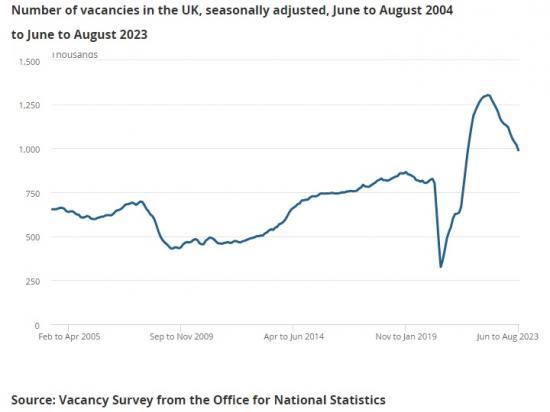
The number of vacancies in June to August 2023 was 989,000, a decrease of 64,000 from March to May 2023.
Vacancy numbers fell on the quarter for the 14th consecutive period in June to August 2023, down by 6.0% from March to May 2023 with vacancies falling in 13 of the 18 industry sectors.
In June to August 2023, total vacancies were down by 268,000 from the level of a year ago, although they remained 188,000 above their pre-coronavirus (COVID-19) January to March 2020 levels.
In June 2023, workforce jobs fell by 153,000 on the quarter to 36.7 million, with self-employment jobs showing a record quarterly fall.
Vacancies for June to August 2023
In June to August 2023, the estimated number of vacancies fell by 64,000 to 989,000, the 14th consecutive period to show a fall on the quarter since May to July 2022 and the first time vacancies have been under 1 million since May to July 2021.
The total number of vacancies fell by 6.0% from the previous quarter, with administrative and support service activities, and professional, scientific and technical activities contracting the most, falling by 15.7% and 12.1%, respectively. The largest growth was in mining and quarrying at 5.9%.
June to August 2023 continued the sequence of quarterly falls that began in May to July 2022, with vacancies falling by 64,000 from the previous quarter. The industry sector showing the largest fall in vacancy numbers was professional, scientific and technical activities, down by 13,000.
When comparing June to August 2023 with the same time last year, total vacancies fell by 268,000 (21.3%) with falls in 16 of the 18 industry sectors. The industry with the largest fall was accommodation and food service activities, where the number of vacancies fell by 48,000.
The total number of vacancies remains 188,000 above January to March 2020 pre-coronavirus (COVID-19) levels, with human health and social work activities showing the largest increase of 45,000. Only real estate activities are currently below pre-coronavirus (COVID-19) levels.
In May to July 2023, the number of unemployed people per vacancy was at 1.4, up from 1.2 in February to April 2023. Although this ratio remains low by historical standards it does show a slight loosening of the labour market as the number of vacancies fell against an increase in unemployment.
In June 2023, UK workforce jobs fell to 36.7 million. This is a fall of 153,000 since March 2023, with a record quarterly fall of 197,000 in self-employment jobs having the largest contribution. Employee jobs offset this slightly, increasing by 68,000 on the quarter, but a further fall of 25,000 across government-supported trainees and HM Forces resulted in total workforce jobs falling for the first time since December 2020. Despite the quarterly fall, workforce jobs remain 995,000 above their December 2019 pre-coronavirus (COVID-19) position.
The total number of jobs includes both employee jobs and self-employment jobs. The former has risen every quarter since September 2020 resulting in a record high of 32.4 million and is 1.6 million above its December 2019 pre-coronavirus level. This level of growth has not been repeated in self-employment jobs, which remain 651,000 below December 2019 levels. The growth in the employee jobs component of workforce jobs up to June 2023 is also reflected in the number of employees on payroll reported in the Earnings and employment from Pay As You Earn Real Time Information, seasonally adjusted dataset, which has also increased over the same time period.
Read the full ONS report HERE