Gender pay gap in the UK - 2023
5th November 2023
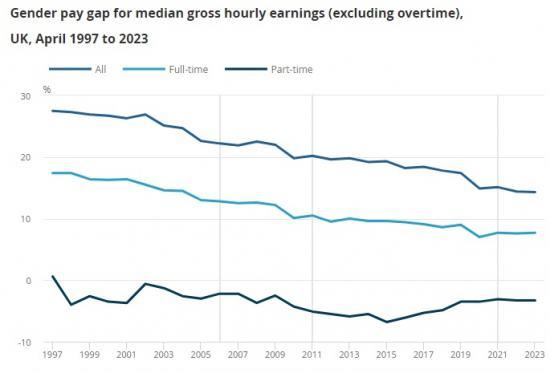
The gender pay gap has been declining slowly over time; over the last decade it has fallen by approximately a quarter among full-time employees, and in April 2023 it stands at 7.7%.
There remains a large difference in the gender pay gap between employees aged 40 years and over and those aged under 40 years.
Compared with lower-paid employees, the gender pay gap among higher earners is much larger, however this difference has decreased in recent years.
The gender pay gap has decreased across all major occupational groups between 2022 and 2023.
The gender pay gap in skilled trades occupations remains the largest of the major occupational groups, however, it has also decreased by the largest amount over the past years.
The gender pay gap among full-time employees is higher in every English region than in Wales, Scotland or Northern Ireland.
The gender pay gap measures the difference between average hourly earnings (excluding overtime) of men and women as a proportion of men's average hourly earnings (excluding overtime). It is a measure across all jobs in the UK, not of the difference in pay between men and women for doing the same job.
Figure 1: The gender pay gap has been declining slowly over time, falling by approximately a quarter over the last decade among full-time employees and all employees.
The gender pay gap has been declining slowly over time. Over the last decade it has fallen by approximately a quarter among both full-time employees and all employees.
In 2023, the gap among full-time employees increased to 7.7%, up from 7.6% in 2022. This is still below the gap of 9.0% before the coronavirus (COVID-19) pandemic in 2019. Among all employees, the gender pay gap decreased to 14.3% in 2023, from 14.4% in 2022, and is still below the levels seen in 2019 (17.4%).
The gender pay gap for part-time employees stayed consistent at negative 3.3%, however, over the long term the upward trend in the part-time gender pay gap seen since 2015 is continuing.
The gender pay gap is higher for all employees than it is for full-time employees or part-time employees. This is because women fill more part-time jobs, which in comparison with full-time jobs have lower hourly median pay. ASHE data shows that in 2023 approximately 86% of male employees were in full-time jobs, compared with approximately 61% of female employees.
Read the full report HERE