NHS Recovery In Scotland Is Lagging Behind England's - The Day Before The Scottish Budget
3rd December 2024
How is the NHS in Scotland performing, and what does this mean for the Scottish Budget?.
Healthcare is the Scottish Government's largest area of spending. The NHS Recovery, Health and Social Care budget is plannedto be £20.6 billion this year, around one-third of the total Scottish Government budget - and close to half of day-to-day spending on public services. Decisions about health spending are therefore crucial for the upcoming Scottish Budget, as they influence how much money is available for other public services and how much needs to be raised through devolved taxes.
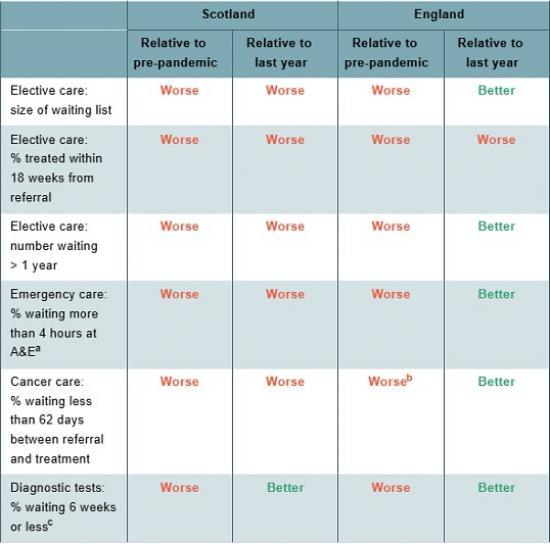
One of the key priorities of the Scottish Government is ‘ensuring high quality and sustainable public services'. In this comment, as part of our wider work in advance of the 2025-26 Scottish Budget, I update our analysis of Scottish NHS performance from earlier this year. I first show that hospital activity remains substantially below pre-pandemic levels. I then show that various measures of waiting time performance have worsened over the last year.
Throughout, I compare NHS performance in Scotland with performance in England. Scotland has long spent more publicly on healthcare per person than England, though this gap has closed substantially over the last two decades. Health services in both Scotland and England were similarly affected by the COVID-19 pandemic, and so England is an important benchmark against which to assess the performance and recovery of the Scottish NHS.
NHS activity
Let us first examine how NHS activity (i.e. the number of patients receiving treatment) has changed over time in Scotland. Figure 1 shows how various measures of NHS activity have changed relative to the final quarter of 2019 (the last full quarter unaffected by the COVID-19 pandemic). Panel A shows four important types of hospital activity: day cases (procedures delivered within a day), elective inpatients (pre-planned procedures delivered with an overnight stay), emergency inpatients (emergency patients admitted to hospital) and outpatient appointments (treatment or assessment in a clinic that only takes a short time to complete). Panel B repeats this analysis for two experimental measures of primary care activity: direct contacts (direct contact between clinical staff and patients, such as in-person and telephone appointments) and indirect contacts (including prescription management, interactions with hospitals, test results and administration).
Conclusion
Performance in the Scottish NHS remains below pre-pandemic levels across many measures. Even more concerningly, many measures of performance have continued to worsen over the last year. In large part, that is because most NHS hospital activity remains far below pre-pandemic levels, far from the ambitious targets in the Scottish Government's 2021 NHS Recovery Plan. Since hospitals are overall treating fewer patients than pre-pandemic, with only slow improvement over the last year, it should come as little surprise that waiting times are not improving. Indeed, across most measures of waiting times, performance has worsened over the last year.
One reason for this failure to increase hospital activity above pre-pandemic levels is that average length of stay is much higher than pre-pandemic. This might reflect the increased complexity of the patients that hospitals have to treat, including the continued presence of patients with COVID-19 in hospitals. But the failure to increase hospital activity likely also reflects challenges in discharging patients. However, it is likely not explained by a shortage of staff - the NHS in Scotland has many more staff than pre-pandemic (though the increase in staff since the start of the pandemic in Scotland is smaller than that in England).
The pattern in the English NHS is different. In short, while performance in both countries is below pre-pandemic levels (and lower than governments and populations would like it to be), things are, if anything, still getting worse in Scotland, whereas they have started to improve in England. Many types of hospital activity in England are now higher than pre-pandemic, though still far from recovery targets, and most of the performance measures considered here have improved over the last year. In England, there has been a large focus from both the previous and the current government on improving NHS performance and productivity. Similar focus is needed in Scotland.
Looking ahead to the Scottish Budget, the key question is to what extent this poor NHS performance will force the Scottish Government to prioritise further increases in health spending relative to other services. Then, aside from any funding decision, there remains the ongoing challenge of ensuring that money is spent well, staff are deployed effectively, and productivity in the NHS is enhanced - all essential if waiting times are to be reduced.
Read the full IFS report HERE