Impact Of Reweighting On Labour Force Survey Key Indicators - December 2024
3rd December 2024
Indicative estimates of the Labour Force Survey (LFS) reweighting methodology on key indicators for the UK, up to and including April to June 2024.
The Labour Force Survey (LFS) has been reweighted from January to March 2019, to use more recent population estimates, increasing the UK population of those aged 16 to 64 years by 484,000 (1.1%) in April to June 2024.
The stronger growth in population estimates since mid-2022 has resulted in increased levels' estimates across most of the labour market series, although rates and averages have generally seen little change.
The changes in population have increased the seasonally adjusted estimates of the employment level by 402,000, the unemployment level by 30,000 and the economically inactive level by 60,000, for April to June 2024.
The employment rate is revised up 0.1 percentage points to 74.6% in April to June 2024, meanwhile, the unemployment rate is largely unchanged at 4.2% and the economic inactivity rate is down 0.1 percentage points to 22.1%.
The reweighted LFS employment data reduce the gap between LFS and payroll estimates of the number of employees. The new data also show that the overall employment level is now 313,000 above pre-coronavirus (COVID-19) pandemic levels, rather than at a similar level as current data do.
Looking at the countries of the UK, Scotland shows the biggest revisions owing to population change as we are using information from their 2022 Census; revisions to Northern Ireland are mainly because of the correction of an error in the weighting method used.
Indicative estimates of growth for both output per hour worked, and output per worker, were revised downwards by 0.6 percentage points for April to June 2024 compared with a year ago. Growth for output per hour worked was revised down from -0.3% to -0.9% and output per worker from 0.9% to 0.3%.
This article contains indicative estimates of the impact of the reweighting on the headline Labour Market and Productivity estimates for periods up to April to June 2024; reweighted estimates of the latest periods will be incorporated into our next Labour Market release on 17 December 2024 and the Productivity Flash estimate and Overview release on 18 February 2025.
An increased amount of volatility will remain in LFS estimates until the recent improvements that have been implemented fully feed through the survey; therefore, we continue to advise caution when interpreting changes in headline rates, and recommend using them as part of our suite of labour market indicators, alongside Workforce Jobs (WFJ), Claimant Count data and Pay As You Earn (PAYE) Real Time Information (RTI) estimates.
Background
The Labour Force Survey (LFS) is a household survey, which is the basis for producing estimates of employment, unemployment, and economic inactivity in the UK along with many other labour market statistics. Given that the LFS is a sample, its responses are weighted to estimates of the UK population to produce representative estimates of the labour market.
In February 2024, we reweighted the LFS to be consistent with population estimates published in November 2023, along with forward population projections based on the latest estimates at that time. Only periods from July to September 2022 onwards were reweighted, with earlier periods, back to 2011, modelled for headline measures by age and sex only.
Since then, new population estimates and projections have been released, based on updated assumptions incorporating higher levels of net migration, along with the results of Scotland's 2022 Census. The population estimates used do not consider the most recent estimates of migration published by the Office for National Statistics (ONS) in November 2024.
We have now reweighted the LFS using this more recent population information, updating the population weights used for periods from January to March 2019 onwards. The reweighted LFS estimates incorporate information on the size and composition of the UK population, based on 2022 mid-year estimates. For England, Wales and Northern Ireland, they are projected forward using scaling factors from 2021-based national population projections, published in January 2024. For Scotland, they are projected forward using scaling factors from 2020-based national population projections, published in January 2023. This reweighting also revises the weighting methodology used for periods from January to March 2020, to June to August 2022, to align them with the methodology used for later periods. We have also made slight changes to the age groups used in the weighting methodology for Northern Ireland and moved to using more up to date geographies.
Along with aligning weighting methodology, an error was found in the weighting code used for Northern Ireland, relating to the calculation and application of design weights. This error has been corrected as part of this reweighting. This has resulted in larger revisions to Northern Ireland estimates, from January to March 2020 onwards, that are mainly because of the correction. This correction has minimal impact on the UK series.
Population change
The revisions to populations and therefore the effect on estimates come under three distinct categories. These cover (1) June to August 2011 until December 2019 to February 2020, (2) January to March 2020 until June to August 2022, and (3) July to September 2022 onwards. This reflects the periods for which new population information is being incorporated as part of this new partial reweighting of the Labour Force Survey (LFS).
From June to August 2011 until December 2019 to February 2020, the only significant source of revision is Scotland's Census 2022. Previous population estimates have been realigned to be consistent with Census results, with historic estimates brought in line with this new benchmark. These revisions continue to affect later population numbers.
Revisions from January to March 2020 until June to August 2022 additionally reflect the replacement of previous populations. These are partially derived from Pay As You Earn (PAYE) Real Time Information (RTI) data and accompanying LFS methodology, with the latest population estimates. As a result of this change, we have also revised our weighting methodology for these periods to be consistent with the methods already in use for later periods.
The revisions from July to September 2022 onwards reflect the higher population growth assumptions in the National Population Projections bulletin, published in January 2024.
LFS data have been reweighted from January to March 2019 onwards. Therefore, this reweighting exercise creates a discontinuity between December 2018 to February 2019 and January to March 2019, where there will be a step change in LFS estimates. However, we have modelled the seasonally adjusted UK levels of employment, unemployment and economic inactivity by sex and age band back to June to August 2011. This is to ensure that headline rates and levels by sex and age band (datasets A02SA and A05SA) can be assessed without a discontinuity.
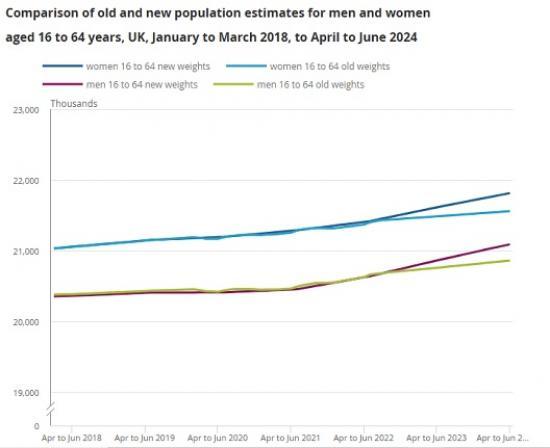
Figure 1 shows how this latest information records a higher increase in population for those aged 16 to 64 years, reflecting higher levels of net migration. This has increased the total UK population by 484,000 in April to June 2024, comprised of increases in the male population by 229,000, and the female population by 255,000.
The population estimates for those aged 35 to 49 years show very little revision prior to the 2022 mid-year estimates. Revisions since mid-2022 are driven by the higher net migration assumptions in the 2021-based National Population Projections.
Much more detail in the ONS report HERE