UK trade with the United States - 2023
22nd January 2025
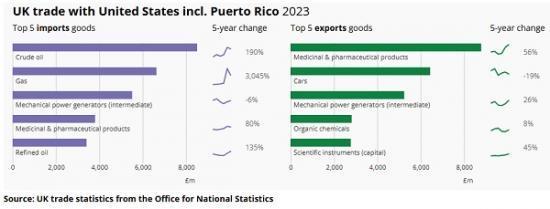
In 2023, the UK imported £57.9 billion of goods from the United States (10.0% of all goods imports) and exported £60.4 billion of goods (15.3% of all goods exports).
Machinery and transport equipment was the main commodity traded with the United States in 2023, with £19.9 billion of imports and £27.2 billion of exports.
In 2023, the UK imported £57.4 billion of services from the United States (19.5% of all services imports) and exported £126.3 billion of services (27.0% of all services exports).
Other business services was the main service type traded with the United States, with £29.7 billion imported and £56.9 billion exported.
Exports of business and management consulting and public relations services was the main service export to the United States, with £22.9 billion exported in 2023 accounting for over half (54.8%) of all UK exports of this service type.
In 2023, the United States was the UK's largest import and export partner for services and was the UK's largest export partner and second largest import partner for goods.
The potential of trade tariffs
President-elect Donald Trump has promised to increase the United States' tariffs on its international trade. The proposed tariffs would be a tax of between 10% and 20% on every product imported by the United States, as well as higher tariffs on imports from China, Canada and Mexico.
Tariffs are taxes charged on the import of goods from foreign countries. They are now mainly used to protect domestic industries from foreign competition by increasing the price of imported goods to persuade consumers to purchase domestic products instead.
Most tariffs are set as a percentage of the value of the goods in question and in general, the importer pays the tariff. Tariffs are collected by the national customs authority of the country into which the goods are being brought (so tariffs on goods entering the UK will be paid to HM Revenue and Customs). Exporters do not usually pay the tariff as such, rather, they experience adverse effects from their product being made more expensive on the foreign market. This could mean that exporters may have to cut their prices to remain competitive.
While tariffs on UK goods imported to the United States are not certain, in this article we present statistics on trade in goods and services with the United States for 2023, the last full year for which we have available data. We will continue to monitor trends in trade with the United States following the application of any tariffs and include any analysis in our monthly UK trade statistical bulletin.
UK trade in goods with United States
In 2023, the UK imported £57.9 billion of goods from the United States, which accounted for 10.0% of all goods imports, making the United States our second largest import partner, behind only Germany. There were £60.4 billion of goods exports to the United States, making it our largest export partner, accounting for 15.3% of all goods exports.
Goods imports
The UK imported £19.9 billion of machinery and transport equipment imports from the United States in 2023, comprising 9.2% of all imports of this commodity (Figure 1). Machinery and transport equipment includes various components, including mechanical machinery, engines, aircraft and cars. The largest commodities imported were £5.5 billion of mechanical power generators (intermediate) and £3.1 billion of aircraft (Table 1).
The UK imported £18.7 billion of fuels from the United States in 2023, comprising 23.5% of all imports of this commodity. This primarily included £8.5 billion of crude oil (unrefined petroleum which is then refined to produce useable products such as petrol or diesel), and £6.6 billion of natural gas.
There were £7.8 billion of chemical imports from the United States in 2023, accounting for 11.2% of all imports of this commodity. Imports of medicinal and pharmaceutical products made up approximately half (£3.8 billion) of the UK's imports of chemicals from the United States. This includes medicines such as vitamins, antibiotics and vaccines as well as products such as bandages, wadding and gauze for use in medical, surgical or dental settings.
Goods exports
Machinery and transport equipment was also the main goods export from the UK to the United States in 2023, with £27.2 billion of exports making up almost half (45.1%) of all goods exports to the United States. This included £6.4 billion of car exports, which accounted for 18.4% of all UK car exports. The United States were our largest export partner for cars, ahead of Germany and the Netherlands. Exports of mechanical power generators (intermediate) accounted for £5.2 billion of the machinery and transport equipment exports and includes products such as internal combustion engines, turbines and power generating machinery and their components.
Chemicals were the second largest commodity exported, with £14.2 billion of chemical exports to the United States in 2023 accounting for almost a quarter (23.6%) of the UK's total chemical exports. This primarily included £8.8 billion of medicinal and pharmaceutical products, while there were £2.8 billion of organic chemicals exported.
More detailed estimates on the UK's trade in goods with the United States can be found in our UK trade: country-by-commodity imports dataset and UK trade: country-by-commodity exports dataset.
UK trade in services with the United States
In 2023, the UK imported £57.4 billion of services from the United States and exported £126.3 billion. This accounted for 19.5% of all service imports and 27.0% of all service exports, making the United States our largest trading partner for both imports and exports of services.
Services imports
The main service type imported from the United States in 2023 was other business services, with imports of £29.7 billion making up over half (51.7%) of all service imports from the United States (Figure 2). Other business services covers a wide range of services relating to business such as research and development, professional and management consulting and technical and trade-related services. Imports of this service type consisted mainly of £9.2 billion of services between affiliated enterprises and £6.4 billion of intragroup fees and cost recharge (Table 2). Services between affiliated enterprises covers payments between branches or subsidiaries and their parent enterprise, which often represent contributions to the general management and overhead expenses of branches.
Travel was the next largest service import with £6.9 billion of travel services imports from the United States in 2023. This was primarily because of £5.4 billion of other personal travel, which includes the expenditure of UK residents who visit the United States for holidays, recreational and cultural activities through their purchases made while in the country.
Other notable service imports from the United States in 2023 were £5.9 billion of financial services and £5.8 billion of intellectual property services.
Services exports
Other business services was also the largest service export to the United States in 2023, with £56.9 billion of exports making up almost half (45.0%) of all service exports to the United States. Exports of other business services to the United States accounted for a third (32.6%) of the UK's total exports of this service type in 2023. Business and management consulting and public relations services made up much of these exports, with £22.9 billion exported in 2023, over half (54.8%) of all exports of this service type to the United States.
Financial services were the next largest service export, with £28.6 billion of exports accounting for almost a third (31.2%) of the UK's total financial services exports in 2023. These exports consisted primarily of £21.3 billion of explicitly charged and other financial services, which includes fees charged on financial products such as mortgages, investment management portfolios and credit card transactions.
Other notable service exports to the United States in 2023 were:
£11.1 billion of insurance and pension services
£8.7 billion of telecommunications, computer and information services
£7.3 billion of travel services
More detailed estimates on the UK's trade in services with the United States can be found in our UK trade in services: service type by partner country dataset.
Trade asymmetries with the United States
Trade asymmetries are the differences between the published trade statistics of a given country and its partner countries' equivalent "mirror flows". In the case of the trading relationship between the UK and the United States, there are asymmetries with both countries reporting a trade in goods and services surplus with each other.
We at the Office for National Statistics (ONS) report a surplus of £71.4 billion in trade in goods and services with the United States in 2023. The United States Bureau of Economic Analysis (BEA) report a surplus of $14.5 billion (approximately £11.6 billion when converted to British pounds using the 2023 average exchange rate from the Bank of England).
The presence of trade asymmetries does not mean that either country is inaccurate in their estimation. Differences can be caused by a range of conceptual and measurement variations between the estimation practices of different countries. The measurement of trade flows and relationships are complex. This means asymmetries are an inevitable consequence and can affect all data compilers.
For trade between the UK and United States, the differences are mainly in reported estimates of trade in services. Both countries adhere to the latest guidance on estimating international trade as set out in the International Monetary Fund (IMF) Balance of Payments and International Investment Position Manual, sixth edition (BPM6) (PDF, 3.0 MB). However, the implementation of the latest international guidelines progressed at different speeds in the two countries leading to some definitional and methodological differences that contribute to trade asymmetries when estimating trade in services.
Additionally, there are some different territorial definitions applied by the ONS and BEA when estimating trade flows. For example, the ONS does not include Crown Dependencies (Jersey, Guernsey and Isle of Man) in UK trade estimates, which is in line with the European System of Accounts - ESA 2010. However, the BEA does include Crown Dependencies within its UK trade statistics. Such differences in territorial definitions are likely to lead to trade asymmetries, as trade values will be allocated to different countries if they do not follow the same definitions.
We publish analysis on trade in services asymmetries in our Asymmetries in trade data articles. The BEA has published analysis on the United States asymmetries with the UK in their Understanding Asymmetries Between BEA's and Partner Countries' Trade Statistics article.
HM Revenue and Customs (HMRC) publishes more information on UK trade asymmetries for trade in goods statistics. HMRC have also evaluated trade in goods asymmetries with the United States in their Asymmetry analysis for trade in goods statistics between the UK and the USA, 2017 to 2022 article.
Read more details with graphs at ONS