Prime Minister sets out biggest sustained increase in defence spending since the Cold War, protecting British people in new era for national security
26th February 2025
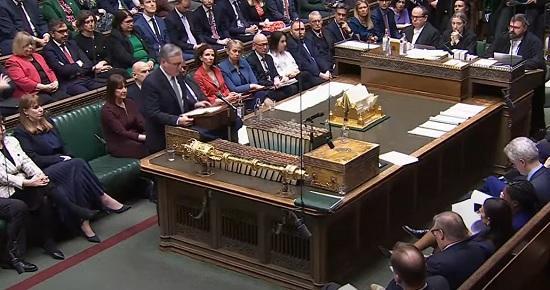
The Prime Minister has today (Tuesday 25 February) set out his commitment to increase spending on defence to 2.5% of GDP from April 2027.
Defence spending to increase to 2.5% of GDP from April 2027, with an ambition to reach 3% in the next parliament.
Reinvigorated approach to defence industry will drive economic growth and create jobs across the UK, while bolstering national security and protecting borders.
Commitment will see the biggest investment in defence spending since the Cold War as the UK enters era of intensifying geopolitical competition and conflict.
As the UK faces a period of profound change, with conflicts overseas undermining security and prosperity at home, the Prime Minister has today (Tuesday 25 February 2025) set out that his commitment to increase spending on defence to 2.5% of GDP from April 2027.
He has also set an ambition to spend 3% of GDP on defence in the next parliament, as economic and fiscal conditions allow, in order to keep the British people safe and secure for generations to come.
As set out in the Plan for Change, national security is the first duty of the government. In recent years, the world has been reshaped by global instability, including Russian aggression in Ukraine, increasing threats from malign actors, rapid technological change, and the accelerating impacts of climate change.
The Prime Minister has today set out how the UK will be stepping up to meet this generational challenge with a generational response.
The announcement comes the day after the third anniversary of Russia's barbaric illegal war in Ukraine and shows that the UK will step up and meet this pivotal moment of global instability head-on, with a commitment that will see the biggest sustained increase in defence spending since the Cold War.
The Prime Minister knows that the working people of Britain have paid the cost of malign actors abroad, whether through increased energy bills, or threats to British interests and values. He is committed to making the country safer, more secure, and increasingly resilient against these interconnected threats.
Today's announcement demonstrates the UK's global leadership in this space. In calls with foreign leaders over the weekend, the Prime Minister reiterated the UK’s commitment to securing a just and enduring peace in Ukraine and the need for Europe to step up for the good of collective European security.
The investment in defence will protect UK citizens from threats at home but will also create a secure and stable environment in which businesses can thrive, supporting the Government’s number one mission to deliver economic growth.
The increased spending will sustain our globally competitive industry, supporting highly skilled jobs and apprenticeships across the whole of the UK. In 2023-24, defence spending by the UK Government supported over 430,000 jobs across the UK, the equivalent to one in every 60.
68% of defence spending goes to businesses outside London and the South East, bolstering regional economies from Scotland to the North West.
Through the upcoming Defence Industrial Strategy, this substantial investment will drive R&D and innovation across the UK, including developing technologies such as AI, quantum and space capabilities.
Prime Minister Keir Starmer said, "It is my first duty as Prime Minister to keep our country safe. In an ever more dangerous world, increasing the resilience of our country so we can protect the British people, resist future shocks and bolster British interests, is vital.
In my Plan for Change, I pledged to improve the lives of people in every corner of the UK, by growing the economy. By spending more on defence, we will deliver the stability that underpins economic growth, and will unlock prosperity through new jobs, skills and opportunity across the country.
As we enter this new era for national security, Britain will once again lead the way.
In addition to our plan to reach 2.5%, the Prime Minister also announced that the definition of defence spending will be updated to recognise what our security and intelligence agencies do to boost our security, as well as our military. This change means that the UK will now spend 2.6% of GDP on defence in 2027.
This shift recognises that the activities of our intelligence increasingly overlap and complement that of our Armed Forces, emphasising the need for total deterrence against the modern hybrid threats we face, from cyber-attacks to sabotage.
The increase in defence spending will be funded by reducing Overseas Development Assistance (ODA) from 0.5% to 0.3% of GNI and reinvesting it into defence.
This difficult choice reflects the evolving nature of the threat and the strategic shift required to meet it whilst maintaining economic stability, a core foundation of the Plan for Change. Meeting the fiscal rules is non-negotiable, and the government will take the tough but necessary decisions to ensure they are met.
The UK remains fully committed to making the world a safer and more prosperous place. In the current geopolitical environment, the Prime Minister is clear that the best way to do that is by deterring and preventing conflict and targeting our aid more effectively. For example, we have delivered an increase of £113m in humanitarian funding for people in Sudan and those who have fled to neighbouring countries, which will help to reduce migration flows to the UK and help address one of the major humanitarian crises of our era.
The government remains committed to reverting spending on overseas aid to 0.7% of Gross National Income, when the fiscal conditions allow.
This comes alongside an ongoing review into ODA spend which will ensure that every pound of development assistance is spent in the most impactful way.
This increase in defence investment will help us build a modern and resilient Armed Forces. It will accelerate the adoption of cutting-edge capabilities that are vital to retain a decisive edge as threats rapidly evolve. Targeted investment will reverse the hollowing out of recent decades and rebuild stockpiles, munitions, and enablers depleted after a period focused on international terrorism and global crises.
This modernisation will be supported through improved productivity, efficiency, and financial discipline across defence.
The Prime Minister has also committed to publishing a single new national security strategy, bringing together all reviews into one document and reflecting the decisions on resource set out today. This will be published following the Spring Statement next month and ahead of the NATO Summit in June.
The new commitment on spending comes ahead of Prime Minister’s visit to Washington DC this week, where he will tell President Trump that he wants to see the UK-USA bilateral relationship strengthened and deepened even further, to secure the prosperity and security of both nations for decades to come.
The government has already significantly increased investment in its national security capabilities, increasing spending on defence by nearly £3 billion in this year alone at the Budget. In addition to growing the defence budget, spending on the Single Intelligence Account was increased by around £340 million between 2023-24 and 2025-26, ensuring that our world-leading intelligence agencies maintain their cutting-edge capabilities.
Defence spending benefits every nation and region of the country - 68% of defence spend with UK businesses goes outside of London and the South East. In 2023-2024, the MOD spent the following across the UK:
£7.1bn in the South East
£6.9bn in the South West
£3.8bn in the North West
£2.1bn in Scotland
£2.1bn in London
£1.6bn in the West Midlands
£1.5bn in the East of England
£1.4bn in the East Midlands
£910m in Wales
£630m in Yorkshire and the Humber
£380m in the North East
£240m in Northern Ireland
This spending supported a breadth of industry specialisms across the country. Early work on the Defence Industrial Strategy suggests that the following UK sub-sectors have the highest growth potential: AI, autonomous systems, combat air, cyber, missiles, nuclear submarines, quantum, shipbuilding design and space.
Full Statement by Prime Minister
Mr. Speaker, three years since Russia launched its vile assault on Ukraine, I would like to address the international situation and the implications for Britain’s national security.
Mr. Speaker, in my first week as Prime Minister, I travelled to the NATO summit in Washington with a simple message.
That NATO and our allies could trust this Government would fulfil Britain and indeed the Labour Party’s historic role to put our collective security first.
I spoke of my great pride, Mr Speaker, to lead the party that was a founding member of NATO, the inheritor of the legacy of Clement Attlee and Ernest Bevin - who not only stood behind Winston Churchill in wartime but ‘won the peace’ by establishing the great post-war order here and abroad.
Mr. Speaker, it is a proud legacy but in a world like ours it is also a heavy one. Because the historical load we must carry to fulfil our duty is not as light as it once was.
We must bend our backs across this House because these times demand a united Britain, and we must deploy all of our resources to achieve security.
Mr. Speaker, as a young man, I vividly remember the Berlin Wall coming down. It felt as if we were casting off the shackles of history, continent united by freedom and democracy. If you had told me then, that in my lifetime we would see Russian tanks rolling into European cities again I would not have believed you.
Yet here we are, in a world where everything has changed. Because three years ago that is exactly what happened.
Britain can be proud of our response. British families opened their doors to fleeing Ukrainian citizens, the ‘yellow and light blue’ fluttering on town halls and churches, the length and breadth of this country.
And the party opposite, in Government was robust in our response. I supported that in opposition; I applaud them for it now.
And we have built on that, bringing our support for Ukraine to a record level this year.
Mr. Speaker, we should not pretend that any of this has been easy.
Working people have already felt the cost of Russian actions through rising prices and bills.
Nonetheless, one of the great lessons of our history is that instability in Europe will always wash up on our shores, and that tyrants like Putin only respond to strength.
Russia is a menace in our waters, in our airspace and on our streets. They have launched cyber-attacks on our NHS - only seven years ago, a chemical weapons attack on the streets of Salisbury.
We must stand by Ukraine – because if we do not achieve a lasting peace, then the economic instability, the threats to our security, they will only grow.
And so, as the nature of that conflict changes, as it has in recent weeks, it brings our response into sharper focus.
A new era that we must meet, as we have so often in the past, together – and with strength.
Mr. Speaker, the fundamentals of British strategy are unchanged.
I know that the current moment is volatile, but there is still no good reason why they cannot endure.
So let me spell out to the House exactly how we will renew them for these times.
First, NATO is the bedrock of our security – and will remain so.
It has brought peace for 75 years. It is as important today as the day on which it was founded.
Putin thought he would weaken NATO; he has achieved the exact opposite.
And it remains the organisation which receives the vast bulk of our defence effort, in every domain, and that must continue.
Second, we must reject any false choice between our allies, between one side of the Atlantic or the other. That is against our history – country and party – because it is against our fundamental national interest.
The US is our most important bilateral alliance. It straddles everything from nuclear technology, to NATO, to Five Eyes, AUKUS and beyond.
It has survived countless external challenges in the past. We’ve fought wars together; we’re the closest partners in trade, growth and security.
So this week when I meet President Trump I will be clear. I want this relationship to go from strength to strength.
But Mr. Speaker, strength in this world also depends on a new alliance with Europe.
As I said in Paris last week, our commitment to European defence and security is unwavering. But now is the time to deepen it.
So we will find new ways to work together on our collective interests and threats, protecting our borders, bringing our companies together, seeking out new opportunities for growth.
Third, Mr Speaker, we seek peace not conflict, and we believe in the power of diplomacy to deliver that end.
That, of course, is most pressing in Ukraine. Nobody in this House or this country wants the bloodshed to continue – nobody.
And Mr. Speaker, I have seen the devastation in Ukraine first-hand.
What you see in places like Bucha – that never leaves you.
But for peace to endure in Ukraine and beyond, we need deterrence.
I know that this House will endorse the principle of winning peace through strength.
So we will continue to stand behind the people of Ukraine. We must ensure they negotiate their future and we will continue to put them in the strongest position for a lasting peace.
Fourth, Mr. Speaker, we must change our national security posture.
Because a generational challenge requires a generational response.
That will demand some extremely difficult and painful choices.
And through those choices, as hard as they are, we must also seek unity.
A whole society effort that will reach into the lives, the industries and the homes of the British people.
I started this statement by recalling the era of Attlee and Bevin, and, of course, this year we will mark many anniversaries of that greatest generation.
We must find courage in our history. Courage in who we are as a nation because courage is what our own era now demands of us.
So, starting today, I can announce this Government will begin the biggest sustained increase in defence spending since the end of the Cold War.
We will deliver our commitment to spend 2.5% of GDP on defence but we will bring it forward so that we reach that level in 2027.
And we will maintain that for the rest of this Parliament.
Let me spell that out, Mr Speaker. That means spending £13.4 billion more on defence every year from 2027.
But Mr. Speaker, we also face enemies that are sophisticated in cyber-attacks, sabotage, even assassination.
And so our intelligence and security services are an increasingly vital part of protecting both us and our allies.
So on top of the funding of 2.5% that I have just announced, going forward, we will recognise the incredible contribution of our intelligence and security services to the defence of the nation, which means, taken together, we will be spending 2.6% on defence by 2027.
But Mr. Speaker, we must go further still.
I have long argued that in the face of ongoing, generational challenges, all European allies must step up and do more for our own defence.
So, subject to economic and fiscal conditions, and aligned with our strategic and operational needs, we will also set a clear ambition for Defence spending to rise to 3% of GDP in the next Parliament.
Mr Speaker, I want to be very clear, the nature of warfare has changed – significantly. That is clear from the battlefield in Ukraine, and so we must modernise and reform our capabilities as we invest.
I equally want to be very clear that like any other investment we make we must seek value for money.
And that’s why we’re putting in place a new Defence Reform and Efficiency Plan, jointly led by my Right Honourable Friends the Chancellor and the Defence Secretary.
This investment means that the UK will strengthen its position, as a leader in NATO and in the collective defence of our continent, and we should welcome that role.
It is good for our national security. It is also good for the defining mission of this government to restore growth to our economy. And we should be optimistic of what it can deliver in those terms.
But Mr. Speaker, in the short-term, it can only be funded through hard choices.
And in this case, that means we will cut our spending on development assistance, moving from 0.5% of GNI today to 0.3% in 2027 fully funding our increased investment in Defence.
I want to be clear to the House, that is not an announcement I am happy to make.
I am proud of our pioneering record on overseas development, and we will continue to play a key humanitarian role in Sudan, in Ukraine and in Gaza, tackling climate change, supporting multinational efforts on global health and challenges like vaccination.
In recent years the development budget was redirected towards asylum backlogs, paying for hotels. So, as we are clearing that backlog at a record pace there are efficiencies that will reduce the need to cut spending on our overseas programmes.
But nonetheless, it remains a cut – and I will not pretend otherwise.
We will do everything we can to return to a world where that is not the case and rebuild our capacity on development.
But at times like this, the defence and security of the British people must always come first. That is the number one priority of this Government.
But Mr. Speaker, it is not just about spending. Our whole approach to national security must now change.
We will have to ask British industry, British universities, British businesses, and the British people to play a bigger part; use this to renew the social contract of our nation, the rights and responsibilities that we owe one another.
The first test of our defence policy is, of course, whether it keeps our country safe. But the second should be whether it improves the conditions of the British people, does it help provide the economic security that working people need.
Because ultimately, as Attlee and Bevin knew, that is fundamental to national security as well.
We will use this investment as an opportunity.
We will translate defence spending into British growth, British jobs, British skills, British innovation; we will use the full powers of the Procurement Act to rebuild our industrial base.
And, Mr. Speaker, as the Strategic Defence Review is well underway and across Government we are conducting a number of other reviews relevant to national security, it is obvious that these reviews must pull together.
So before the NATO summit in June, we will publish a single National Security Strategy and we will bring it to this House.
Because Mr. Speaker, as I said earlier, that is how we must meet the threats of our age – together and with strength.
A new approach to defence. A revival of our industrial base. A deepening of our alliances.
The instruments of our national power brought together, creating opportunity, assuring our allies, delivering security for our country.
Mr. Speaker, at moments like these in our past, Britain has stood up to be counted. It has come together, and it has demonstrated strength.
That is what the security of our country needs now, and it is what this Government will deliver.
And I commend this statement to the House.