STEP Fusion is 'amazing' for Greater Lincolnshire
18th August 2025
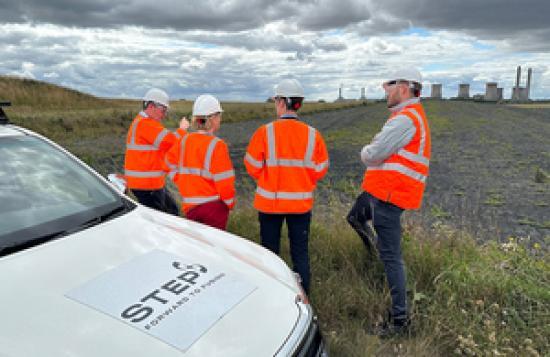
Mayor Dame Andrea Jenkyns visits West Burton to see first hand how the UK's world-leading fusion energy programme will deliver for local people.
Dame Andrea Jenkyns, Mayor of Greater Lincolnshire, visited the STEP Fusion site at West Burton on Thursday to see first-hand how the UK's world-leading fusion energy programme is set to deliver exciting new opportunities for Lincolnshire residents.
During her visit, Mayor Jenkyns observed the demolition of cooling towers at the neighbouring former coal-fired Cottam power station - one of the largest demolitions of its type in history. With a proud heritage of powering the UK from North Nottinghamshire, many former workers from both the Cottam and West Burton former power stations gathered to witness this historic moment. The demolition marks a significant milestone in the region's energy transformation, as the area bordering Lincolnshire along the River Trent becomes a global hub for fusion energy.
Following the demolition, Mayor Jenkyns toured the STEP Fusion site at West Burton and met with project leaders to discuss how the programme is set to create thousands of skilled jobs in construction and engineering over the next 15 years and beyond. Targeting first operations by 2040, the STEP programme is already boosting the development of local skills. Colleges and universities across the region are expanding fusion-relevant courses to ensure local people benefit from these new high-skilled jobs.
A 20-year skills partnership has already been agreed between the UK Atomic Energy Authority and the East Midlands Combined County Authority. This is helping to drive fusion skills and economic growth across both Lincolnshire and the wider East Midlands, alongside a £2.5 billion investment from central government into fusion energy over the next five years. As the prototype fusion energy plant develops, STEP Fusion will work with Mayor Jenkyns and other partners to help create local construction, engineering and fusion-related jobs - keeping West Burton at the heart of the community for decades to come.
Whilst on site at West Burton, Lincolnshire Mayor Dame Andrea Jenkyns said:
At STEP Fusion in West Burton, I've seen what's possible and it's very exciting. The impact across Greater Lincolnshire on skills to service the fusion industry and the industries that come off this, the job creation and growth, is amazing.
I want to make sure that we get a good part of this, and that Greater Lincolnshire can thrive for generations to come.
STEP Fusion's Programme Director, Dr. James Cowan commented:
Mayor Andrea's visit today underlines just how important regional collaboration is to making STEP Fusion a success.
Greater Lincolnshire has the skills, ambition, and drive to play a key role in this national project. The Mayor's support helps us ensure that the opportunities created here at West Burton, from high-value jobs to new supply chains, will not only regenerate the area but also continue the site's proud legacy in energy generation, securing skilled employment and economic growth for decades to come.
Notes to Editors
The first of its kind, STEP is the UK's major technology and infrastructure programme to build a prototype fusion power plant that will demonstrate net energy, fuel self-sufficiency and a viable route to plant maintenance. This will pave the way for the potential development of a fleet of future fusion power plants around the world and the commercialisation of fusion energy.
We'll achieve this by producing a prototype tokamak power plant - in an innovative spherical shape - that will demonstrate net energy. That's why the programme is called STEP: it stands for ‘Spherical Tokamak for Energy Production'.
But STEP is about more than tokamak technology - it’s a huge endeavour encompassing design, site development and construction, alongside supply chain logistics and industry. Fusion research and development has the potential to catalyse new ideas and technologies that will benefit multiple industries and help secure our future on this planet.
By fusing government and business, inspiration and pragmatism, theory and practice, UK-expertise and international impact, we’re going to realise the step-change that will secure humanity’s bright future. A recent report by AMION, commissioned by local authorities, set out the economic potential of the STEP programme.
UK government's fusion development programmes are currently making an impact—across jobs, innovation, collaboration, and regulatory leadership
Economic Growth & Job Creation
Strong return on investment: A 2009-2019 analysis shows that £346 million of public investment in UKAEA fusion research and infrastructure generated around £1.4 billion in economic benefit — approximately £4 in return per £1 invested, supporting an average of 4,000 jobs per year.
Recent job gains: More recent data (2009/10-2023/24) indicate a gross value-added impact of £1.8-£1.9 billion from fusion R&D, with 5,100 jobs annually supported on average, about 60% of which are in the UK supply chain
Skills, Training & Infrastructure Development
Fusion Futures Programme
Since October 2023, the government has committed £650 million to this flagship initiative—funding includes:
2,200+ training places to cultivate a skilled fusion workforce.
A Fuel Cycle Testing Facility, infrastructure enhancements at Culham, challenge funds for industry, international collaboration support, and more
Record R&D boost in 2025: A further £410 million was allocated to accelerate fusion development, covering skills training, engineering capacity, repurposing of the JET facility, and advancing the STEP programme.
Strategic Fusion Prototype: STEP Programme
STEP (Spherical Tokamak for Energy Production) is the UK’s ambitious prototype fusion power plant, aiming for net energy production by 2040 in Nottinghamshire, transforming a former coal site and anchoring a regional clean energy industrial cluster
The government is investing £2.5 billion over five years into STEP and associated industrial strategy, positioning fusion at the heart of its clean energy and industrial ambitions
Regulatory Leadership & Enabling Frameworks
Fusion-specific planning rules: In July 2025, the UK became the first country in the world to develop fusion-specific National Policy Statements, integrating fusion projects into the Nationally Significant Infrastructure Project regime. This move streamlines approvals, gives certainty to developers, and supports planning for regions such as Nottinghamshire and Oxfordshire
Regulatory differentiation
Fission and fusion are treated separately under UK regulation where fusion is viewed as lower hazard, simplifying its framework, reducing barriers, and encouraging international companies to set up in the UK
International Partnerships & Technology Leadership
UK-US fusion collaboration
As of November 2023, the UK formed a formal partnership with the U.S. Department of Energy. This enables shared R&D, access to facilities, harmonised regulations, and development of resilient supply chains—all aimed at making fusion commercially viable by 2040
Global recognition
The UK’s STEP framework is a template for fusion strategies elsewhere; Germany and Japan frequently cite the UK’s approach as influential
6. Broader Innovation Spillovers
Fusion projects have catalysed advancements beyond energy:
Technology transfer: Work in robotics, AI, advanced materials, diagnostics, hydrogen, and supercomputing has emerged from fusion research spillover.
Medical applications
Separately, Astral Systems (Bristol) has developed a tabletop fusion reactor to produce neutrons for medical radioisotopes—addressing global shortages. It's not yet energy-generating, but represents a practical fusion breakthrough in healthcare.
The UK’s fusion development programmes are delivering tangible results—from job creation and skills training to regulatory innovation and international leadership. By backing STEP and fostering enabling infrastructure and policies, the UK is setting the stage for a clean-energy transformation. And while commercial fusion lies ahead, practical spin-offs—like healthcare applications and advanced technology systems—are already taking shape.
Read the AMIOM report
Pdf 12 Pages
Notes
The Joint European Torus (JET) has been the UK’s (and Europe’s) flagship fusion experiment for over four decades. Here’s a clear breakdown of what it is, what it achieved, and what’s happening to it now:
What JET Is
JET (Joint European Torus) was built at Culham, Oxfordshire, in the late 1970s-80s and began operation in 1983.
It’s the largest operational tokamak in the world (until ITER in France comes online).
Purpose: To test and prove the physics of magnetically confined fusion, specifically with the deuterium–tritium (D–T) fuel mix needed for real-world fusion power.
Operated by the UK Atomic Energy Authority (UKAEA), but funded and run in partnership with the EU fusion programme (EURATOM) until Brexit (after which the UK continued through association agreements).
Key Achievements
World Record Energy Output (2021/2022): JET produced 59 megajoules of energy over 5 seconds, the highest sustained energy ever from a fusion reaction—demonstrating that sustained D–T fusion is technically possible.
Plasma Control & Materials Research: Tested different wall linings, including beryllium and tungsten, to simulate ITER’s conditions.
Training Ground: JET trained generations of fusion scientists and engineers who now work on ITER, STEP, and private fusion ventures.
Proof of Concept: Provided essential physics data that informs ITER (France) and the UK’s STEP prototype power plant.
How It Is Being Changed / Repurposed
JET officially ended scientific operations in December 2023 after 40 years of experiments. Instead of being dismantled immediately, the UK government is repurposing the site and equipment:
Repurposing the Facility
JET is being transformed into a fusion technology testbed, rather than shut down completely.
It will support UKAEA’s Fusion Fuel Cycle Facility, testing how to breed, handle, and recycle tritium fuel—vital for commercial plants.
Training & Skills Hub
The site is being used for training engineers and scientists in fusion operations, robotics, and remote handling (skills needed for ITER and STEP).
Decommissioning & Knowledge Transfer
Some components (e.g., plasma-facing materials, diagnostics) are being studied as part of the world’s first fusion decommissioning programme.
This provides valuable know-how in dismantling future fusion plants safely and economically.
Link to STEP Programme
Lessons from JET’s operation feed directly into STEP, the UK’s planned prototype fusion power station at West Burton (target: ~2040).
🔹 Why This Matters
JET is shifting from "fusion experiment" → "fusion enabler".
Its new role is about:
Testing technologies for real plants (fuel cycles, materials).
Training the next workforce.
Pioneering decommissioning to set global standards.
In short: JET proved fusion works. Now, as it winds down, it’s being turned into a springboard for the UK’s STEP programme and future commercial fusion plants worldwide.
PHOTO
Dame Andrea Jenkyns, Mayor of Greater Lincolnshire and Lee Sirdifield, Chief Executive of the Greater Lincolnshire Combined County Authority take a tour of the West Burton site.
Image credit: UK Industrial Fusion Solutions Ltd.