Hutton scientist wins prestigious prize for her work on barley roots - and what's happening to barley crops in 2025
21st August 2025
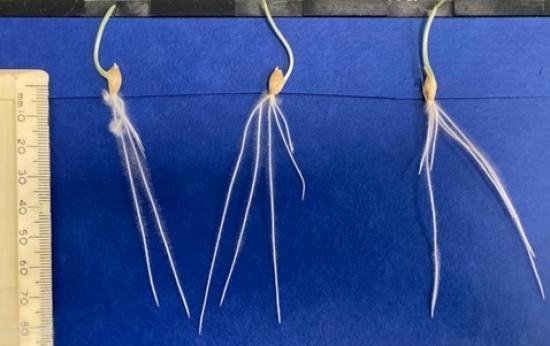
Dr Gwendolyn Kirschner, a researcher at The James Hutton Institute, has won a prestigious postdoctoral prize from the Scottish Universities Life Sciences Alliance (SULSA) for her work on the control of root angle in barley. She is studying gravity signalling that could help plants to access available resources, like water, via their roots.
SULSA has awarded four prizes to outstanding postdoctoral researchers whose work shows excellent potential to make an impact in the field of life sciences, to allow the recipients to raise their profile in Scotland.
The prize aims to support the next generation of life science leaders in Scotland and includes a fully funded tour of three Scottish universities where the awardee will deliver a seminar and meet staff, as well as flexible funding to be used for at their discretion for further career development.
Dr Kirschner said, "The SULSA postdoctoral prize will allow me to visit the universities of the Highlands and Islands, Edinburgh and Glasgow to present my research - an ideal opportunity to meet the plant research community, explore collaborations and learn more about the local resources in Scotland, for example local barley varieties."
The Hutton is a world leading research institute addressing the issue of global food security by finding scientific solutions for the sustainable management of land and natural resources and the demands for improved agricultural productivity and crop resilience in the face of climate change.
Dr Kirschner's research asks the question, how do plant stems and branches grow upwards, but roots grow downwards?
It is because plants are able to sense gravity and orient their growth in relation to it. Scientists already know how roots can sense and react to a gravitational stimulus, such as a rotation, but they don't yet know how roots maintain growth angles over a period of time, and how they maintain angles that are different from vertical.
The seminal roots of barley, the first roots that are established after germination, are an excellent model to study root angle, because all seminal roots have a similar age and similar developmental stage, but they grow at different angles.
Dr Kirschner's project compares the signalling pathways that take place in roots with different angles to understand if the angle set-point is regulated on the level of gene expression or proteins, and which key players regulate the angle.
The root angle is important because it determines plant root architecture within the soil and thereby the plant's access to water and nutrients. Roots with a very steep angle are positioned deep in the soil and reach deep-soil water and mobile nutrients such as nitrate, while roots with a more shallow angle cover space at the soil surface and can take up immobile nutrients such as phosphate.
To understand the influence of the root for crop performance, Dr Kirschner uses barley mutants with different root angles, to compare the influence of the root angle on water and nutrient uptake under different soil conditions. In the long term, this knowledge will help to produce crop varieties that are resilient to climate change and that can thrive in low input systems.
With a better understanding of root angle regulation, scientists can improve plant yields by modifying the root system architecture to increase access to water and nutrients in the soil and in response to adverse environmental conditions, such as drought.
Dr Kirschner's work is part of the research taking place at the Hutton's International Barley Hub, a centre of excellence linking industry-focussed research with innovation, to deliver immediate impact and ensure the long-term sustainability of the UK and international agriculture, brewing and distilling, food and non-food sectors.
Notes
SULSA was established in 2004 by the Scottish Funding Council and 6 Scottish universities to encourage researchers across Scottish higher education to pool resources and collaborate in order to increase international competition.
Now, as a strategic partnership of twelve universities and one research institution, SULSA acts as a gateway into the connected and vibrant life sciences research community in Scotland and supports equal access for career progression and collaborative research opportunities across its member institutions.
The James Hutton Institute is Scotland's pre-eminent interdisciplinary scientific research institute at the forefront of transformative science for the sustainable management of land, crop and nature resources that support thriving rural communities in Scotland and across the globe. It has just under 500 employees, 110 PhD students and has its main campuses in Invergowrie near Dundee. It takes its name from the 18th-century Scottish Enlightenment scientist, James Hutton, widely regarded as the founder of geology and agronomy. www.hutton.ac.uk
The International Barley Hub (IBH) is a centre of excellence linking industry-focussed research with innovation, to both deliver immediate impact and ensure the long-term sustainability of the UK and international agriculture, brewing and distilling, food and non-food sectors. The IBH is backed by a £35M investment as part of the Tay Cities deal. It is underpinned by the research excellence of the James Hutton Institute and University of Dundee as well as international partners and the full range of the barley sector industry to deliver step changes in UK and global barley production and use, resilience across the supply and value chains from primary grower to end user and its expansion into new areas such as non-food uses. The establishment of the IBH creates many opportunities, such as improving product quality, processability and competitiveness for companies using barley as a key ingredient in their products and expanding the variety and range of uses for this globally important crop, thereby protecting and adding to the considerable value it has within the global bioeconomy.
Barley Production in the Highlands—Overview
How much barley is grown?
Across all of Scotland in 2019, barley occupied approximately 290,900 hectares, making it the dominant cereal crop—around 62% of total cereal areas
Of this, spring barley accounted for about 134,744 ha (approximately 58% of all cereal land), while winter barley covered around 30,996 ha
In 2023, Scotland produced around 1.6 million tonnes of spring barley and 348 thousand tonnes of winter barley
Highland & Islands Region Contribution
According to the Scottish Crop Map 2019, the Highlands and Islands region—encompassing parts of the Highland Council area and associated island groups—accounted for approximately 25,847 hectares of arable crop production (excluding grassland), which is roughly 11% of Scotland's total cropping area.
While the data doesn't specify exact barley allocation in that region alone, spring and winter barley likely represent a significant part of that 25,847 ha, given barley's dominance among cereal crops.
Where in the Highlands is barley grown?
Black Isle (near Lemlair, as shown above): Known for fertile soils and visible barley cultivation.
Speyside: Estates like Ballindalloch farm around 400 acres (~162 ha) of spring barley specifically for local distilleries
Farmland bordering Moray Firth: Farms such as Corskie Farm cultivate large tracts—e.g., 722 ha of spring barley, alongside winter barley areas—well-suited for malting
Orkney, Shetland, Caithness, Western Isles: Home to the traditional six-row barley variety bere, grown on a much smaller scale—typically 5-15 hectares of land, prized for its heritage and adaptation to northern conditions.
Barley harvest under threat of reduced yields due to a hot and drier summer in 2025
the 2025 barley harvest in the UK is indeed under threat of reduced yields, largely due to an unusually hot, dry spring and summer that has stressed crops across critical development stages.
What's Driving Yield Concerns?
Historic Dryness and Heat
Spring 2025 was the warmest and driest in over 50 years—creating significant stress on crops early in the season.
June ranked as the second-hottest nationwide since record-keeping began in 1884, accompanied by below-average rainfall, especially in Northern, Eastern England, and parts of Scotland.
Wikipedia
Declining Crop Conditions
As of late May, crop condition ratings plummeted:
Winter and spring barley, along with winter wheat, saw sharp declines, with only 36% of winter wheat rated good/excellent (down from 60% a month earlier).
By 23 June, AHDB data showed:
Winter barley: 50% in good/excellent condition (versus 69% same time last year)
Spring barley: 52% in good/excellent condition (down from 71% in 2024)
Harvest Challenges & Variability
The harvest began earlier than any time since 2006. By early July, 10% of winter barley was already harvested—well above the 5-year average of 6%.
Early-combined fields reported thinner straw and quality issues due to heat stress in growth stages.
Yields have varied dramatically across regions:
Some farms are reporting up to 29% below the five-year average.
Others are seeing up to 19% above average yields.
On average, UK winter barley yields are near the five-year average at 6.7 t/ha, but with quality concerns, particularly elevated grain nitrogen levels, which can challenge malting standards.
A Harvest "On a Knife-Edge"
The Energy and Climate Intelligence Unit (ECIU) warns that, due to this extreme spring dryness, 2025 harvests could end up among the worst on record, depending heavily on upcoming rainfall:
If conditions persist, 2025 could rival—or even surpass—the worst UK harvest years.
Even moderate improvement would still likely land the harvest among the seven worst in modern history.
Energy & Climate Intelligence Unit
Farmers echo these concerns
"Crops... stressed and their yield potential now capped."
Energy & Climate Intelligence Unit
Are Yields Under Threat?
Absolutely yes. The evidence is clear:
Historical drought and heat in spring and early summer have significantly stressed barley crops.
Crop condition ratings for both winter and spring barley are notably below 2024 levels.
Harvested yields are lower in many areas, and quality issues like high nitrogen are emerging.
The national winter barley yield may appear stable on average, but large regional disparities and quality concerns persist.
Authorities and analysts caution that, depending on further weather and support, 2025 could be one of the poorest harvests in decades.
The 2025 UK barley harvest faces a tangible risk of reduced yields and quality issues, especially for malting barley. While some growers have fared well, many face significant setbacks due to prolonged drought, heat stress, and inconsistent rainfall.
Food Prices may be affected in 2026
2025 poor barley harvest will likely lead to food price increases in 2026. Based on current evidence, here's what we know—and what to expect:
Immediate Food Price Pressures Already in Play
UK food and beverage prices rose by 4.9% year-on-year in July 2025, with additional upward pressure from drought-impacted produce from southern Europe (like fruits and vegetables) and higher global commodity prices.
Think-tanks warn of long-term "climateflation," with food prices in the UK potentially rising 25-34% by 2050 due to increasingly extreme weather episodes affecting domestic and global food supply chains.
The Guardian
2. Global Supply Dynamics Could Cushion Grain Prices
Despite the UK's domestic challenges, global wheat stocks and production are expected to rise in the 2025/26 marketing year, especially in Russia, the EU, and North America. This abundance is likely to help restrain global grain price increases, which could mitigate pressure on UK food prices.
UkrAgroConsult
3. Input Costs for 2026 Crops Are Rising, Especially Fertiliser
For the 2026 harvest, the cost of production is forecast to climb, notably due to a 14% increase in fertiliser prices year-on-year. For instance:
Winter barley production is estimated at about £1,495 per hectare, while spring barley is around £1,268 per hectare.
AHDB
These elevated input costs could translate into increased farm gate prices—but their pass-through to consumer food prices remains uncertain.
4. Domestic Factors and Broader Food Supply
A UK-wide poor harvest reduces domestic supply, potentially raising reliance on imports and import prices.
Other sectors beyond cereals may also see supply constraints—e.g., limited pea harvests or high fertilizer costs—that could influence prices of processed foods.
Retailers and food producers might pass on added production or import costs to consumers, depending on margins and competition.