Nutritionist backs farmers' campaign to highlight the humble carrot
6th September 2025
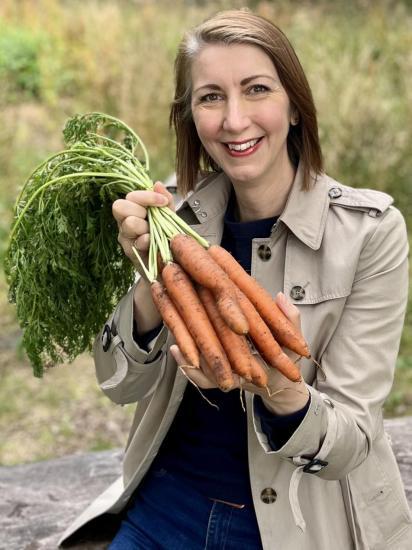
“CARROTS are one of our nation’s most versatile yet underappreciated foods,” says leading nutritionist Dr Laura Wyness.
Dr Wyness, who has 20 years’ experience as an author, podcast host and public speaker on nutrition and public health, heard through a colleague about a small group of farmers who have joined together to organise British Carrot Day 2025.
“I was very keen to support the farmers as I think when a food falls into the category of ‘common staple’ there is a very real risk of their nutritional value being forgotten about,” explained Dr Wyness, a Scot who wouldn’t make her overnight oats without the addition of some grated carrot.
“Going back to the basics of nutrition it’s so important to eat a rainbow - to get as many colours as possible on the plate - and this is where carrots come into their own. Yes, carrots are hugely nutritious in their own right but the colour they add, for example to my bland-looking porridge oats, is invaluable in making other healthy foods seem so much more appealing. It’s a brain thing and something we probably all know, subconsciously, through the way children are much more likely to eat bright colours, along with interesting shapes and textures.”
British Carrot Day 2025 takes place on Friday, October 3rd and plans are coming together for this national celebration of all-things carrot.
Members of the British Carrot Growers Association have dug deep into their own pockets to register and organise this autumn’s event and hope it will become an annual celebration to encourage people to buy, get creative, eat, and cook with carrots.
Eighth-generation carrot grower Rodger Hobson, who farms near York, is chairman of the association.
“We’re just a small group of farmers who want to tell our story,” he explains.
“Because they are relatively cheap to buy, people don’t realise how difficult they are to grow. They wilt if it’s too hot - so this year’s heatwaves have been a nightmare - and go mouldy when it’s too wet. We have to swaddle them in straw to protect them from frosts in winter and the slightest attack of carrot fly can wipe out a whole crop.
“They are terribly fussy and don’t like growing in the same soil; I leave my fields a whole ten years before replanting them with carrots.
“If Carrot Day can persuade people to buy the odd extra bag of carrots - maybe trying some of the recipes that people like Dr Laura have kindly put together to support us - then all the effort will have been worthwhile.
“Shoppers are always complaining about the food miles involved in our shelves being full of fruit and vegetables from far-flung countries. Our message is that if they want to secure British grown produce for themselves, their children and their grandchildren it’s important they start supporting it now.”
Rodger’s favourite way of eating carrots is as a side dish, glazed in honey, with his Sunday roast. He also enjoys eating them raw, cut into batons and dipped in hummus.
But back to nutritionist Dr Wyness, 47, who has worked as an expert on programmes such as BBC2’s The Food Detectives.
“The stand-out nutrient in carrots is beta-carotene and this gives them their bright colour,” she explains.
“Our bodies convert beta-carotene into retinol, which is the active form of Vitamin A that helps support vision, skin health and our immune system.
“Carrots also provide beneficial fibre; something 96 per cent of adults in the UK don’t eat enough of according to the National Diet and Nutrition Survey (NDNS). With a medium-sized carrot containing 2g of fibre they can really help push people up to the 30g recommended daily amount. Carrots make a satisfying snack when dipped into hummus or yoghurt as this provides a healthy combination of produce and protein foods.”
National Carrot Day aims to push people out of their carrot culinary comfort zones; to look at them as a more versatile vegetable than simply slicing up to placate hungry toddlers or boiling up and buttering. For more information, including recipe ideas, visit www.britishcarrots.co.uk
TOP TIPS TO GET MORE CARROTS INTO YOUR DIET:
Rather than simply slicing, take five minutes to watch some You Tube videos on different chopping techniques such as julienne, for restaurant chic matchstick-shaped lengths
Invest in a simple spiralizer. They can be bought for less than £15 and you will be able to try using with so many different vegetables in addition to carrots, such as courgettes
Don’t forget simply peeling and eating carrots raw as a snack
PAIRING PRODUCE & PROTEIN
Having a snack that combines produce (e.g. carrots) and protein foods (e.g. hummus, yoghurt dip or cottage cheese) provides a healthy balance of nutrients to satisfy hunger and stabilise blood sugar levels. Helping avoid a blood sugar rollercoaster and big energy slumps. It’s a better snack option than a biscuit.
Thursday 2 October 2025 will also see the annual BCGA demonstration day, which brings together carrot growers, industry professionals and retailers to network, knowledge-share and celebrate the best in carrot cultivation via variety trials, trade stands and competitions. This year, the event will be hosted by Tompsett Growers in Honingham, near Norwich and will be sponsored by Elsoms Seeds, BASF Numhems and Hazera.
Carrot facts and stats:
The carrot crop is Britain’s major root vegetable, producing over 700,000 tonnes of carrots each year from 9,000 hectares.
Each year 22 billion carrot seeds are sown in Britain, producing around 100 carrots per year for every member of the population.
The sales value of British carrots is around £290 million.
Freshly harvested carrots are washed, packed and distributed to nearly every shop in the whole of Britain almost every day of the year.
The UK is 97% self-sufficient in carrots – a great success story.
The crop is harvested all-year round.
Carrot farmers have had a tough time recently – the weather was awful from July 2023 through to May 2024, which meant carrot growers had to import some of their carrots because harvesting was so challenging. This led to a situation last Christmas where supermarkets were full of carrots from Israel, and they were being discounted down to 15p a bag.
Carrot farmers have become very adept at protecting carrots over the winter from frosts and snow, by covering them with straw.
Growing a carrot is a lot tricker than it looks. Once they have been harvested farmers like Rodger Hobson, chair of the British Carrot Growers, don't grow carrots again in the same field for a whole decade to protect the carrots from diseases and pests carried in the soil.
And, you've guessed, Beatrix Potter was right - rabbits are always trying to steal them! Rodger, who read Engineering at Oxford before returning home to the family farm near York, has even invented a special fencing machine to try and protect his carrots from burrowing bunnies.
Carrot history - It is thought that the carrot first came from Afghanistan sometime around the 7th Century AD, when they were originally purple!
Carrots were known to both the Greeks and Romans. In fact, the Greeks called the carrot “Philtron” and used it as a love medicine – making men more ardent and women more yielding. The orange carrot is thought to have dated back to the Dutch in the 16th Century.
Today’s carrots have 50% more carotene that those of 1970 – and the vitamin A in carrots are good for eye health (old wives’ tale is they help you see in the dark)
The British Carrot Growers' Association will hold their annual Carrot Demonstration Day on Thursday 2 October in Honingham, near Norwich. Carrot farmers will meet at the special open day to talk about all things carrot and look at new varieties and innovative ways of growing them.
The British Carrot Awareness Day will take place on Friday 3 October and will be a day to celebrate the love of British carrots and the growers.