Claude AI And Other AI Platforms Are Changing Employment Across Many Industries
16th September 2025
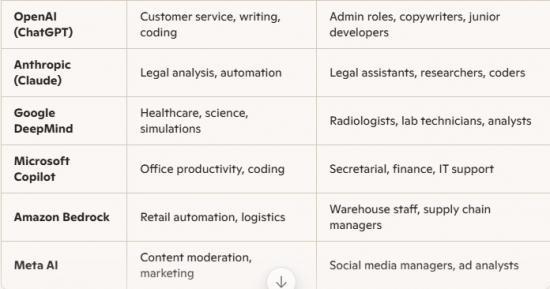
Several UK-based companies are actively using Anthropic’s Claude AI, and its deployment is already reshaping certain job categories—especially those involving repetitive, automatable tasks.
Claude’s London-based EMEA hub has also attracted dozens of startups and consultancies, especially in finance, law, and tech, where compliance and precision are critical.
Types of Jobs Most Affected
Anthropic’s own Economic Index reveals which job categories are seeing the most automation through Claude AI:
Most Automated Tasks
Software Engineering (37.2%) Tasks like debugging, network troubleshooting, and code generation are being directly handled by Claude.
Writing & Editing (10.3%) Roles in copywriting, journalism, and marketing are seeing Claude used for drafting, editing, and even creative ideation.
Research & Education Claude is used to generate teaching materials, summarize academic papers, and assist in curriculum design.
Legal & Compliance Document review, risk analysis, and contract summarization are increasingly automated in law firms.
Vulnerable Job Categories
While Claude is most active in high-skill domains, the ripple effects are being felt in:
Administrative roles: Scheduling, email drafting, and data entry are increasingly automated.
Customer service: AI chatbots powered by Claude are replacing tier-1 support agents.
Junior creative roles: Entry-level content creators and designers face competition from Claude’s generative capabilities.
In short, Claude is not just a productivity tool—it’s a disruptive force. While it augments human work in many cases, it also automates tasks outright, especially in roles where precision, repetition, and language are central.
The UK job market is being reshaped by a wave of AI platforms, each with its own disruptive potential.
How These Platforms Are Disrupting Jobs
1. Generative AI (ChatGPT, Claude, Copilot)
Automates writing, summarizing, and coding tasks.
Reduces demand for entry-level roles in marketing, law, and tech.
Used by UK firms to streamline operations and cut costs.
2. AI in Healthcare (DeepMind, IBM Watson)
Assists in diagnostics and patient triage.
May reduce reliance on junior clinical staff, but also improves efficiency.
3. Retail & Logistics AI (Amazon, Ocado Smart Platform)
Automates inventory, delivery routing, and customer interactions.
Threatens manual and mid-tier logistics roles.
4. AI in Finance (BloombergGPT, Kensho)
Used for market analysis, fraud detection, and compliance.
Impacts roles in financial research and back-office operations.
Who’s Most at Risk?
According to the Institute for Public Policy Research, up to 8 million UK jobs could be affected by AI adoption. The most vulnerable groups include:
Low-skilled and part-time workers
Young graduates in entry-level roles
Women in administrative and support positions
McKinsey also notes that job adverts have dropped most in occupations exposed to AI automation, even though productivity gains remain elusive.
The UK government has launched a 50-point AI Opportunities Action Plan and is investing in AI Growth Zones to balance innovation with job creation. But regulation is still light-touch, and many firms are moving faster than policy.
How the Public Is Experiencing AI Changes
Silent Adoption at Work
A third of UK workers admit they use AI tools like ChatGPT or Claude but don’t tell their managers.
Why the secrecy? Many fear that revealing their reliance on AI could make them seem replaceable or less competent.
Only 13% openly discuss AI use with their bosses, and nearly a quarter worry colleagues would question their ability if they knew how often they use it.
Anxiety About Job Security
Over 51% of UK adults fear AI could take or alter their jobs, with younger workers especially concerned.
This fear is driving a shift from the “great resignation” to the “great stay”—people are clinging to their current jobs amid rising redundancies and falling vacancies.
The number of job moves dropped from 1.1 million in late 2021 to just 709,000 in mid-2025.
Public Sector Already Feeling the Shift
More than half of UK public servants in finance, digital, and transformation roles are using generative AI daily, but 41.9% have encountered errors caused by these tools.
Despite this, over two-thirds believe AI has the potential to improve policy development and analysis.
Trust Gap and Uneven Support
Many workers report no formal guidance or support for AI use in their workplace.
The Ada Lovelace Institute warns of a growing “trust gap” between government enthusiasm and public unease.
The Trades Union Congress (TUC) is calling for worker involvement in AI deployment decisions, fearing that without safeguards, AI could worsen inequality and job quality.
In short, the public is already living through the AI transition—some quietly embracing it, others bracing for its consequences. The tension between innovation and insecurity is palpable.