Consumer price inflation, UK - August 2025 - 3.8% No Change From July
17th September 2025
The Consumer Prices Index including owner occupiers' housing costs (CPIH) rose by 4.1% in the 12 months to August 2025, down from 4.2% in the 12 months to July.
On a monthly basis, CPIH rose by 0.3% in August 2025, compared with a rise of 0.4% in August 2024.
The Consumer Prices Index (CPI) rose by 3.8% in the 12 months to August 2025, unchanged from July.
On a monthly basis, CPI rose by 0.3% in August 2025, the same rate as in August 2024.
Air fares made the largest downward contribution to the monthly change in both CPIH and CPI annual rates; restaurants and hotels, and motor fuels made large, partially offsetting, upward contributions.
Core CPIH (CPIH excluding energy, food, alcohol and tobacco) rose by 4.0% in the 12 months to August 2025, down from 4.2% in the 12 months to July; the CPIH goods annual rate rose slightly from 2.7% to 2.8%, while the CPIH services annual rate slowed from 5.2% to 4.9%.
Core CPI (CPI excluding energy, food, alcohol and tobacco) rose by 3.6% in the 12 months to August 2025, down from 3.8% in the 12 months to July; the CPI goods annual rate rose slightly from 2.7% to 2.8%, while the CPI services annual rate slowed from 5.0% to 4.7%.
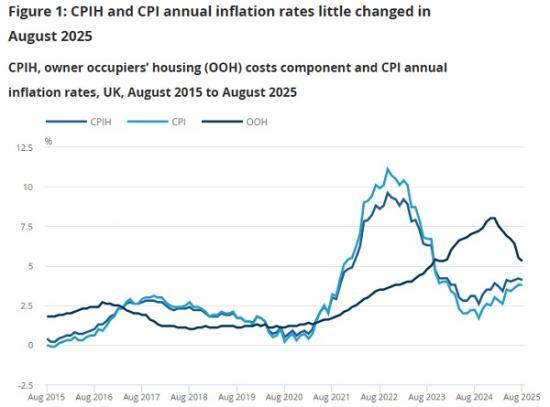
The Consumer Prices Index including owner occupiers' housing costs (CPIH) rose by 4.1% in the 12 months to August 2025, down from 4.2% in the 12 months to July (Figure 1).
On a monthly basis, CPIH rose by 0.3% in August 2025, compared with a rise of 0.4% in August 2024.
The owner occupiers' housing (OOH) costs component of CPIH rose by 5.3% in the 12 months to August 2025, down from 5.5% in the 12 months to July. The rate has slowed for seven consecutive months and is the lowest recorded since December 2023, when it was also 5.3%. It was last lower in September 2023, at 5.0%. OOH costs rose by 0.4% on the month, compared with a 0.6% increase a year earlier.
The Consumer Prices Index (CPI) rose by 3.8% in the 12 months to August 2025, unchanged from July. The August and July 2025 figures were the joint-highest recorded since January 2024, when the rate was 4.0%.
On a monthly basis, CPI rose by 0.3% in August 2025, the same rate as in August 2024.
The main drivers of the annual inflation rate for CPIH and CPI are the same where they are common to both measures. However, the OOH costs component accounts for approximately 17% of the CPIH and is the main driver for differences between the CPIH and CPI inflation rates. This makes CPIH our most comprehensive measure of inflation.
Transport
Prices in the transport division rose overall by 2.4% in the 12 months to August 2025, down from 3.2% in the 12 months to July (Figure 3). On a monthly basis, prices rose by 0.4% in August 2025, compared with a rise of 1.3% a year ago.
The slowing in the annual rate reflected downward effects from air fares and, to a lesser extent, vehicle maintenance and repair, partially offset by an upward effect from motor fuels.
Air fares rose by 2.1% between July and August 2025, compared with a rise of 22.2% between the same months in 2024. The smaller monthly rise in August 2025 resulted from a relatively high July index, which was probably influenced by the timing of the flights priced in relation to school summer holidays, particularly return flights from Europe. These return European flights were during the school term in July 2024, but during the school holidays in July 2025, potentially making them more expensive this year.
Prices for vehicle maintenance and repair fell this year but rose a year ago, particularly for roadside recovery services.
Within transport, these downward effects were partially offset by an upward contribution from motor fuels. The average price of petrol rose by 0.3 pence per litre between July and August 2025, compared with a fall of 2.1 pence per litre between July and August 2024. The average price stood at 134.2 pence per litre in August 2025, down from 142.3 pence per litre a year earlier.
Similarly, diesel prices rose by 0.8 pence per litre in August 2025, compared with a fall of 2.6 pence per litre in August 2024. The average price stood at 142.2 pence per litre in August 2025, down from 147.8 pence per litre a year earlier. These movements resulted in overall motor fuel prices falling by 4.9% in the 12 months to August 2025, compared with a larger fall of 6.7% in the 12 months to July.
Housing and household services
The 12-month inflation rate for housing and household services was 6.0% in August 2025, down from 6.2% in July. On a monthly basis, prices rose by 0.3% in August 2025, compared with a rise of 0.4% a year ago.
The easing in the 12-month rate between July and August 2025 mainly reflected a downward effect from owner occupiers' housing (OOH) costs, which rose by 5.3% in the 12 months to August 2025, compared with a rise of 5.5% in the 12 months to July 2025. The August figure was the lowest recorded since December 2023, when the rate was also 5.3%. It was last lower in September 2023, at 5.0%. On a monthly basis, OOH costs rose by 0.4% in August 2025 compared with a rise of 0.6% a year ago.
Restaurants and hotels
The overall easing in the inflation rate was partially offset by an upward effect from restaurants and hotels, where prices rose by 3.8% in the 12 months to August 2025, up from 3.4% in the 12 months to July. On a monthly basis, prices fell by 0.2% in August 2025, compared with a fall of 0.7% a year ago.
The largest upward effect came from accommodation services, specifically from overnight hotel stays priced the previous day, where prices fell this year by less than a year ago. There was also a smaller upward effect from canteens.
Food and non-alcoholic beverages
The 12-month inflation rate for food and non-alcoholic beverages was 5.1% in August 2025, up from 4.9% in July. This was the fifth consecutive increase in the annual rate and the highest recorded since January 2024, but it remains well below the peak seen in early 2023 (Figure 4). On a monthly basis, food and non-alcoholic beverages prices rose by 0.4% in August 2025, compared with a rise of 0.2% a year ago.
There were small upward effects to the change in the rate from 3 of the 11 food and non-alcoholic beverages classes, namely vegetables; milk, cheese and eggs (particularly cheese); and fish. These were partially offset by small downward effects from bread and cereals; and oils and fats.
Table of contents
Main points
Consumer price inflation rates
Notable movements in prices
Latest movements in CPIH inflation
Latest movements in CPI inflation
Data on consumer price inflation
Glossary
Data sources and quality
Related links
Cite this statistical bulletin
Print this Statistical bulletin
Download as PDF
1.Main points
The Consumer Prices Index including owner occupiers' housing costs (CPIH) rose by 4.1% in the 12 months to August 2025, down from 4.2% in the 12 months to July.
On a monthly basis, CPIH rose by 0.3% in August 2025, compared with a rise of 0.4% in August 2024.
The Consumer Prices Index (CPI) rose by 3.8% in the 12 months to August 2025, unchanged from July.
On a monthly basis, CPI rose by 0.3% in August 2025, the same rate as in August 2024.
Air fares made the largest downward contribution to the monthly change in both CPIH and CPI annual rates; restaurants and hotels, and motor fuels made large, partially offsetting, upward contributions.
Core CPIH (CPIH excluding energy, food, alcohol and tobacco) rose by 4.0% in the 12 months to August 2025, down from 4.2% in the 12 months to July; the CPIH goods annual rate rose slightly from 2.7% to 2.8%, while the CPIH services annual rate slowed from 5.2% to 4.9%.
Core CPI (CPI excluding energy, food, alcohol and tobacco) rose by 3.6% in the 12 months to August 2025, down from 3.8% in the 12 months to July; the CPI goods annual rate rose slightly from 2.7% to 2.8%, while the CPI services annual rate slowed from 5.0% to 4.7%.
Back to table of contents
2.Consumer price inflation rates
Table 1: CPIH, OOH component and CPI index values, and annual and monthly rates
UK, August 2024 to August 2025
CPIH Index
(UK, 2015 = 100) CPIH 12-
month rate (%) CPIH 1-
month rate (%) CPI Index
(UK, 2015=100) CPI 12-
month rate (%) CPI 1-
month rate (%) OOH Index
(UK, 2015=100) OOH 12-
month rate (%)
2024 Aug 133.4 3.1 0.4 134.3 2.2 0.3 127.7 7.1
Sep 133.5 2.6 0.1 134.2 1.7 0.0 128.5 7.2
Oct 134.3 3.2 0.6 135.0 2.3 0.6 129.5 7.4
Nov 134.6 3.5 0.2 135.1 2.6 0.1 130.5 7.8
Dec 135.1 3.5 0.3 135.6 2.5 0.3 131.3 8.0
2025 Jan 135.1 3.9 0.0 135.4 3.0 -0.1 131.8 8.0
Feb 135.6 3.7 0.4 136.0 2.8 0.4 132.4 7.5
Mar 136.1 3.4 0.3 136.5 2.6 0.3 132.9 7.2
Apr 137.7 4.1 1.2 138.2 3.5 1.2 133.2 6.9
May 138.0 4.0 0.2 138.4 3.4 0.2 133.7 6.7
Jun 138.4 4.1 0.3 138.9 3.6 0.3 134.2 6.4
Jul 138.5 4.2 0.0 139.0 3.8 0.1 134.0 5.5
Aug 138.9 4.1 0.3 139.3 3.8 0.3 134.5 5.3
Source: Consumer price inflation from the Office for National Statistics
Download this tableTable 1: CPIH, OOH component and CPI index values, and annual and monthly rates
.xls .csv
Figure 1: CPIH and CPI annual inflation rates little changed in August 2025
CPIH, owner occupiers’ housing (OOH) costs component and CPI annual inflation rates, UK, August 2015 to August 2025
CPIHCPIOOHAug 2025Aug 2024Aug 2023Aug 2022Aug 2021Aug 2020Aug 2019Aug 2018Aug 2017Aug 2016Aug 2015-2.502.557.51012.5%
Oct 2019
● CPIH: 1.5
● CPI: 1.5
● OOH: 1.2
Source: Consumer price inflation from the Office for National Statistics
Download this chartFigure 1: CPIH and CPI annual inflation rates little changed in August 2025
Image .csv .xls
The Consumer Prices Index including owner occupiers' housing costs (CPIH) rose by 4.1% in the 12 months to August 2025, down from 4.2% in the 12 months to July (Figure 1).
On a monthly basis, CPIH rose by 0.3% in August 2025, compared with a rise of 0.4% in August 2024.
The owner occupiers' housing (OOH) costs component of CPIH rose by 5.3% in the 12 months to August 2025, down from 5.5% in the 12 months to July. The rate has slowed for seven consecutive months and is the lowest recorded since December 2023, when it was also 5.3%. It was last lower in September 2023, at 5.0%. OOH costs rose by 0.4% on the month, compared with a 0.6% increase a year earlier.
The Consumer Prices Index (CPI) rose by 3.8% in the 12 months to August 2025, unchanged from July. The August and July 2025 figures were the joint-highest recorded since January 2024, when the rate was 4.0%.
On a monthly basis, CPI rose by 0.3% in August 2025, the same rate as in August 2024.
The main drivers of the annual inflation rate for CPIH and CPI are the same where they are common to both measures. However, the OOH costs component accounts for approximately 17% of the CPIH and is the main driver for differences between the CPIH and CPI inflation rates. This makes CPIH our most comprehensive measure of inflation. We cover this in more detail in Section 4: Latest movements in CPIH inflation and provide a commentary on the CPI in Section 5: Latest movements in CPI inflation. We also cover both CPIH and CPI in Section 3: Notable movements in prices, though the figures reflect CPIH.
Back to table of contents
3.Notable movements in prices
Table 2: CPIH annual and monthly inflation rates by division
UK, August 2024, July 2025, and August 2025
CPIH 12-month rate (%) CPIH 1-month rate (%)
July 2025 August 2025 August 2024 August 2025
CPIH All items 4.2 4.1 0.4 0.3
Food and non-alcoholic beverages 4.9 5.1 0.2 0.4
Alcohol and tobacco 5.7 5.9 0.0 0.3
Clothing and footwear 0.3 0.2 1.0 1.0
Housing and household services 6.2 6.0 0.4 0.3
of which owner occupiers' housing costs 5.5 5.3 0.6 0.4
Furniture and household goods 0.7 0.8 0.6 0.7
Health 3.5 3.4 0.5 0.4
Transport 3.2 2.4 1.3 0.4
Communication 6.1 6.1 0.0 -0.1
Recreation and culture 3.4 3.2 0.4 0.3
Education 7.5 7.5 0.0 0.0
Restaurants and hotels 3.4 3.8 -0.7 -0.2
Miscellaneous goods and services 2.2 2.3 0.3 0.3
All goods 2.7 2.8 0.2 0.4
All services 5.2 4.9 0.4 0.2
CPIH exc food, energy, alcohol and tobacco (core CPIH) 4.2 4.0 0.5 0.3
Source: Consumer price inflation from the Office for National Statistics
Download this tableTable 2: CPIH annual and monthly inflation rates by division
.xls .csv
Figure 2: Transport led the downward contributions to change in CPIH annual inflation
Contributions to change in the CPIH annual inflation rate, UK, between July and August 2025
TransportHousing and household servicesof which owner occupiersʼ housing costsRecreation and cultureEducationCommunicationHealthClothing and footwearMiscellaneous goods and servicesFurniture and household goodsAlcohol and tobaccoFood and non-alcoholic beveragesRestaurants and hotels-0.10-0.075-0.05-0.0250.0250.050.075Percentage points
Source: Consumer price inflation from the Office for National Statistics
Notes:
Individual contributions may not sum to the total because of rounding.
More information on the contents of each division can be found in Table 3 in our accompanying Consumer price inflation dataset.
Download this chartFigure 2: Transport led the downward contributions to change in CPIH annual inflation
Image .csv .xls
Figure 2 shows the contributions from the 12 divisions to the change in the annual Consumer Prices Index including owner occupiers' housing costs (CPIH) inflation rate between July and August 2025. These sum to the change in the annual rate between the latest two months, that is, the easing from 4.2% to 4.1%.
The slight slowdown in the rate into August 2025 reflected downward contributions from three divisions, partially offset by upward contributions from five divisions. The largest downward contributions came from transport, particularly air fares, and housing and household services. These were partially offset by a large upward contribution from restaurants and hotels.
Transport
Prices in the transport division rose overall by 2.4% in the 12 months to August 2025, down from 3.2% in the 12 months to July (Figure 3). On a monthly basis, prices rose by 0.4% in August 2025, compared with a rise of 1.3% a year ago.
The slowing in the annual rate reflected downward effects from air fares and, to a lesser extent, vehicle maintenance and repair, partially offset by an upward effect from motor fuels.
Figure 3: Easing in annual transport inflation driven by air fares
Transport, motor fuels and air fares 12-month inflation rates, UK, August 2015 to August 2025
TransportMotor fuelsAir FaresAug 2025Aug 2024Aug 2023Aug 2022Aug 2021Aug 2020Aug 2019Aug 2018Aug 2017Aug 2016Aug 2015-40-200204060%
Source: Consumer price inflation from the Office for National Statistics
Download this chartFigure 3: Easing in annual transport inflation driven by air fares
Image .csv .xls
Air fares rose by 2.1% between July and August 2025, compared with a rise of 22.2% between the same months in 2024. The smaller monthly rise in August 2025 resulted from a relatively high July index, which was probably influenced by the timing of the flights priced in relation to school summer holidays, particularly return flights from Europe. These return European flights were during the school term in July 2024, but during the school holidays in July 2025, potentially making them more expensive this year.
Prices for vehicle maintenance and repair fell this year but rose a year ago, particularly for roadside recovery services.
Within transport, these downward effects were partially offset by an upward contribution from motor fuels. The average price of petrol rose by 0.3 pence per litre between July and August 2025, compared with a fall of 2.1 pence per litre between July and August 2024. The average price stood at 134.2 pence per litre in August 2025, down from 142.3 pence per litre a year earlier.
Similarly, diesel prices rose by 0.8 pence per litre in August 2025, compared with a fall of 2.6 pence per litre in August 2024. The average price stood at 142.2 pence per litre in August 2025, down from 147.8 pence per litre a year earlier. These movements resulted in overall motor fuel prices falling by 4.9% in the 12 months to August 2025, compared with a larger fall of 6.7% in the 12 months to July.
Housing and household services
The 12-month inflation rate for housing and household services was 6.0% in August 2025, down from 6.2% in July. On a monthly basis, prices rose by 0.3% in August 2025, compared with a rise of 0.4% a year ago.
The easing in the 12-month rate between July and August 2025 mainly reflected a downward effect from owner occupiers' housing (OOH) costs, which rose by 5.3% in the 12 months to August 2025, compared with a rise of 5.5% in the 12 months to July 2025. The August figure was the lowest recorded since December 2023, when the rate was also 5.3%. It was last lower in September 2023, at 5.0%. On a monthly basis, OOH costs rose by 0.4% in August 2025 compared with a rise of 0.6% a year ago.
Restaurants and hotels
The overall easing in the inflation rate was partially offset by an upward effect from restaurants and hotels, where prices rose by 3.8% in the 12 months to August 2025, up from 3.4% in the 12 months to July. On a monthly basis, prices fell by 0.2% in August 2025, compared with a fall of 0.7% a year ago.
The largest upward effect came from accommodation services, specifically from overnight hotel stays priced the previous day, where prices fell this year by less than a year ago. There was also a smaller upward effect from canteens.
Food and non-alcoholic beverages
The 12-month inflation rate for food and non-alcoholic beverages was 5.1% in August 2025, up from 4.9% in July. This was the fifth consecutive increase in the annual rate and the highest recorded since January 2024, but it remains well below the peak seen in early 2023 (Figure 4). On a monthly basis, food and non-alcoholic beverages prices rose by 0.4% in August 2025, compared with a rise of 0.2% a year ago.
Figure 4: Food and non-alcoholic beverages annual inflation rate highest since January 2024
CPIH, and food and non-alcoholic beverages 12-month inflation rates, UK, August 2015 to August 2025
CPIHFood and non-alcoholic beveragesAug 2015Aug 2016Aug 2017Aug 2018Aug 2019Aug 2020Aug 2021Aug 2022Aug 2023Aug 2024Aug 2025-50510152025%
Sep 2019
● CPIH: 1.7
● Food and non-alcoholic beverages: 1.7
Source: Consumer price inflation from the Office for National Statistics
Download this chartFigure 4: Food and non-alcoholic beverages annual inflation rate highest since January 2024
Image .csv .xls
There were small upward effects to the change in the rate from 3 of the 11 food and non-alcoholic beverages classes, namely vegetables; milk, cheese and eggs (particularly cheese); and fish. These were partially offset by small downward effects from bread and cereals; and oils and fats.
Back to table of contents
4.Latest movements in CPIH inflation
Figure 5: CPIH goods annual inflation rate highest since October 2023, while services inflation lowest since July 2022
CPIH goods, services and core annual inflation rates, UK, August 2015 to August 2025
CPIHGoodsServicesCPIH excl energy, food, alcohol & tobaccoAug 2015Aug 2016Aug 2017Aug 2018Aug 2019Aug 2020Aug 2021Aug 2022Aug 2023Aug 2024Aug 2025-505101520%
Source: Consumer price inflation from the Office for National Statistics
Download this chartFigure 5: CPIH goods annual inflation rate highest since October 2023, while services inflation lowest since July 2022
Image .csv .xls
Figure 5 shows the 12-month inflation rates for the Consumer Prices Index including owner occupiers' housing costs (CPIH) series for all goods and all services, together with CPIH excluding energy, food, alcohol and tobacco (often referred to as core CPIH). The CPIH inflation rate is added for comparison.
The CPIH all goods index rose by 2.8% in the 12 months to August 2025, up from 2.7% in the 12 months to July. This is the highest rate since October 2023, when it was 2.9%. The largest upward contribution to the change in the annual rate came from energy, primarily motor fuels.
The CPIH all services index rose by 4.9% in the 12 months to August 2025, down from 5.2% in the 12 months to July. This is the lowest rate since July 2022, when it was also 4.9%. The rate was last lower in June 2022, at 4.5%. The largest downward contributions to the change in the annual rate came from transport services (specifically air fares) and housing services (mainly owner occupiers' housing costs).
The core CPIH annual inflation rate was 4.0% in August 2025, down from 4.2% in July. The rate was also 4.0% in September 2024 and January 2022, it was last lower in December 2021, at 3.8%.
Read the full ONS report HERE