Could heated clothes reduce your heating bills?
17th October 2025
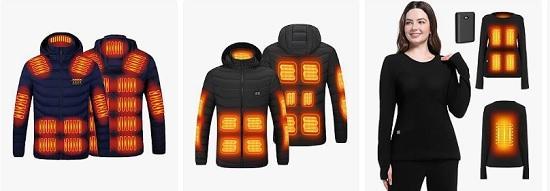
It may not be for everyone but battery heated clothes are a light and an efficient way to maintain body temperatures in cold times.
Battery-heated clothes (jackets, socks, gloves) can make a noticeable difference to how warm you feel and are a cheap way to heat a person.
They won't replace a home-heating system for keeping the whole house warm. They're great for short periods (working outside, sitting still), can cut how much you need to heat a room, and are cheap to run — but limited by battery life, cold-temperature battery performance, and safety/fit quality.
How much heat do heated clothes give realistic numbers
Heated jacket 8-15 W on medium setting (let's use 10 W as a reasonable average).
Heated socks 3-6 W per sock (let's use 3 W each → 6 W total).
Total wearable load (jacket + socks) = 10 W + 6 W = 16 W.
Common battery packs for heated garments are around 7.4 V × 5 Ah = 37 Wh (some are 7.4 V × 10 Ah = 74 Wh).
Runtime with a 37 Wh battery = 37 Wh ÷ 16 W = 2.3125 hours → ≈ 2.3 hours.
Runtime with a 74 Wh battery = 74 Wh ÷ 16 W = 4.625 hours → ≈ 4.6 hours.
So a single moderate battery gives a couple of hours of continuous heating; a larger battery 4-5 hours. If you use a lower power setting your run time increases proportionally.
Energy cost per charge (UK example using £0.28 / kWh electricity):
37 Wh = 0.037 kWh → cost = 0.037 × £0.28 = £0.01036 → 1p to charge.
74 Wh = 0.074 kWh → cost = 0.074 × £0.28 = £0.02072 → 2p to charge.
So very cheap to run electrically per session.
How that compares to whole-house heating
A typical electric room heater is 1.5 kW (1,500 W). Running that for 2.3 hours uses 1,500 W × 2.3 h = 3.45 kWh, cost = 3.45 × £0.28 = £0.966 (97p).
By contrast your heated clothes (37 Wh battery) gave you 2.3 hours of direct personal warmth for ~1 pence of electricity (battery charging). Big difference.
BUT - heated clothes warm your body, not the room air. They're great if you're the one person sitting still; they don't keep the house warm for others.
Practical benefits & realistic use cases
Good for:
Sitting still at home (reading, TV) while lowering thermostat a few degrees.
Outdoor/vehicle use (walking dog, fishing, watching sports).
Working in unheated workshops / sheds.
Reducing short-term heating bills by letting you tolerate a lower room temperature.
Limitations:
Battery runtime: limited to a few hours per battery; need spare batteries or mains-connected use for all-day warmth.
Cold reduces battery capacity: in sub-zero temps expect reduced runtime.
Coverage: only warms where garment contacts; you still need base insulation and good clothing layers.
Not a replacement for heating a home or drying clothes.
Safety, reliability and buying tips
Buy from reputable brands (CE/UKCA, UL listed batteries where possible). Cheap knockoffs have higher fire risk.
Check battery specs: prefer 74 Wh battery if you want multi-hour use without recharging. 74 Wh is under typical airline 100 Wh limit but check transport rules for flights.
Waterproofing: if you're in Caithness rain/wind, ensure the garment and connectors are waterproof.
Never sleep with powered heated clothes unless manufacturer explicitly certifies safe for sleeping.
Replace batteries that bulge or overheat; follow charge/discharge instructions.
Avoid DIY wiring; use manufacturer connectors.
Keep spare battery packs if you need all-day heat — swapping in a fresh battery is common.
Consider integrated rechargeable battery vs. external USB-powerbank compatibility — external powerbanks are convenient but may not supply the right voltage.
Practical recommendations home use
If your goal is to reduce heating bills modestly: wear good insulation layers + heated jacket/socks for the evening TV time — then turn thermostat down 1-2°C. That will save more than the device costs.
If your oil boiler is old and you're waiting to switch heating system, heated clothing is a cheap interim comfort measure.
For all-day home heating replacement: not realistic unless you outfit everyone with heated clothing + many large batteries (impractical).
For outdoor use or short indoor sessions, heated clothes are highly cost-effective.
Evening watching TV (2.5 hours)
Use heated jacket + socks on medium with 74 Wh battery → keeps you comfortable; cost 2p to charge; you can set thermostat lower by 2°C and save maybe ~£0.20-£1.00 that evening (depending on home heating system). Net saving likely positive if done regularly.
Working in unheated shed (6 hours)
Need at least two 74 Wh batteries (swap mid-day) or mains-powered heater. Heated clothes alone may be workable but plan battery swaps.
[url=https://www.amazon.co.uk/s?k=heated+clothes&ref=nb_sb_noss]Check on Amazon[/url]