Coaliton of the Willing To Help Ukraine - Another Statement
25th October 2025
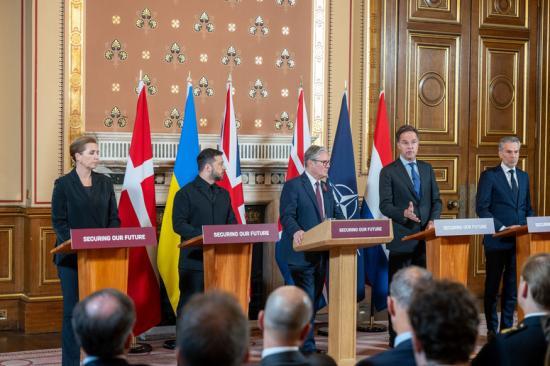
The term Coalition of the Willing (in relation to the war in Ukraine) refers to a group of countries that have pledged enhanced support for Ukraine — including committing to a "reassurance force" deployed once a cease-fire or peace deal is reached — rather than a rigid alliance with a fixed membership.
All rather vague you may think.
It was announced in early 2025 by Keir Starmer (UK Prime Minister) and Emmanuel Macron (French President) as leaders of this initiative.
The idea: build a multinational group ready to provide military/equipment/other support to Ukraine, and to deploy a "reassurance force" inside Ukraine (or be ready to) once a peace deal is reached with Russia.
Membership is fluid: countries are joining in various ways (logistics, equipment, troops) and there is no publicly fixed list of all members.
Some of the countries reported as participating
Here are examples of countries reported to be part of, or signalling interest to join, the Coalition:
United Kingdom (UK) - co-lead.
France - co-lead.
Germany - indicated readiness.
Italy - mentioned.
Finland - announced it will be part.
Belgium, Bulgaria, Croatia, Cyprus, Czech Republic, Denmark, Estonia, Ireland, Latvia, Lithuania, Luxembourg, Netherlands, Norway, Poland, Portugal, Romania, Slovenia, Spain, Sweden, Turkey – among others listed in early March 2025 meetings.
Non-European countries also mentioned: Canada and Australia have been referenced as having expressed interest.
Being "in the coalition" does not necessarily mean a country will send troops. Some countries commit to equipment, logistics or other forms of support only.
The specific number of countries changes; some reports talk about "more than 30 countries" preparing to join.
Some countries are explicitly not part, or have not yet joined: for example, Hungary and Slovakia have not joined the coalition, per reports.
euronews
Because the initiative is still evolving, the full list of members and their commitments is not publicly fixed or final.
And now the statement made on Friday 24 October 2025
The Prime Minister and President Macron today co-chaired a virtual meeting of the Coalition of the Willing, attended by President Zelenskyy.
Leaders were united in their support for Ukraine, in particular during the challenging winter period, and desire for a just and lasting peace and an end to the bloodshed. They welcomed President Zelenskyy's support for a full, unconditional ceasefire. They noted that President Putin, by contrast, had rejected a ceasefire, and that Russia had escalated its attacks on Ukrainian civilians and infrastructure and recklessly violated NATO airspace.
They fully supported President Trump's comments that the current line of contact must be the starting point for any talks. They reiterated their full support for Ukraine’s sovereignty and territorial integrity and the principle that borders must not be changed by force.
Leaders underlined the importance of increasing economic pressure on Russia now and until a just and lasting peace for Ukraine has been secured. They resolved to take further steps to take Russian oil and gas off the global market, end remaining imports into their territories, and deter third countries from trading in Russian oil and gas and fuelling Russia’s war effort. They welcomed the United States’ recent action to that end.
In addition, Leaders agreed to pursue additional measures to tackle the threat posed by shadow fleet vessels to the maritime environment and national security. These would include further sanctions, steps to discourage third countries from engaging with the shadow fleet, increased information sharing as well as readiness to make use of regulatory and interdiction powers. They agreed to take forward closer coordination to increase collective impact.
They also expressed their intent to address Ukraine’s pressing financial needs for 2026-2027 including working up options to use the full value of immobilised Russian sovereign assets, so that Ukraine has the resources it needs to defend its territory and rebuild its armed forces. They were clear that this should be in addition to existing flows of bilateral military aid, which would not diminish.
They strongly condemned Russia’s ongoing campaign to destroy Ukraine’s energy and gas infrastructure, an effort clearly intended to create a humanitarian disaster and break the resilience of the Ukrainian people. They agreed to ensure Ukraine’s energy resilience and to provide urgent assistance to protect and rebuild energy infrastructure, and to continue to provide additional military support, including air defence.
Finally, they reiterated their determination to put in place robust arrangements for Ukraine’s future security, so that it can deter and defend against future attack. They confirmed that plans are in place to deploy a Multinational Force Ukraine once hostilities have ceased, with a view to help secure Ukraine’s skies and seas and regenerate Ukraine’s armed forces.