Too young to count and children who miss out on FREE meals
26th October 2025
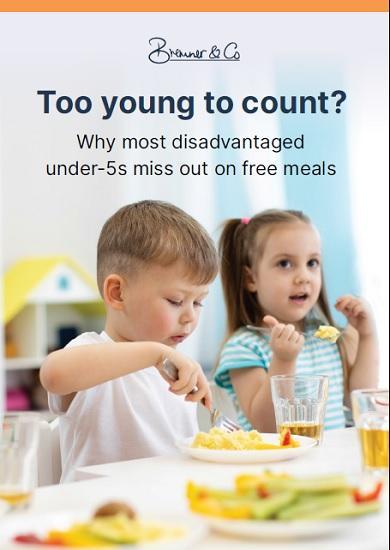
A new report - ‘Too young to count' - reveals that, despite rising hunger and poverty, most children in childcare are excluded from free meal support.
Nearly 300,000 young children in poverty will miss out on free meals in nurseries and childcare settings, according to a new report.
Despite government plans to expand Free School Meals (FSM) to all Universal Credit (UC) households from September 2026, fewer than 4% of children in formal childcare will receive a free meal compared with 30% of pupils in schools.
The report by Bremner & Co, supported by The Food Foundation, Impact on Urban Health and the Early Years Food Coalition, exposes a hidden crisis in early years food provision.
While the FSM expansion coming next year is a welcome step for school-aged children, this research shows that early years children are being left behind. The report shows that 290,000 children under-five living in UC households and attending nurseries, pre-schools or childminders will still not qualify for a free meal.
"The children who need nutritious food the most are the least likely to get it," said Dayna Brackley, Partner at Bremner & Co. "We are facing a situation where providers see more children arriving hungry, but without the means to feed them."
Key findings
290,000 disadvantaged young children will miss out on free meals despite attending nurseries, pre-schools or childminders.
Free meal eligibility in childcare will rise only slightly under the new policy, from 24,000 to 39,000 - fewer than 4% of the >1.1 million children in formal childcare.
By contrast, nearly 30% of pupils in schools will receive a free meal after the FSM expansion, exposing a stark disparity between early years and school-aged children.
There is no dedicated government funding for meals in early years settings, unlike school food, meaning settings have to feed eligible children out of their own pocket.
Families are struggling to provide healthy food at home, with 17% of households with under-fours experiencing food insecurity.
The growing gap
From September 2025, children as young as nine months in working families are entitled to 30 hours of free childcare a week. But most of these children will still not be eligible for a free meal because of unfair rules on setting type, attendance and registration.
The research shows that policy design, not just funding, is driving inequality. To qualify for a Free Early Years Meal, a child must:
Attend a specific type of state-maintained nursery
Be present both before and after lunch
Be registered by a parent or carer through a formal application process
These extra barriers mean that even where families meet income and benefits-related criteria, most young children remain excluded.
Call to action
The report urges government to act now to prevent thousands of young children from going hungry in childcare. Recommendations include:
Extending free meals to all children in UC households, regardless of the type of childcare setting they attend.
Removing unfair rules such as the requirement a child attends both before and after lunch to receive a meal.
Introducing automatic registration so no entitled child misses out.
Providing dedicated funding to childcare providers, so they are not expected to feed hungry children without resources.
Good nutrition in the early years is fundamental to children's health, development and life chances. With 36% of families with their youngest child under five living in poverty, the report warns that failure to act will deepen inequalities and undermine the government's ambition to give every child the best start in life.
Read the report HERE
Pdf 20 Pages
Source https://bremnerco.com/
Relevant Scottish reports
Dietary Intake in Scotland's Children (DISH) (published January 2025) by Food Standards Scotland: This covers children aged 2-15 in Scotland and gives detailed nutrient-intake and diet‐quality data.
Growing Up in Scotland: Sweep 3 Food and Activity Report (covers younger children, aged about 2 to under‐5) from Scottish Government: Includes data on food types eaten by pre-school children, effect of deprivation, parental knowledge and behaviours.
Scottish Government
The revised guidance document Setting the Table: Nutritional guidance and food standards for early years childcare providers in Scotland: Provides standards and evidence context for meals in early years (0-5) childcare settings.
Also, surveys and reports highlighting food insecurity among parents/children in Scotland: e.g., more than one in four parents of children ≤18 reported struggling to provide enough food.
The Scotsman
Gaps / differences compared to "Too Young to Count"
The "Too Young to Count" report focuses specifically on free meals in nursery/childcare settings (i.e., early years settings) and the disparity between school‐age and pre‐school meals. The Scottish reports above are broader (diet quality, food insecurity, early years nutrition) but less focused on systematic coverage of free meals entitlement and uptake in early years childcare settings.
The Scottish data show evidence that meals/food provision and diet quality in early years settings matter and that there are inequalities (by income/deprivation) but there appears to be less publicly available detailed research in Scotland exclusively on the number of younger children in childcare missing free meals or on the proportion of early years settings offering free meals.
Some of the Scottish guidance documents note that the evidence base on food provision in early years settings is "very limited". For example:
"Whilst there is widespread recognition of the importance of early years exposure to food, the data and evidence on the provision of food in ELC settings is currently very limited.
Some Are Missing Out
Many young children in Scotland (and across the UK) who don't attend nursery or other funded early-learning settings are at greater risk of missing out on regular, nutritious meals — especially if their families are on low incomes.
Nurseries and early learning settings are a key source of food
Most Scottish nurseries and early-learning centres provide at least one hot meal and snacks each day, following nutritional standards (from Setting the Table guidance).
For children who attend full-day sessions, that can mean as much as half of their daily food intake comes from nursery.
Food Standards Scotland and NHS Health Scotland note that these meals are often healthier and more balanced than what some children may eat at home, particularly in lower-income households.
Children not attending nurseries may miss:
A reliable, healthy meal each day (and healthy snacks)
Exposure to fruit, vegetables, and varied foods that some families can't always afford
Positive eating routines and social experiences that promote healthy habits later in life
So yes — for children not in nursery, particularly those from families experiencing food insecurity, this can mean a significant gap in their daily nutrition.
The impact is greatest in lower-income families
The Too Young to Count report (UK-wide) found that up to 800,000 children under five miss out on free or subsidised meals simply because they aren't in childcare.
In Scotland, Food Standards Scotland's DISH report (2025) shows higher levels of poor diet quality among young children in deprived areas.
Surveys (e.g. Growing Up in Scotland) consistently find that cost, transport, and lack of availability mean some children don't access early-learning or childcare — and those tend to be the same children most at risk of food insecurity.
Scottish Government policy context
The Scottish Government offers 1,140 hours of funded early learning and childcare (ELC) for 3- and 4-year-olds (and eligible 2-year-olds).
These places include free meals, but families who don't take up places — or children under 2 — don't receive equivalent food support.
Unlike school-age children, there's no universal entitlement to free meals or vouchers for under-5s outside nursery.
In summary
If a young child in Scotland does not attend nursery or childcare, they may indeed miss out on a major source of nutritious food — particularly if their household struggles financially.
This creates a policy gap between:
early-years children in nursery (who get structured, healthy meals), and
those at home (where food access depends entirely on the family’s means).
Existing programmes & entitlements
Scottish Milk and Healthy Snack Scheme (SMHSS)
Covers all pre-school children (under five) who attend a registered childcare setting for 2 or more hours per day.
Provides a portion of plain fresh milk (or a specified non-dairy alternative) and a healthy snack (fruit or vegetables).
This helps children in early years settings get at least a healthy snack + drink even if they’re not in full-day sessions.
Free meals in early learning & childcare (ELC) funded sessions
Children aged 3 and 4 (and eligible 2-year-olds) in funded ELC places are entitled to a free meal on the days they attend.
The meal may be breakfast, lunch or dinner depending on the session.
Example: Stirling Council says children in funded nursery sessions get a free meal: "If your child attends during the morning or stays all day, they will be offered a free lunch."
Stirling Council
Expansion of free school meals & nutrition policy
For school-age children, Scotland is expanding entitlement such that all children in P1-P5 receive free school meals.
The national plan “National Good Food Nation Plan” sets out ambitions for early years nutrition and integrating food provision in childcare settings.
Scottish Food Coalition
Remaining gaps & policy options
Even with the above, there are gaps and potential areas for improvement in policy, especially for children not attending full funded ELC sessions or attending fewer hours:
Children who attend part-time, short sessions (e.g., under 2 hours) may miss exposure to a full meal or snack entitlement.
Children who are at home (i.e., not in any funded childcare or ELC session) have less access to structured meals/snacks in a setting and thus may rely solely on home provision.
Policy options that could help:
Universal entitlement of free meals/snacks for all under-5s, regardless of childcare attendance or hours.
Extending snack/meal schemes to cover children attending non-funded sessions, childminders, or informal care settings.
Holiday/after-hours food support for preschool children (mirroring school holiday food programmes) so that children who attend less frequently still have reliable access to healthy meals.
Targeted support for families at risk of food insecurity (including subsidies, vouchers or home food parcel programmes) to reach children outside of the childcare system.
Better data & monitoring of breakfast/lunch provision in ELC settings, and of children not in ELC who may be at risk of missing nutritious meals.