The Housing Challenge - England And Scotland Look Likely To Miss Targets
26th October 2025
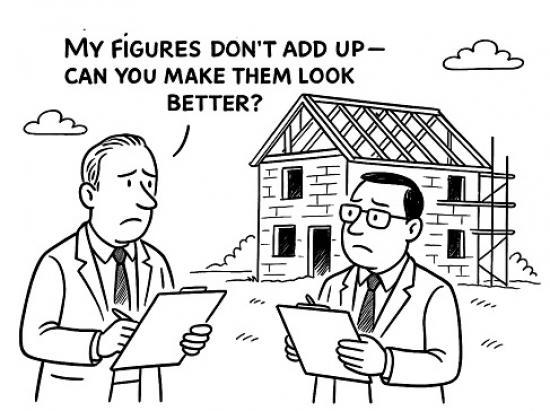
it is quite likely that the UK Government who control targets in England will fail (or at least come up well short of) meeting its stated target of building 1.5 million new homes over the next five years (roughly 300,000 homes per year).
The government has committed to building 1.5 million new homes over five years, across England, under its "Our plan to build more homes".
To support that, major planning reforms are being introduced: mandatory housing targets for councils, increased targets for annual approvals (e.g., 370,000 homes per year in England) and resourcing for local planning authorities.
The government argues that these reforms will "turbocharge" house-building and enable delivery of the target.
Several serious structural and practical issues raise big doubts:
Historical delivery falls well short
Analyses show that even with optimistic assumptions, the private sector alone is unlikely to hit the levels required: e.g., the Centre for Cities estimate is that only ~1.12 million homes will be delivered by 2029 — leaving a gap of ~388,000 compared to 1.5 million.
The New Economics Foundation calculates that social-housing building would need to increase tenfold by 2027/28 to stand a chance of hitting the target.
New Economics Foundation
Labour and industry concerns
Councils have described the target as "unrealistic" or "impossible" under current conditions.
The construction sector warns of a major workforce and skills gap: fewer workers than needed, large numbers nearing retirement, Brexit and immigration changes reducing supply of labour.
Planning approvals are already at historic lows in many areas, which will choke off supply pipelines.
Demand-side and other constraints
Even if capacity exists to build homes, demand needs to match (especially for private-sale homes) and financing / mortgage markets are under pressure.
Building at this scale demands major increases in land supply, infrastructure, skilled labour, and significant investment — all of which are challenged under current economic/cost pressures.
Putting all this together, the rough "probability" estimate is that there is less than a 50% chance of hitting the 1.5 million target (and perhaps something like a 25-40% chance of doing so smoothly). More likely is that the government will fall short, perhaps by several hundred thousand homes (as many analysts forecast).
Maybe 1.0-1.2 million homes are more plausible than 1.5 million over the period.
What would need to change for the target to become realistic
For the target to become more credible, the following would need serious and effective action:
Massive ramp-up in social/affordable housing delivery, since private development alone seems insufficient.
Addressing workforce/skills shortages: bigger recruitment, training, retention of construction trades.
Speeding up planning and approval processes, so that sites can start building sooner and pipeline isn't held up.
Ensuring demand and finance: making sure homes being built are ones people can buy or rent; ensuring mortgage and investment markets support them.
Land supply and infrastructure: Ensure enough land (including brownfield, possibly greenbelt in some places), and infrastructure to support new housing.
Cost control: Construction costs, materials, labour inflation all need to be managed.
Scottish Government targets for house building
The Scottish Government's main official target in respect of affordable housing is to deliver 110,000 affordable homes by 2032 (under the Housing to 2040 Strategy / the Affordable Housing Supply Programme).
Of these 110,000 homes: at least 70% (≈ 77,000) are to be for social rent.
And 10% are to be in remote, rural and island communities.
For 2025-26 specifically, the Scottish Government budget and Programme for Government commit to the delivery of "over 8,000 affordable homes" in that year across social rent, mid-market rent and low-cost home ownership.
Additional/more specific commitments:
A funding package of up to £4.9 billion over four years (announced in 2025) aimed at delivering around 36,000 affordable homes via that investment.
There has been a joint campaign report by Shelter Scotland / Scottish Federation of Housing Associations / Chartered Institute of Housing Scotland which argues Scotland needs ≈15,693 new affordable homes per year in the next Parliament (2026-31) to meet underlying need.
Between 23 March 2022 and 30 Dec 2024, around 24,400 homes had been completed towards the 110,000-target (≈24% of the total).
More recently, by June 2025, about 29,680 affordable homes had been completed.
Yet building activity is slowing: in the year to June 2025, across all tenures there were ~18,869 completions in Scotland (-6% vs previous year).
Under the AHSP (Affordable Housing Supply Programme) approvals, starts and completions are all down significantly: in year to June 2025 approvals down 33%, starts down 22%, completions down 27%.
The SPICe briefing notes: "With just over seven years of the target period remaining, an average of around 11,000 homes need to be completed annually for the target to be met. At current levels of approvals and site starts the target looks challenging to meet."
Will they succeed or likely fail?
Likely failures / major risks
The required pace (11,000 affordable homes per year) is higher than current levels of delivery (recent completions are significantly lower).
Construction activity is declining, especially in the social/affordable sector, which is key for hitting the target.
The gap between what experts say is needed (≈15,693 homes/yr) and what is being delivered widens the risk of under-supply.
Cost pressures (in construction, materials, labour), planning delays, infrastructure / site-unlocking issues all pose structural risks.
Rural/remote/island target (10% of total) is also tricky because building in those areas is often more expensive and complex.
Arguments for potential success / mitigating factors
The government has committed significant investment (£4.9 bn over 4 years) which can boost capacity.
Scottish Construction Now
The specific commitment for 2025/26 (8,000+ homes) shows they are at least targeting near-term deliverables.
The target is over a long period (to 2032) so there is time for acceleration and for peaks in building activity.
They are also unlocking planning/infrastructure initiatives which, if successful, could help boost supply.
Putting the evidence together, I believe there is a greater risk of failure than success for the 110,000 affordable homes by 2032 target, under current trajectories. An estimate is perhaps a 30-40% chance of full success, more likely is partial delivery (perhaps 60-80% of target) unless there is a marked step-change in capacity and delivery.
Summary
Target: 110,000 affordable homes by 2032 (with 70% social rent, 10% rural/island)
Current progress: 29,680 by mid-2025 (27% of target).
Delivery is slowing, and the required annual delivery rate is higher than current delivery.
Without major acceleration, the target is at high risk of being missed.
However, there is still time, and the government has made funding commitments that could change the trajectory.