Digital suite provides foundation for Tritium Fuel Cycle training
27th October 2025
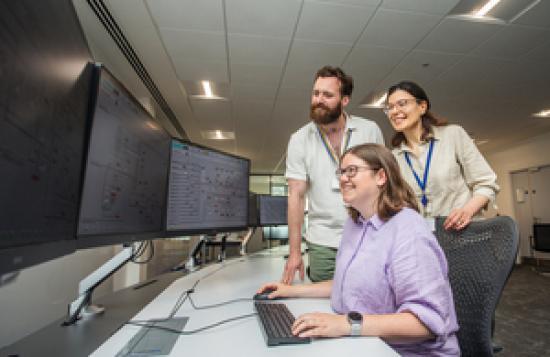
World-first Tritium Fuel Cycle virtual control room installed at UKAEA's Culham Campus to train engineers in the handling and management of tritium.
World-first Tritium Fuel Cycle virtual control room installed at UKAEA's Culham Campus.
Facility designed and delivered by Bilfinger UK, representing significant investment in UK supply chain.
Simulations will be used to train engineers in the handling and management of tritium
Virtual control room extends UKAEA's extensive use of digital training platforms.
Capabilities for testing fuel cycles developed by third party companies and organisations
The UK Atomic Energy Authority's (UKAEA) reputation as a world leader in the use of digital platforms for training, research and development purposes is extending into the tritium fuel cycle technologies which will be critical in delivering sustainable fusion energy in the future.
Developed in conjunction with Bilfinger UK, UKAEA's new and unique virtual simulator will provide operators of the UKAEA-Eni H3AT Tritium Loop Facility with the opportunity to undergo simulated training exercises in a safe and controlled environment.
The digital system will also allow UKAEA to simulate potential changes to H3AT's operating parameters and possible knock-on effects, increasing optimisation and efficiencies of processes.
Furthermore, alongside the ability to demonstrate H3AT's capabilities to visiting stakeholders, the virtual control room could be made available in the future for third parties to test their own fuel cycle management systems.
Stephen Wheeler, Executive Director for Fusion Technology and Tritium Fuel Cycle, at UKAEA, said "The UKAEA-Eni H3AT Tritium Loop Facility will be the largest and most advanced tritium fuel cycle in the world. It also represents a significant advance in the enhancement of industry capability within the fusion sector.
By creating this digital control room with the support of Bilfinger, we’re increasing technical capability and supporting industry to deliver the mechanisms that will serve fusion in the future. The development will provide an unprecedented opportunity to train the next generation of fusion engineers through cutting-edge virtual simulation technology.
Using digital technology to train operators is business-as-usual across several divisions at UKAEA, so it is really pleasing that we are able to employ the same principles within the UKAEA-Eni H3AT Tritium Loop Facility.
We are also delighted to have been able to support a broad supply chain through this investment.
Bilfinger UK has experience in delivering marquee projects across multiple sectors. In addition to providing the control system, as a Tier One contractor Bilfinger UK facilitated and co-ordinated the sub-contracting process, including to Schneider Electric, AVEVA and Siemens.
Darren Clement, Vice President EAP, Bilfinger Engineering and Maintenance UK, said "The exciting research at Culham has the potential to dramatically change the world’s future energy mix - realising the potential for safe, clean and virtually limitless energy. This virtual control room will give UKAEA the ability to further improve its processes while also ensuring staff are able to learn the important skills needed to help make sure operations run smoothly and safely.
At the same time, it can also help give important stakeholders a valuable insight into the ground-breaking work taking place in Culham. We’ve supported the nuclear industry for 60 years, supporting pioneers and major operators as they safely deliver clean energy in abundance.
UKAEA has a proven track record in using digital platforms to increase efficiencies of time and cost during staff training and the development of new technologies and processes.
The Remote Operations team at the Joint European Torus (JET) has been using such platforms for over 25 years, and they will now be applied to support the decommissioning of the fusion machine.
Additionally, a full digital rehearsal of fuel debris retrieval at Fukushima Daiichi was conducted using the Next Generation Digital Mock-Up (NG-DMU), developed under the LongOps project, working with the Nuclear Decommissioning Authority, UK Research and Innovation, and the Tokyo Electric Power Company.
How the UK is using tritium
Fusion energy research
In the UK, tritium is a key fuel component for experimental nuclear-fusion reactors. For example, the UK Atomic Energy Authority (UKAEA) and its facility Joint European Torus (JET) at Culham have developed laser-based diagnostics to release and measure tritium trapped in the tokamak.
UKAEA Fusion Energy
Furthermore, the UK is investing in infrastructure to support tritium fuel cycles: for example the "H3AT" tritium-loop facility under construction, and the "LIBRTI" programme (Lithium Breeding Tritium Innovation) to breed (produce) tritium from lithium for future fusion plants.
The UKAEA also runs training courses on tritium—they note that UKAEA has "been safely handling, processing and storing tritium for more than 40 years" as part of fusion research.
GOV.UK
Legacy/industrial use & regulation
Tritium in the UK is also found in industrial and research applications.
A review document notes
"Tritium has been used in the manufacture of radionuclide-labelled materials for application in medicine, research and industry, ... in luminous paint employed in some wristwatches and compasses, and in emergency exit signs, gun-sights..."
GOV.UK
Also, there is mention of tritium “adventitiously produced” in nuclear reactors and associated facilities, and some deliberate production historically in UK.
In terms of waste / recycling: there’s a UK company offering tritium-recycling services (for sealed sources) because although tritium is recyclable in principle, in the UK “no recycling routes are available” for many forms, meaning they are stock-piled.
ACB
Environmental & safety issues
Because tritium is radioactive (beta emitter with half-life 12.3 years) and can appear in forms like tritiated water (HTO) or tritiated hydrogen gas (HT), the UK has regulatory reviews of its discharges, behaviour and packaging.
How other countries use tritium
Many other countries use tritium in broadly similar ways, and some in additional ways; here are some comparisons:
Fusion fuel globally: Countries with fusion programmes (US, France, Japan, China, EU countries, Canada) treat tritium as a key element of deuterium-tritium (D-T) fusion. The UK’s usage of tritium for fusion aligns with that global pattern. The challenge of tritium supply and tritium breeding is a common feature.
Self-luminous devices / instrumentation: Historically in many countries, tritium was used in luminous paints, wrist-watches, exit signage, compasses, etc. The UK document mentions these uses, and these uses have been international.
Nuclear weapons / defence: Tritium is used in the boosting of nuclear warheads (so defence uses) in countries with nuclear arsenals (US, Russia, UK, France). The UK Harris report shows tritium’s “most significant use ... in nuclear weapons”.
Worldwide regulation / discharge concerns: Many countries with nuclear power reactors, heavy water reactors, or reprocessing facilities have to monitor and regulate tritium emissions (liquid/gas) and manage radioactive waste. So the UK’s regulatory focus matches international peers.
Key points & how the UK may differ / particular emphasis
The UK places strong emphasis on the fusion-fuel cycle for tritium (breeding, storage, fuel-loop design) rather than just legacy uses. The LIBRTI investment and H3AT loop facility show that.
The UK is also collaborating internationally (for example with Canadian Nuclear Laboratories) on tritium management: the UK-Canada MoU covers tritium fuel-cycle technologies.
Because of the UK’s nuclear legacy (reactor and reprocessing sites) there’s a long-standing issue of tritium discharges and environmental monitoring. Some other countries have less visible legacy or smaller scale (though many do).
In terms of commercial everyday applications, the UK appears to still have remnants (e.g., luminous devices) but many jurisdictions have reduced these uses because of regulatory concerns.
Supply of tritium is a global bottleneck: because it’s scarce, many fusion plans hinge on being able to breed tritium (from lithium) or recycle it. The UK is explicitly investing in that.
Limitations, risks & unanswered issues
Tritium’s radioactivity is weak (beta) and has a short range; but if tritiated water is ingested or enters biological systems, there is risk. So safe handling, containment and disposal are important.
The UK review shows “no recycling routes available” for many tritium-bearing wastes — this remains a challenge.
For fusion plants to become commercial, the tritium fuel cycle must be closed (breed & reuse) to avoid running out of tritium, and that is still in development.
Internationally, different countries have different regulatory regimes, which means that comparison is approximate — e.g., some may allow more legacy uses of luminous devices than the UK, and some may have fewer environmental disclosures.
Because tritium is tied to both civil (fusion, industrial) and military (weapons) uses, its supply, regulation, and security are additional concerns.