UK trade - October 2025
12th December 2025
The value of goods imports increased by £0.8 billion (1.5%) in October 2025, because of a rise in imports from both EU and non-EU countries.
The value of goods exports rose by £1.5 billion (5.2%) in October 2025, mainly because of an increase in exports to non-EU countries.
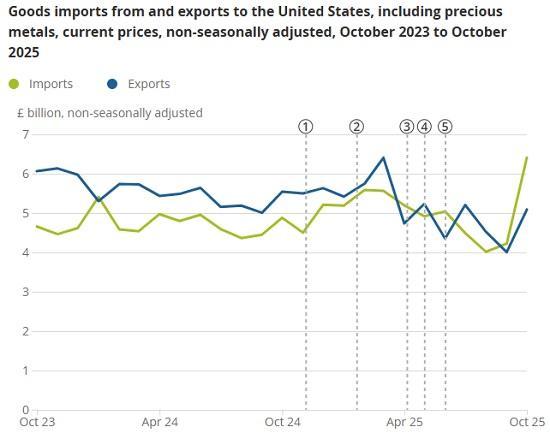
Exports of goods to the United States, including precious metals, rose by £1.1 billion (27%) in October 2025, while imports of goods rose by £2.2 billion (51.6%).
The total goods and services trade deficit widened by £4.0 billion to £6.7 billion in the three months to October 2025.
The trade in goods deficit widened by £3.9 billion to £60.5 billion in the three months to October 2025, while the trade in services surplus is estimated to have remained unchanged at £53.8 billion.
After removing the effect of inflation by calculating "chained volume measures" (as explained in Section 11: Glossary), total goods imports increased by £0.6 billion (1.0%) in October 2025 (Figure 2). This was because of a £0.4 billion (1.5%) rise in imports from non-EU countries, and a £0.2 billion (0.6%) rise in imports from the EU.
Total goods exports increased by £1.5 billion (4.9%) in October 2025, after the effect of inflation was removed. This was mainly because exports to non-EU countries rose by £1.2 billion (7.7%), while exports to the EU also rose by £0.3 billion (2.0%).
UK trade with the United States
Exports of goods to the United States, including precious metals, rose by £1.1 billion (27.0%) in October 2025 after two consecutive monthly falls (Figure 3). The value of goods exports to the United States have remained relatively low since the introduction of tariffs in April.
In October 2025, exports of chemicals rose by £0.6 billion because of higher imports of medicinal and pharmaceutical products. Exports of machinery and transport equipment also increased by £0.4 billion because of higher exports of cars. The rise in car exports may be linked to a phased recovery following a cyber incident, with the Society of Motor Manufacturers and Traders reporting a growth in car exports in October compared with September.
Imports of goods from the United States, including precious metals, increased by £2.2 billion (51.6%) in October 2025, primarily because of higher imports of material manufactures, which was linked to an increase in non-ferrous metals. Non-ferrous metals include silver, platinum and palladium bullion bars, which are components of precious metals. Trade in precious metals can be large and highly volatile, distorting underlying trends in trade in goods. In addition to precious metals, silver, platinum, palladium and other metals are widely used in industry, with silver surging in price in October because of strong demand from industrial users leading to shortage in supply according to the Financial Times.
Monthly data can be erratic; therefore, movements should be treated with caution.
More detailed estimates on the UK's trade in goods with the United States can be found in our Trade in goods: country-by-commodity imports dataset and in our Trade in goods: country-by-commodity exports dataset. Our UK trade with the United States article provides a more detailed look at our trade in goods and services with the United States in 2024.
Goods imports
Imports from the EU increased by £0.3 billion (1.2%) in October 2025. This increase was primarily because of a £0.4 billion rise in imports of machinery and transport equipment, which was partially offset by small falls in imports of material manufactures (excluding precious metals) and food and live animals (Figure 4). The increase in imports of machinery and transport equipment was linked to higher imports of cars from Germany.
Imports from non-EU countries increased by £0.4 billion (1.9%) in October 2025. This increase was primarily because of a £1.3 billion rise in imports of material manufactures (excluding precious metals), which was partially offset by a £0.5 billion fall in imports of chemicals, £0.2 billion falls in imports of fuels and machinery and transport equipment. The increase in imports of materials manufactures resulted from higher imports of non-ferrous metals from the United States. The decrease in chemical imports was linked to lower imports of medicinal and pharmaceutical products from the United States and Switzerland, and inorganic chemicals from Canada.
Goods exports
Exports to the EU increased by £0.2 billion (1.7%) in October 2025. This increase was primarily because of a £0.2 billion rise in exports of machinery and transport equipment linked to higher exports of mechanical power generators (intermediate) to Spain (Figure 5).
Exports to non-EU countries increased by £1.3 billion (8.6%) in October 2025. This increase was because of £0.3 billion rises in exports of chemicals and machinery and transport equipment, a £0.2 billion rise in exports of material manufactures (excluding precious metals), and smaller increases in exports of most commodities. The rise in chemical exports was because of higher exports of both medicinal and pharmaceutical products and inorganic chemicals to the United States. The increase in exports of machinery and transport equipment was linked to higher exports of cars to the United States and Japan, as well as mechanical power generators (intermediate) to China.
Three-monthly trade in goods and services
Total imports of goods increased by £1.0 billion (0.7%) in the three months to October 2025, compared with the three months to July 2025 (Table 2). This was because goods imports from non-EU countries increased by £0.6 billion (0.8%), and goods imports from the EU also increased by £0.4 billion (0.5%).
Total exports of goods decreased by £3.0 billion (3.1%) in the three months to October 2025. This fall was because goods exports to the EU decreased by £2.0 billion (4.3%), and goods exports to non-EU countries also decreased by £1.0 billion (2.0%).
For trade in services in the three months to October 2025, International Trade in Services (ITIS) survey figures are forecast using time series data. This forecast is combined with additional data sources, to estimate trade in services totals. We plan to revise this forecast in our gross domestic product (GDP) quarterly national accounts bulletin, and in our Balance of payments bulletin, both publishing on 22 December, using ITIS survey data.
Early estimates indicate that imports of services decreased by around £0.1 billion (0.1%) in the three months to October 2025, compared with the three months to July 2025, while exports of services also fell by an estimated £0.1 billion (0.1%).
Read the full ONS report HERE