A World Divided - What the World Inequality Report 2026 Reveals About Global Wealth, Power and Opportunity
17th December 2025
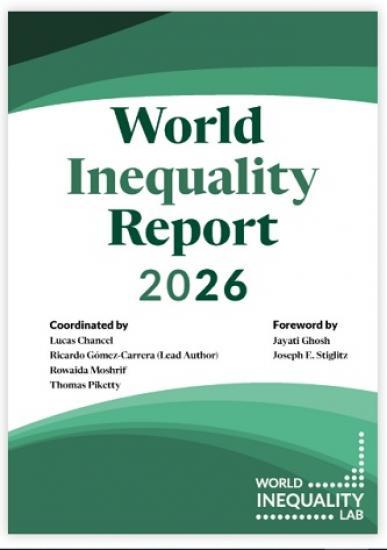
The World Inequality Report 2026 presents a stark and unsettling picture of the global economy. Despite decades of economic growth and technological progress, inequality remains not only widespread but extraordinarily concentrated.
The report's central message is clear. Inequality is neither accidental nor inevitable.
It is the result of political, economic and institutional choices that have systematically favoured wealth and capital over labour, and the richest few over the global majority.
At the most basic level, global wealth is distributed in an extreme and highly uneven manner. The report shows that the top 10 per cent of the world's population owns around three-quarters of all global wealth, while the bottom half of humanity owns just a tiny fraction.
Income follows a similar pattern, with more than half of all global income flowing to the top 10 per cent, and only a small share reaching the poorest 50 per cent. Most strikingly, the wealth of the very richest — the top 0.001 per cent — now exceeds that of the entire bottom half of the world combined.
This level of concentration is historically exceptional and challenges the idea that modern economies naturally generate broad-based prosperity.
The report emphasises that inequality is not merely about money. It is deeply structural, cutting across gender, education and access to opportunity. When unpaid domestic and care work is taken into account, women globally earn far less than men, revealing an economic system that systematically undervalues work that is essential to social functioning.
Education inequality further entrenches these divides. Children in wealthy regions benefit from levels of public investment that are dozens of times higher than those available to children in poorer parts of the world.
These disparities shape life chances long before individuals enter the labour market, locking inequality into future generations.
One of the most important contributions of the 2026 report is its analysis of climate inequality. The report reframes climate change not simply as a problem of individual consumption, but as a problem of capital ownership.
The wealthiest groups, through their control of polluting assets and investment decisions, are responsible for a vastly disproportionate share of global carbon emissions.
By contrast, the poorest half of the world contributes almost nothing to climate damage while suffering many of its worst effects. This insight challenges policy approaches that focus narrowly on consumer behaviour and highlights the need to address ownership, investment and financial flows.
Global inequality is also reinforced by international financial structures. The report finds that poorer countries effectively transfer large sums of wealth to richer countries each year through debt servicing, profit repatriation and financial returns.
These outflows far exceed the value of development aid, undermining the ability of poorer states to invest in health, education and infrastructure. In this sense, inequality is not only domestic but global, embedded in the rules governing trade, finance and taxation.
Crucially, the report rejects the idea that inequality is unavoidable. Historical comparisons show that countries with strong progressive taxation, robust public services and inclusive institutions have achieved significantly lower levels of inequality.
Where inequality has risen sharply, it has often followed deliberate policy shifts - reductions in top tax rates, weakened labour protections and underinvestment in public goods. The report therefore frames inequality as a political choice rather than an economic necessity.
In response, the World Inequality Report 2026 calls for a renewed commitment to redistribution and international cooperation. It argues for progressive taxation on income and wealth, greater transparency in global finance, and substantial public investment in education, healthcare and climate transition.
Without such measures, the report warns, inequality will continue to deepen, threatening social cohesion, democratic stability and global efforts to address climate change.
In sum, the report offers a powerful diagnosis of a world increasingly divided between those who own and those who do not. It makes clear that the persistence of extreme inequality is not a failure of data or understanding, but a failure of collective political will.
Whether the coming decades entrench this divide or begin to close it will depend on the choices governments and societies are willing to make.
Th report was published on 10 December 2025.
Read the full report HERE
Download the report HERE
Download a Summary Report HERE
Pdf 22 Pages
Pdf 205 Pages