Consumer price inflation UK November 2025 Slight Fall 3.4% To 3.2%
17th December 2025
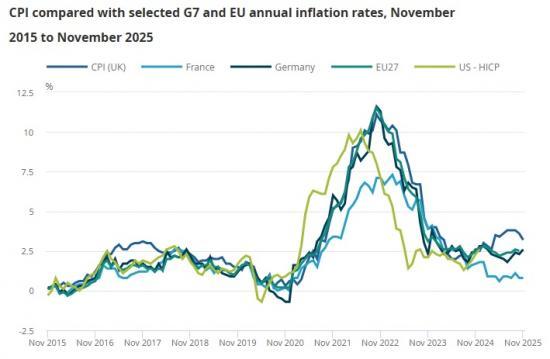
The Consumer Prices Index including owner occupiers' housing costs (CPIH) rose by 3.5% in the 12 months to November 2025, down from 3.8% in the 12 months to October.
On a monthly basis, CPIH fell by 0.1% in November 2025, compared with a rise of 0.2% in November 2024.
The Consumer Prices Index (CPI) rose by 3.2% in the 12 months to November 2025, down from 3.6% in the 12 months to October.
On a monthly basis, CPI fell by 0.2% in November 2025, compared with a rise of 0.1% in November 2024.
Food and non-alcoholic beverages, and alcohol and tobacco made the largest downward contributions to the monthly change in both CPIH and CPI annual rates.
Core CPIH (CPIH excluding energy, food, alcohol and tobacco) rose by 3.5% in the 12 months to November 2025, down from 3.7% in the 12 months to October; the CPIH goods annual rate slowed from 2.6% to 2.1%, while the CPIH services annual rate eased slightly from 4.6% to 4.5%.
Core CPI (CPI excluding energy, food, alcohol and tobacco) rose by 3.2% in the 12 months to November 2025, down from 3.4% in the 12 months to October; the CPI goods annual rate slowed from 2.6% to 2.1%, while the CPI services annual rate eased slightly from 4.5% to 4.4%.
Food and non-alcoholic beverages
Food and non-alcoholic beverages prices rose by 4.2% in the 12 months to November 2025, down from 4.9% in the 12 months to October (Figure 3). On a monthly basis, food and non-alcoholic beverages prices fell by 0.2% in November 2025, compared with a rise of 0.5% a year ago.
The main downward effect to the change in the rate came from bread and cereals, where the prices of products such as cakes, biscuits and breakfast cereals fell this year but rose a year ago. There were other smaller downward effects from dairy products and the sugar, jam, syrups, chocolate and confectionery class.
Alcohol and tobacco
Prices in the alcohol and tobacco division rose by 4.0% in the 12 months to November 2025, down from 5.9% in the 12 months to October. The November figure was the lowest recorded since December 2022, when the rate was 3.8%. On a monthly basis, prices fell by 0.4% in November 2025, compared with a rise of 1.4% a year ago.
The easing in the 12-month rate reflected a downward effect from tobacco, where prices fell by 0.1% between October and November 2025, compared with a rise of 3.3% a year ago. The rise in November 2024 was possibly influenced by an increase in tobacco duty, which took effect on 30 October 2024. Duty rates on tobacco did not increase in 2025 until 26 November, which was after the data collection period for the month.
Housing and household services
The 12-month inflation rate for housing and household services was 4.8% in November 2025, down from 5.0% in October. On a monthly basis, prices rose by 0.4% in November 2025, compared with a rise of 0.6% a year ago.
The easing in the 12-month rate between October and November 2025 mainly reflected a downward effect from owner occupiers' housing (OOH) costs. These rose by 4.5% in the 12 months to November 2025, compared with a rise of 4.8% in the 12 months to October. The rate has slowed for 10 consecutive months and was last lower in June 2023, when it was 4.4%. OOH costs rose by 0.6% in the month to November 2025, compared with a 0.8% increase a year ago.
Clothing and footwear
Clothing and footwear prices fell by 0.6% in the 12 months to November 2025, compared with a rise of 0.3% in the 12 months to October (Figure 4). The low November rate was matched in February 2025. The rate was last lower in March 2021, when prices fell by 3.8% on the year.
On a monthly basis, prices fell by 0.3% into November 2025 compared with a rise of 0.6% a year ago. These price movements, to some extent, reflect changes in the proportion of discounted prices in the datasets.
This proportion increased between October and November in both years, possibly linked to the influence of Black Friday, but the increase was greater in 2025 than 2024.
Read the full ONS report HERE