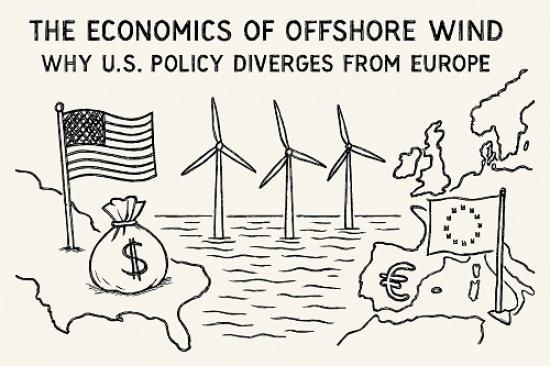
The Economics of Offshore Wind: Why U.S - Policy Diverges from Europe
23rd December 2025
Offshore wind power is one of the fastest-growing sources of renewable electricity globally.
However, policies governing its development vary sharply across countries, with profound implications for energy security, investment, and household electricity bills.
In the United States, the Trump administration has recently 22 December 2025 suspended several major offshore wind projects, citing national security concerns.
In contrast, European nations have actively promoted offshore wind as a cornerstone of climate, industrial, and energy policy. Understanding these divergent approaches reveals why policy decisions today will affect electricity prices and energy security for decades.
U.S. Policy: Suspension of Offshore Wind Projects
In December 2025, the Trump administration announced the suspension of five major offshore wind projects on the U.S. East Coast. Projects affected included Vineyard Wind (Massachusetts), Sunrise Wind and Empire Wind (New York), Revolution Wind (Rhode Island/Connecticut), and Coastal Virginia Offshore Wind — several of which were already under construction. The Department of the Interior, in coordination with the Department of Defense, cited national security concerns, primarily the potential for turbine blades and towers to interfere with radar systems and complicate military operations.
This action followed an earlier memorandum issued by President Trump that temporarily withdrew millions of acres of federal waters from wind leasing pending a comprehensive review of offshore wind permitting and leasing practices.
Although officially framed as a security measure, critics argue that the suspension reflects a broader political stance against wind energy. The halt affects billions of dollars in private and corporate investment and threatens construction jobs, supply chains, and near-term electricity reliability. Legal challenges have already emerged; federal courts have ruled parts of previous freezes unlawful, describing them as "arbitrary and capricious."
Critics also highlight that offshore wind itself enhances energy security by providing domestic, fuel-free electricity, reducing reliance on imported fossil fuels.
European Policy: Strategic Expansion of Offshore Wind
In sharp contrast, Europe is aggressively promoting offshore wind as a core component of its energy transition strategy. The European Union, along with countries bordering the North Sea and the Baltic, targets over 100 GW of offshore wind capacity by 2030 and 300 GW or more by 2050.
Offshore wind is embedded in climate policy, energy security planning, and industrial development initiatives, such as the EU's Wind Power Package and Clean Industrial Deal, which provide regulatory certainty, funding mechanisms, and cross-border collaboration frameworks.
European governments have implemented contracts for difference (CfDs) and competitive auctions, ensuring long-term price stability for investors and consumers alike. This approach not only supports rapid expansion of renewable capacity but also strengthens domestic supply chains and job creation. Countries such as the UK, Germany, and the Netherlands continue to expand offshore pipelines, while emerging markets like Poland are testing new auctions to stimulate investment. Offshore wind is thus simultaneously a climate, industrial, and energy security priority in Europe.
Economic Implications: Electricity Bills for Consumers
Offshore wind influences electricity prices primarily by displacing fuel-dependent power generation, such as gas, which often sets the marginal price in wholesale electricity markets. The economic impact differs between Europe and the U.S. due to policy choices.
Europe
Electricity prices in Europe initially rose sharply after 2021 due to high gas prices, the post-pandemic demand rebound, and the war in Ukraine. However, accelerated offshore wind deployment acts as a hedge against future fuel volatility. While consumers contribute to upfront infrastructure costs, long-term benefits include:
Lower wholesale electricity prices as wind reduces reliance on expensive gas-fired generation
Reduced price volatility for households and industry
Enhanced grid stability and domestic energy security
Europe's long-term planning and policy frameworks aim to pay now for cheaper and more predictable electricity bills later.
United States
In contrast, the suspension of offshore wind in the U.S. maintains short-term electricity cost stability but delays the introduction of low-cost, fuel-free generation. Consumers remain exposed to:
Gas price volatility
Infrastructure expansion costs without fuel cost offsets
Growing electricity demand from emerging sectors, such as data centres and electric vehicles
This policy effectively prioritizes short-term regulatory or political goals over long-term bill stability, increasing the risk of higher electricity costs in the future.
In summary, Europe is treating offshore wind as strategic infrastructure—paying some costs now to stabilize bills, improve energy security, and reduce carbon emissions. The U.S. approach under the Trump administration favours immediate risk management and political positioning, leaving consumers exposed to higher long-term energy costs and reduced renewable capacity.
Offshore wind is no longer a marginal energy source; it is central to both energy security and electricity pricing. The divergence between U.S. and European policy illustrates the consequences of regulatory choices: Europe accepts near-term investments to reduce future risks and costs, while the U.S. suspension delays renewable deployment, potentially raising future electricity prices and exposure to fuel market shocks.
As demand grows globally from electrification, AI, and industrial use, these policy differences will have increasingly tangible consequences for households, businesses, and national energy security.