Britain's Lost Decade: Why Growth Won't Come Back or Growth Mirage - Why the UK Trails Its Rivals
23rd December 2025
The UK economy ends 2025 in a subdued state.
Momentum slowed over the year, with official monthly data showing a 0.1% contraction in October and services output falling, reinforcing expectations of near‑term monetary easing to support activity.
On a quarterly basis, GDP was flat in Q3 2025, highlighting a lack of underlying growth even as some European peers posted modest expansions.
Business surveys and official trackers point to persistent fragility in demand, tight cost pressures, and weak investment appetite, all of which have kept growth from gaining traction despite easing inflation and improving real incomes earlier in the year.
Growth versus stagnation or contraction
Taking the recent prints together, the economy is best described as stagnating, with intermittent monthly contractions rather than a clear recessionary trend.
The October dip and earlier softness in activity contrast with a firmer start to 2025, but the Q3 "flat" outcome underscores that the UK has not sustained a durable expansion in the second half of the year. Forecasters broadly see weak private‑sector demand and productivity constraints weighing on momentum, even as policy support turns more accommodative.
International comparisons
Relative to major economies, the UK's recent performance is middling to soft. The euro area grew 0.3% in Q3 2025, with France up 0.5% and Germany flat, while the UK was flat over the same period.
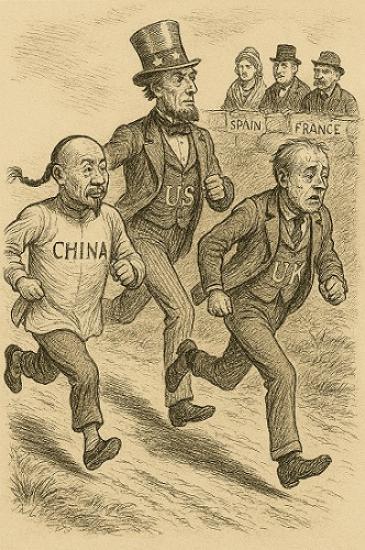
On annual projections, international datasets place the US ahead in level terms and growing faster than the UK, with China's growth rate materially stronger than both; IMF‑based tables for 2025 show China projected at around 4.8% growth versus the UK near the low single digits, underscoring the UK's comparative underperformance in headline GDP growth rates.
OECD projections similarly set UK growth at 1.3% in 2025, slowing to 1.0% in 2026, below the pace expected in the US and far below China.
Key drivers of growth
Consumer spending: Household demand has softened as earlier tailwinds from falling inflation fade, with business‑side indicators reporting cautious trading conditions and pressure on consumer confidence and footfall. Official business insights show strains in financial performance and resilience, consistent with muted consumption growth into year‑end.
Government spending: Fiscal policy has provided a partial offset. The Autumn Budget emphasized growth initiatives—higher public investment, the National Wealth Fund, planning reform, and backing major infrastructure—which support demand but are unlikely to fully overcome structural headwinds in the near term.
Business investment: Private investment remains weak. Forecasts highlight subdued investment intentions amid elevated uncertainty, higher tax burdens, and productivity challenges; business groups and independent forecasters note that public investment is doing more of the heavy lifting while private‑sector capex lags.
Trade and exports: External demand is constrained by trade tensions and slower global growth in key markets. OECD analysis points to heightened trade frictions and tighter financial conditions as drags on UK export performance and overall GDP momentum through 2026.
Long‑term projections
The consensus outlook points to low, positive growth rather than a robust upswing. The OECD projects UK GDP growth at 1.3% in 2025 and 1.0% in 2026, with inflation pressures easing only gradually and fiscal constraints limiting room for expansive policy.
Private‑sector forecasters cluster around similar ranges: KPMG expects 1.2% in 2025 and 1.1% in 2026, noting that public investment supports headline figures while private investment stays modestassets.kpmg.com. EY’s autumn update is a shade more optimistic at 1.5% for 2025 before slowing in 2026, reflecting momentum earlier in the year and the prospect of rate cuts aiding activity.
HM Treasury’s December compilation of independent forecasts captures this distribution, with most projections anchored in the low single digitsGOV.UK. Business groups emphasize that structural issues—weak productivity growth, skills gaps, and uncertainty—continue to trap the UK in a low‑growth regime absent deeper reforms and sustained investment.
The long and short of it
Is the UK growing, stagnating, or contracting? Stagnating, with intermittent monthly contractions (e.g., October) and flat quarterly GDP in Q3.
How does UK GDP growth compare to the US, EU, and China? Weaker than China and the US on projected annual growth; broadly in line or softer than the euro area’s modest Q3 expansion.
Key drivers: Muted consumer demand, policy‑led public investment, weak private investment, and trade headwinds; structural productivity issues cap momentum.
Long‑term outlook: Low single‑digit growth (around 1-1.5% in 2025, easing toward ~1% in 2026) with risks from trade frictions, fiscal tightening, and productivity constraints