Scotland's Shifting Opposition - Why Reform's Rise Matters for Families and Budgets
26th December 2025
Politics in Scotland has long been dominated by the gravitational pull of the SNP.
For years, the party has acted like the sun around which all other forces orbit, setting the rhythm of debate and defining the terms of opposition.
Yet as we approach the elections on May 26, the latest polls suggest that the familiar constellation is beginning to wobble.
Labour, which only last year looked like it was clawing back ground, now finds itself slipping. And into that space, surprisingly, steps Reform UK — a party that until recently was dismissed as a fringe presence, now projected to win three Westminster seats north of the border.
This may sound like a small ripple in a vast sea, but ripples matter. In politics, they can grow into waves that reshape the shoreline. For families already juggling bills, mortgages, and travel costs, the rise of Reform UK is not just a curiosity. It could alter the way opposition works in Scotland, and by extension, the way budget debates unfold in Westminster.
The Poll Story
The headline numbers are stark. The SNP remains dominant, holding its ground as the largest force in Scottish politics.
Labour, after its brief resurgence, is now projected to lose dozens of constituencies it had taken from the SNP. Reform UK, meanwhile, is tipped to win three seats — a breakthrough that would give it a foothold in Scotland for the first time. The Conservatives and Liberal Democrats remain present but peripheral, their polling numbers steady but uninspiring.
On paper, three seats may not sound like much. But in the theatre of politics, symbolism often outweighs arithmetic. Reform UK's entry into the Scottish stage signals that the opposition to the SNP is fragmenting. Labour's claim to be the sole challenger is weakened, and voters who feel disillusioned with the traditional parties suddenly have another option.
Why It Matters for Ordinary Citizens
For families, the question is not which party logo sits on the ballot paper, but which policies shape their daily lives.
A new opposition voice could shift the tone of fiscal arguments in Westminster. Reform UK's rhetoric on taxation, spending, and energy costs may force Labour and the SNP to recalibrate their positions. That matters when you're deciding whether your wages will stretch to the end of the month, or whether your heating bill will swallow the grocery budget.
Political volatility also creates uncertainty. When opposition is fragmented, policy outcomes become less predictable. Housing policy, apprenticeships, and travel costs are all issues that directly affect households and can be caught in the crossfire of shifting alliances and competing priorities.
For families, that means planning ahead becomes harder. Should you lock into a fixed-rate mortgage now, or wait to see if government policy nudges interest rates down? Should you budget for higher train fares, or hope that subsidies survive the next round of cuts? These are not abstract questions; they are the daily arithmetic of ordinary life.
A Practical Checklist for Everyone
To cut through the noise, here are three simple steps:
Watch the numbers: Polls are volatile. Today’s snapshot may not be tomorrow’s reality.
Focus on policies, not personalities: Which party is talking about energy bills, housing, or apprenticeships? That’s where the real impact lies.
Prepare for change: Shifts in opposition can mean sudden changes in budget priorities. Build flexibility into your household planning.
A Closing Thought
Politics in Scotland is not theatre for families — it is the backdrop to every grocery bill, every rent payment, every train ticket.
The rise of Reform UK may not topple the SNP, but it changes the script Labour thought it was writing. For households across Scotland, the message is clear - pay attention not just to who leads, but to who opposes.
Because in the end, it is the balance of voices in parliament that decides whether your budget stretches or snaps.
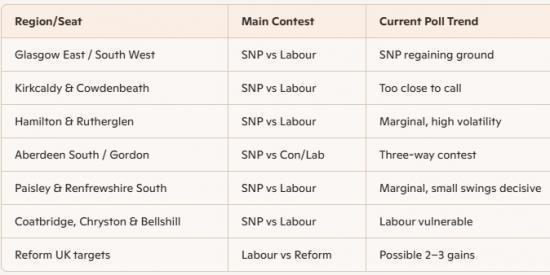
Key Marginal Seats Likely to Change
Several constituencies in Scotland are considered marginal in the May 26 elections, with polls suggesting they could change hands between the SNP, Labour, and potentially Reform UK. The most closely watched battlegrounds are in the Central Belt, parts of Glasgow, and the North East.
Glasgow East & Glasgow South West
Traditionally SNP strongholds, but Labour made gains here in 2024. Polls now suggest these seats could swing back to the SNP.
Kirkcaldy & Cowdenbeath
A Labour gain last year, but current polling shows the SNP competitive again.
Hamilton & Rutherglen
A knife-edge contest between Labour and SNP, emblematic of the wider Central Belt struggle.
North East Scotland (Aberdeen South, Gordon)
Historically contested between SNP and Conservatives, but Labour is also in play.
Paisley & Renfrewshire South
Another Labour-SNP marginal where small swings could decide the outcome.
Coatbridge, Chryston & Bellshill
Labour took this seat in 2024, but SNP polling suggests it could flip back.
Potential Reform UK targets
Polls indicate Reform UK could win up to three Westminster seats in Scotland, though exact constituencies are unclear. Likely candidates are areas with higher disaffection toward Labour in the Central Belt.