Stealth, Jobs, and Power: The F‑35 and China's Challenge
27th December 2025
The Jet That Defines an Era
The Lockheed Martin F‑35 Lightning II is more than a fighter jet. It is the largest defence procurement program in history. It is a symbol of U.S. military dominance, and a magnet for industrial jobs across allied nations.
By late 2025, the F‑35 has become the backbone of Western air power, with over 1,200 aircraft delivered worldwide and thousands more on order. Yet as America expands its stealth fleet, China is racing to close the gap, modernising its own air force with fifth‑generation fighters like the J‑20.
America's Fleet — Stealth at Scale
The United States operates more than 1,230 F‑35s across the Air Force, Navy, and Marine Corps, with plans to exceed 2,500 by 2030. The Air Force alone aims for 1,763 jets, while the Navy expects 273 carrier‑capable F‑35Cs and the Marine Corps 353 short‑takeoff F‑35Bs. This scale dwarfs any other nation's fleet, giving America unmatched stealth capacity and global reach. The program is also an industrial engine, supporting 290,000 workers and contributing $72 billion annually to the U.S. economy.
Britain’s Fleet — Carrier Strike and Nuclear Deterrence
The UK already fields 41 F‑35B jets, operating from its Queen Elizabeth‑class carriers. By 2030, Britain will expand to at least 74 aircraft, including 12 newly ordered F‑35As tied to NATO’s nuclear mission. Unlike Canada, Britain has secured industrial returns: BAE Systems and Rolls‑Royce are integral to global F‑35 production, anchoring thousands of jobs at home.
Canada’s Saga — Jobs in the Crossfire
Canada’s $27 billion F‑35 procurement highlights the tension between military needs and industrial benefits. Ottawa remains committed to 16 jets, but critics argue the deal delivers few domestic jobs, with most benefits flowing south to U.S. factories. Saab’s Gripen proposal, by contrast, promises 12,600 Canadian jobs through local assembly and Bombardier partnerships. The saga mirrors tariff wars: Washington locks allies into its supply chains, while rivals dangle alternatives with industrial sweeteners.
China’s Position — Catching Up, Not Yet Equal
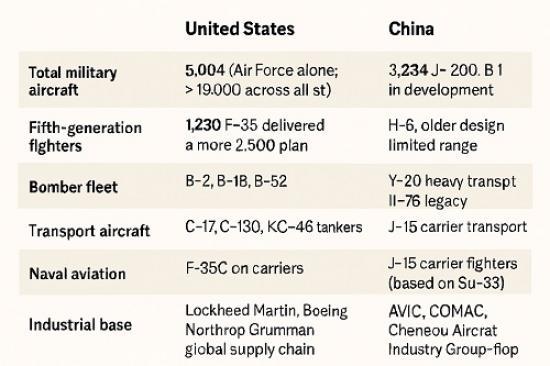
China operates roughly 3,300 military aircraft, compared to America’s 5,000‑plus. The U.S. fleet is not only larger but technologically superior, with more than 1,200 fifth‑generation F‑35s already delivered. China has fielded around 200 J‑20 stealth fighters and is developing the J‑31, but still relies heavily on older designs like the H‑6 bomber and J‑15 carrier fighter. The U.S. can project power globally with B‑2s, B‑52s, and carrier strike groups, while China’s focus remains regional dominance in the Indo‑Pacific.
In short, America’s skies are crowded with stealth jets, while China’s fleet is smaller but modernising fast. The U.S. still dominates in numbers and technology, but Beijing’s rapid build‑up signals a world where air power is no longer unipolar.
Stealth as Industrial Strategy
The F‑35 program is the defining defense project of our time. For the U.S., it is both a military asset and an industrial strategy, securing hundreds of thousands of jobs and binding allies into American supply chains. For Britain, it is a tool of carrier strike and nuclear deterrence, backed by domestic aerospace jobs.
For Canada, it is a saga of dependence and frustration, with Saab’s Gripen offering an alternative vision of industrial sovereignty. For China, it is a race to catch up, modernising rapidly but still trailing America’s scale and reach.
The lesson is clear: fighter jets are not just weapons—they are instruments of economic power. The F‑35 is stealth in the skies, but also stealth in the factories, shaping alliances, jobs, and the balance of power in the 21st century.