Extended Producer Responsibility - The Tax You May Not Have Noticed But Will Push Up Grocery Prices - The Net Zero Grocery Tax
28th December 2025
In recent years, the UK has increasingly sought to integrate environmental policy into everyday economic life.
One prominent development in this area is what the media and critics often call the "Net Zero Grocery Tax". This informal term refers to the UK Government's Extended Producer Responsibility (EPR) scheme for packaging, designed to shift the cost of recycling packaging waste from local authorities to the producers who place packaging on the market.
While intended to incentivise greener packaging and support the UK’s Net Zero commitments, it has attracted public attention and controversy because of its likely impact on grocery bills and household budgets.
Origins and Purpose of the Policy
The concept of the packaging levy arises from two long-standing challenges:
Environmental sustainability - Plastic and other packaging waste contributes significantly to pollution and carbon emissions. Reducing and recycling packaging more effectively is crucial for meeting the UK’s Net Zero targets.
Fair funding – Historically, local councils have borne the cost of collecting, recycling, and disposing of packaging waste, despite manufacturers profiting from sales. Shifting the cost to producers is seen as fairer and more sustainable in the long term.
The UK Government formalised this approach in legislation introduced under the Environment Act framework, creating the Extended Producer Responsibility scheme for packaging. The scheme was quietly developed over several years, gaining traction as part of the UK’s broader Net Zero and circular economy strategies. While media coverage has popularised the term “Net Zero Grocery Tax,” the policy is not a direct tax on food or carbon emissions. Instead, it is a producer-focused levy that businesses are required to pay based on the type and amount of packaging they place on the market.
Mechanics of the EPR Scheme
The EPR framework assigns fees to producers based on the recyclability and volume of packaging:
High-impact packaging – Plastic, composite materials, and hard-to-recycle packaging incur higher fees.
Recyclable packaging – Materials that are easy to recycle are charged at lower rates, creating a financial incentive for more environmentally friendly design.
Reporting obligations – Producers must submit detailed data on packaging placed on the market, enabling the regulator to calculate fees accurately.
While the scheme legally targets producers, the cost is expected to be passed on to consumers through higher product prices, which is why it has come to be perceived as a “grocery tax.”
Timeline of Implementation
The scheme has been gradually phased in:
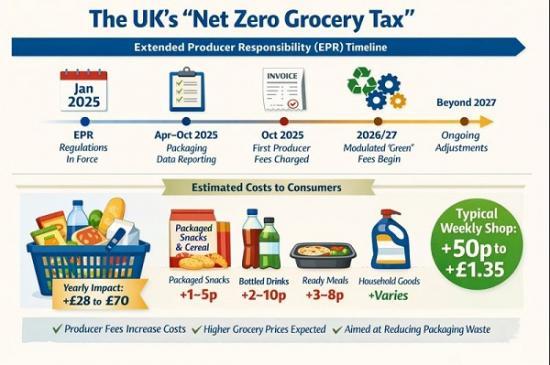
January 2025 – The EPR regulations formally came into effect across the UK, creating the legal framework and compliance requirements.
April–October 2025 – Businesses began reporting packaging data for the first half of the year, enabling accurate calculation of fees.
October 2025 – Producers receive their first invoices under the scheme, marking the first moment when financial liabilities are applied. Retailers are likely to start passing these costs on to consumers soon thereafter.
2026–2027 – The system introduces modulated fees based on recyclability, with higher costs for hard-to-recycle packaging and discounts for more sustainable options.
This staggered implementation means that while businesses have been preparing since early 2025, the actual financial impact on grocery prices will become more noticeable from late 2025 onwards, with further adjustments in 2026/27 as fee modulation begins.
Impact on Consumers
Although consumers are not taxed directly, the pass-through of costs from producers to retailers and then to shoppers is expected to raise household expenses. The government’s impact assessments and independent industry analysis estimate:
Average annual household impact: £28–£56 per year, equivalent to approximately £0.50–£1 per week.
Total grocery sector cost: Around £1.4–£1.7 billion annually, assuming most fees are passed on.
Per-item cost examples:
Packaged snacks or cereals: +1–5 pence
Bottled drinks: +2–10 pence
Ready meals: +3–8 pence
These are approximate estimates, as actual costs will vary depending on packaging type, recyclability, and the degree to which producers and retailers absorb or pass on fees.
Controversies and Criticism
The policy has faced criticism from both consumers and industry groups:
Household cost pressure – Critics argue that this policy disproportionately impacts ordinary shoppers, adding costs to essential goods during a period of general inflation.
Business concerns – Retailers warn that passing on costs could affect profit margins, particularly for small producers, and complicate supply chains.
Political framing – While intended to fund recycling and encourage sustainability, the levy is often described in the media as a “Net Zero grocery tax,” contributing to public misunderstanding.
Local authority concerns – Some councils worry that revenues may not be fully ring‑fenced for recycling services, undermining the policy’s original intent.
Long-term Goals and Benefits
Despite criticism, the EPR scheme is designed to incentivize greener packaging, reduce plastic waste, and help meet Net Zero targets. The modulated fee structure from 2026/27 aims to reward more sustainable packaging designs, potentially reducing costs for producers and consumers over time. In this way, the scheme is not just a fiscal measure but part of a wider strategy for circular economy reform in the UK.
The so-called “Net Zero Grocery Tax” represents a significant shift in environmental policy and consumer economics in the UK. Legally, it is a producer-focused packaging levy under Extended Producer Responsibility, designed to shift recycling costs from local councils to those responsible for placing packaging on the market.
While the policy’s long-term environmental benefits may be substantial, it is likely to increase grocery bills for ordinary households in the short term, with costs emerging clearly from late 2025 and evolving through 2026 as modulated fees take effect. Understanding the true nature of the levy is crucial.
It is not a direct carbon tax on food, but its implementation illustrates the challenges of balancing environmental policy, business costs, and household affordability in the drive towards Net Zero.