Why Drone Wars Will Use Waves, Not Swarms And Why the Battlefield Is Starting to Look a Lot Like a Chessboard
29th December 2025
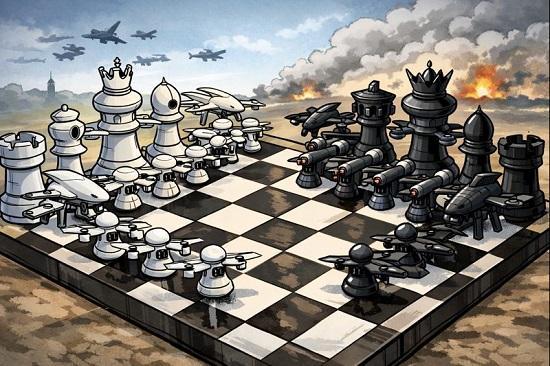
Modern warfare is changing, and the Ukraine-Russia conflict has made one thing clear: drones are no longer specialist tools. They are becoming the everyday units of the battlefield, shaping reconnaissance, logistics, and strike capabilities. But while many people imagine future wars fought with a single, overwhelming cloud of drones — a vast, unstoppable swarm — reality points toward a different pattern.
The future is more likely to be waves of drones, launched in sequenced attacks, each adapting to what the previous wave learned.
These waves behave less like a chaotic swarm of insects and more like carefully staged moves in a chess game. Not a single decisive blow, but a sequence of strategic plays designed to control the field, test defences, and gradually weaken the opponent.
Why Not One Giant Swarm?
At first glance, a massive simultaneous swarm seems like the perfect tactic. In theory, thousands of drones arriving at once could overwhelm air defences through sheer volume. But real conditions impose limits that make this unrealistic:
Communication systems strain when too many units share the network
Electronic warfare can interrupt links and navigation
Airspace gets congested, increasing accidental losses
Targeting becomes harder to coordinate at scale
The cost of losing an entire swarm in one failed strike is enormous
It's the difference between throwing every chess piece forward in one reckless charge and losing control — versus advancing the board with method, pressure, and timing.
Waves: The New Battlefield Rhythm
Wave tactics break the battle into phases. A first wave might probe defences. A second wave might strike identified weaknesses. A third could exploit gaps or deny territory. This isn't just a military tactic — it’s an information tactic, gathering data one step at a time.
In chess terms:
The first wave is like developing the pawns, establishing shape, discovering what the opponent intends, and provoking reactions.
The second wave mirrors the knights and bishops, creating pressure, forcing manoeuvres, and seeking positional advantage.
Later waves resemble the rooks and the queen, using openings that only exist because of earlier moves.
The win rarely comes from a single moment. It comes from the accumulation of pressure.
Adaptation Over Overwhelm
A giant swarm relies on the assumption that the enemy will collapse. Waves assume the enemy will adapt — and aim to stay one step ahead. Each wave can change based on what came before:
Switching approach routes
Adjusting to jamming or radar coverage
Targeting newly exposed infrastructure
Escalating or disengaging as needed
This mirrors high-level chess: when one line closes, you pivot to another. Victory goes not to the side with the most pieces, but to the side that uses them intelligently.
The Future: AI, Autonomy, and the New Strategy Board
As autonomy improves, drones will increasingly act with greater independence — not from full remote control, but on guidance, intent, and pre-planned goals. That creates a future battlefield where:
Human commanders set the strategy,
AI handles the real-time tactics,
And drones execute moves like pieces following the logic of the board.
This does not remove human responsibility, but it changes the pace. Decisions that once took minutes will take seconds. The "board" becomes dynamic: cities, energy networks, and digital infrastructure matter as much as physical terrain.
Chess taught generations that control matters more than aggression, and that the player who sees the next four or five moves wins. Drone warfare may follow the same rule.
Conclusion
Whether in traditional warfare or geopolitical power projection, the age of drones will be defined less by spectacular swarms and more by sequenced, adaptive, wave‑based tactics. It’s not the number of drones that matters most, but how they are used, and in what order. Like a chess master, the future victor isn’t the one with the most pieces — but the one who understands the board.
The battlefield of tomorrow won’t be decided by a single overwhelming move. It will be decided by those who can think several waves ahead.