The Global Language Landscape of AI Interactions
29th December 2025
As artificial intelligence becomes increasingly embedded in daily life, an important question arises: what languages are people using when interacting with AI systems?.
Language use in AI not only reflects global demographics but also shapes how effectively these tools can serve different populations.
Examining the current landscape reveals a clear dominance of English, a significant and growing presence of Chinese, and a diverse array of other languages, each with unique trends and implications.
English: The Dominant Language
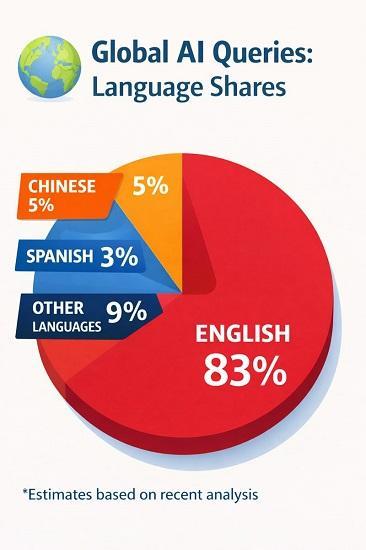
English remains the overwhelmingly dominant language for AI queries worldwide. Estimates suggest that roughly 83 percent of AI interactions occur in English, reflecting both the historical dominance of English-language internet content and the fact that many foundational AI models were trained primarily on English text.
This dominance is reinforced by the global reach of English as a lingua franca, enabling users from non-native English-speaking countries to interact with AI in English when other options are limited.
The predominance of English has clear advantages: AI models trained on English benefit from abundant, high-quality data and broad usage, which allows for nuanced understanding and responsiveness. However, it also creates a gap for users whose primary language is not English, potentially limiting accessibility and reinforcing global linguistic inequities.
Chinese: A Growing Force
Chinese is the second most widely used language in AI interactions, accounting for approximately 5 percent of global queries. This figure reflects both the sheer number of Chinese speakers worldwide and the rapid development of domestic AI platforms, such as DeepSeek, Qwen, Doubao, Yuanbao, and Baidu's Ernie Bot. These platforms serve millions of users daily, both within mainland China and abroad, and are tailored to local linguistic, cultural, and regulatory contexts.
The rise of Chinese-language AI usage demonstrates that non-English languages can achieve significant scale when supported by a robust ecosystem of models and services. Unlike English-language AI, which often serves a global audience, Chinese AI platforms are frequently designed with local regulations and cultural norms in mind, influencing both the content users receive and the types of queries they make.
Other Languages: Diversity and Emerging Use[b]
Beyond English and Chinese, a variety of other languages are increasingly represented in AI interactions. Spanish, Hindi, Arabic, and dozens of other languages collectively account for roughly 12 percent of global queries, reflecting growing adoption of AI tools in regions that have historically been underrepresented in AI datasets.
The expansion of AI into multiple languages presents both opportunities and challenges. On the one hand, broader linguistic support enables more people to access AI’s capabilities, from education to professional assistance to creative endeavours. On the other hand, less training data for many of these languages can result in uneven performance, inaccuracies, or bias, highlighting the importance of multilingual model development and continued investment in underrepresented languages.
[b]Implications for Accessibility and Global Use
The current distribution of AI language usage carries important implications. English dominance ensures high-quality interaction for a large segment of users but can limit inclusivity. Chinese’s rapid growth demonstrates the potential for language-specific ecosystems to thrive, while the diversity of other languages shows that AI can serve a truly global audience if models are developed and trained with sufficient linguistic breadth.
Ultimately, the language landscape of AI is both a reflection of global digital inequality and a roadmap for future development. Expanding AI capabilities across languages will not only increase accessibility but also improve cultural relevance, accuracy, and adoption worldwide. As AI continues to evolve, the interplay between language, data, and user experience will remain central to its success.