UK Defence in 2025 - Spending, Jobs, and Workforce Challenges
1st January 2026
2025 was a pivotal year for UK defence policy, marked by historic spending increases, industrial growth initiatives, and renewed focus on military readiness.
The government set out one of its largest sustained boosts in defence expenditure since the end of the Cold War, aiming to raise defence spending to 2.5% of GDP by 2027, with longer-term ambitions of reaching 3% in the next Parliament.
This financial commitment reflects concerns about rising global threats and the need to modernize capabilities across land, sea, air, and cyber domains. Despite these pledges, experts warn that fulfilling all capability targets may require very large amounts of additional funding over the next two decades.
Defence Industry Growth and Job Creation
In 2025, the UK positioned defence not only as a security imperative but also as a driver of economic growth. Major procurement programs and export deals generated thousands of jobs in manufacturing, engineering, and systems integration, especially outside London and the South East. Efforts to strengthen domestic supply chains, support small and medium-sized enterprises, and foster innovation were central to the government's strategy. If spending continues to rise, the sector could create tens of thousands of new jobs, reinforcing regional economies and building long-term industrial resilience.
Supply Chain and Capability Investments
To enhance operational readiness, the Ministry of Defence focused on building resilient supply chains, increasing domestic munitions production, and co-developing capabilities with allies. Investments aimed to ensure that the UK maintains "always-on" capacity for critical weapons and equipment while reducing reliance on imports. Strategic initiatives included modernizing naval and air assets, enhancing logistics infrastructure, and supporting advanced manufacturing across key regions.
Recruitment and Workforce Challenges
Despite increased spending and industrial expansion, recruitment and retention in the Armed Forces remain significant challenges. Persistent skill gaps and recruitment bottlenecks have affected delivery of modernization projects, particularly in specialized technical roles. The government recognized a "workforce crisis" driven by historic shortfalls, accommodation issues, and morale pressures.
In response, new initiatives were introduced, including a paid "gap year" style programme for under-25s designed to attract young people into the Armed Forces, develop skills, and support longer-term recruitment goals. Early signs indicate modest net growth in personnel for the first time in years, although broader workforce planning emphasizes the need for reserve expansion, retention incentives, and cultural reforms to create a sustainable, skilled force.
Civilian MoD Workforce and Efficiency
Alongside military staffing challenges, the Ministry of Defence pursued civilian workforce restructuring to improve efficiency. Plans included reducing headcount and reallocating resources, alongside automation of administrative functions, to better support frontline capabilities and enable the Armed Forces to focus on operational priorities.
In 2025, the UK defence sector experienced both historic investment and ongoing challenges. Increased spending, export growth, and domestic industrial initiatives are creating significant economic and employment opportunities, while strengthening national and allied security. At the same time, recruitment pressures, skill shortages, and workforce restructuring highlight the importance of comprehensive strategies to sustain military readiness.
The long-term success of the UK's defence ambitions will depend on balancing ambitious capability targets with workforce development, industrial resilience, and effective management of financial and human resources.
Main Issues
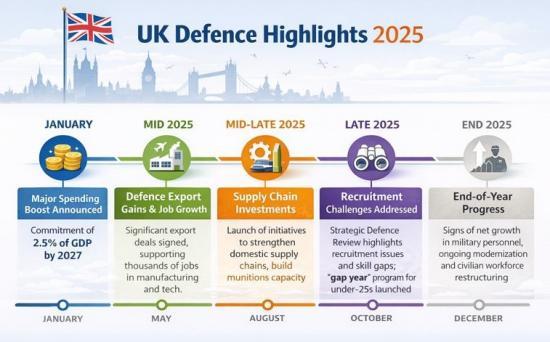
Early 2025: Major defence spending boost announced - aiming for 2.5% of GDP by 2027.
Mid 2025: Significant export deals signed, supporting thousands of jobs in manufacturing and tech.
Mid-Late 2025: Launch of initiatives to strengthen domestic supply chains and build munitions capacity.
Late 2025: Strategic Defence Review highlights recruitment challenges and skill gaps.
Late 2025: Introduction of gap-year style Armed Forces program for under-25s to improve recruitment.
End 2025: Signs of net growth in military personnel and ongoing efforts to modernize and restructure civilian workforce.