UK Nuclear Weapons Spending - Strategy, Investment, and Economic Trends
7th January 2026
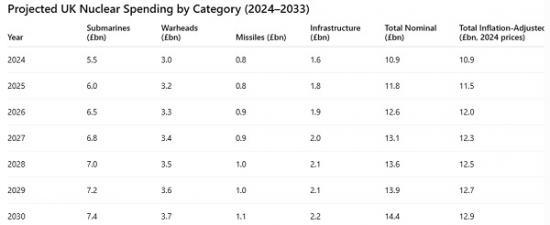
The United Kingdom maintains a strategic nuclear deterrent as a core component of its national defence policy.
In recent years, the government has committed substantial financial resources to sustain and modernise this capability.
Far from being static, UK nuclear spending has been rising significantly, encompassing warhead maintenance, submarine replacement, missile systems, and associated infrastructure. Here we look at the components of UK nuclear spending, its rationale, and trends relative to inflation, while placing the UK's approach in an international context.
Components of UK Nuclear Spending
UK nuclear expenditure can be grouped into four main categories: submarines, warheads, missile systems, and infrastructure.
Submarine Replacement
The largest proportion of nuclear spending is allocated to the replacement of the UK's submarine-based deterrent. The current Vanguard-class submarines are approaching the end of their operational life, and the government is building the Dreadnought-class to maintain continuous at-sea deterrence.
This programme covers the design and construction of four new submarines, nuclear propulsion systems, and associated shipyard infrastructure, as well as long-term operational support. Importantly, these replacements maintain the existing capability rather than expanding the number of submarines or the overall size of the nuclear force.
Warhead Modernisation
The UK is also investing heavily in the modernisation and sustainment of its nuclear warhead stockpile. This includes replacement of ageing warheads, safety and reliability upgrades, laboratory and manufacturing facilities, and maintenance of a highly specialised workforce of scientists and engineers.
The focus is on preserving credible deterrence and operational safety, not increasing explosive yield or creating new categories of weapons.
Missile Systems
The United Kingdom does not manufacture its own ballistic missiles; instead, it leases Trident II D5 missiles from the United States. Spending in this area covers missile maintenance, life-extension, and integration with UK submarines. Compared to submarines and warheads, missile-related costs are relatively modest.
Infrastructure and Support
A significant portion of spending supports infrastructure, regulatory compliance, security, command and control, and nuclear-qualified personnel. These costs are essential to maintain a safe and operational deterrent.
Nuclear Spending in Context
The UK's nuclear deterrent is deliberately small and focused, reflecting a policy of minimum credible deterrence. The country maintains a single delivery system (submarines), does not deploy land-based or air-launched nuclear weapons, and has kept overall warhead numbers relatively low. Spending increases are therefore aimed at sustainment and replacement rather than expansion.
Internationally, the UK’s nuclear force is much smaller than that of the United States, which maintains a triad of delivery systems and thousands of warheads.
France has a larger and more diverse force than the UK in terms of delivery systems but invests less overall. The UK’s strategy is designed to ensure strategic credibility within NATO without replicating the scale of its allies’ arsenals.
Spending Trends and Projections
Official government budgets indicate that UK nuclear spending is rising significantly in cash terms. The Defence Nuclear Enterprise (DNE), which consolidates funding for submarines, warheads, and related infrastructure, was £10.9 billion in 2024/25 and is projected to rise to approximately £11.8 billion in 2025/26.
Long-term projections indicate continued growth, with total programme costs for nuclear deterrence over the next decade expected to exceed £120 billion. This includes construction of the Dreadnought-class submarines, ongoing warhead maintenance, missile integration, and supporting infrastructure.
Nuclear Spending Relative to Inflation
Analysis of spending trends shows that UK nuclear expenditure has been rising faster than general price inflation.
While consumer price inflation in the UK is currently around 3 per cent per year, nuclear and defence spending has grown more rapidly, both in nominal terms and in real terms after adjusting for inflation. Capital spending, which includes major projects like submarine construction, has outpaced inflation over the past decade.
Forecasted increases in nuclear spending suggest this trend will continue, reflecting deliberate policy decisions to expand and sustain capability rather than simply maintain it at previous real-term levels.
Strategic Rationale
The UK government justifies these investments on several grounds. Nuclear deterrence is considered essential for national security and NATO commitments. Submarine construction requires decades-long lead times, making early investment critical. Maintaining a credible deterrent preserves political leverage, assures allies, and deters potential adversaries. At the same time, the relatively small and focused nature of the UK nuclear programme ensures that expenditure is concentrated on capability sustainment and safety rather than quantitative expansion.
Conclusion
In summary, the United Kingdom is investing heavily in its nuclear deterrent. Spending encompasses submarine replacement, warhead modernisation, missile maintenance, and supporting infrastructure. The focus is on sustainment and strategic credibility rather than expansion of the arsenal. Projections show continued increases in spending over the next decade, with growth outpacing inflation and reflecting long-term policy priorities. In international terms, the UK remains a small nuclear power, maintaining a focused deterrent that is technologically sophisticated and strategically credible. Rising investment in this area reflects the long lead times and high costs associated with modern nuclear capability, underscoring its central role in the UK’s defence posture.