Business Rates in Scotland and England Are In Trouble With U-turn in England while Scotland Awaits Budget Decision
9th January 2026
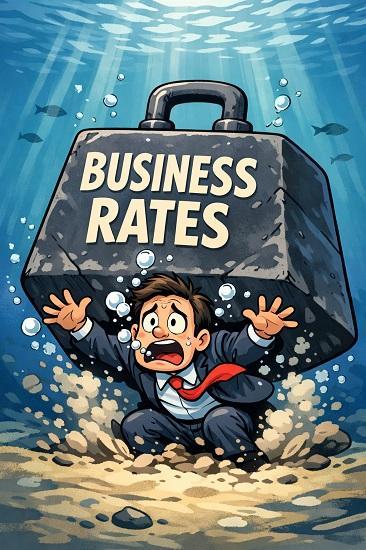
In recent months there has been growing debate over business rates in the UK, particularly following indications that the UK government is reversing part of its planned approach in England.
This has led to questions about whether a full policy U-turn is taking place and how developments in England might affect Scotland, where business rates are devolved.
In England, the UK government has effectively carried out a partial U-turn on business rates, although this change is limited in scope rather than a wholesale reversal.
The focus of the change is on pubs, which were facing sharp increases in business rates following the removal of pandemic-era relief and the effects of a new property revaluation. Strong opposition from the hospitality sector and concerns among MPs that many pubs could become financially unviable prompted the government to reconsider.
As a result, it is now expected that additional relief will be introduced to reduce the impact of higher bills on pubs, potentially through enhanced discounts or transitional protections.
This adjustment does not amount to a complete abandonment of business rates reform in England. The government still intends to modernise the system and has committed to introducing permanently lower multipliers for retail, hospitality and leisure properties from 2026.
However, the decision to soften the immediate impact on pubs represents a political retreat from earlier plans and has been widely described as a U-turn. There is also continuing pressure from business groups to extend similar relief to other parts of the hospitality sector, such as restaurants, hotels and live music venues, many of which face similar cost pressures.
The situation in Scotland is different because business rates are a devolved matter and are set by the Scottish Government. Scotland has not announced a comparable U-turn.
Instead, it has pursued its own approach, which includes freezing the basic rate for smaller properties while allowing higher rates for medium and large properties to rise. As a result, many Scottish businesses, particularly those above the small business threshold, face higher relative costs than their counterparts in England.
Relief for hospitality businesses in Scotland remains more limited than in England, with discounts applying only up to lower property value thresholds.
This has led to criticism from business organisations, which argue that Scottish firms are at a competitive disadvantage and that the current system risks discouraging investment, especially in town centres and tourist-dependent areas. There is also ongoing concern about the additional property surcharge applied in Scotland, which increases bills for larger premises.
Looking ahead, any change in Scotland will depend on decisions taken in the Scottish Budget and on political pressure within Holyrood. While there is growing demand for relief measures that match or at least move closer to those in England, there is no guarantee that Scotland will follow the same path.
The Scottish Government has emphasised fiscal constraints and the need to balance support for businesses with funding for public services.
In summary, the UK government has made a targeted U-turn on business rates in England, largely to protect pubs from sharp increases, while continuing with longer-term reform plans.
Scotland has not mirrored this shift and continues to apply its own business rates framework, which currently places higher costs on many businesses. Whether Scotland will adjust its position remains uncertain and will depend on future budget decisions and political priorities.
The Scottish Budget for the 2026-27 financial year will be announced by Finance Secretary Shona Robison on Tuesday, January 13, 2026, a slightly earlier date than initially suggested, to allow for better scrutiny by the Scottish Parliament. This announcement, detailing income tax, welfare, and spending plans, follows the UK Budget and is later than the typical December schedule due to the UK government's Autumn Statement.